
Bernie Marcus's $2 Billion Bet: What Happens to the Marcus Foundation Now
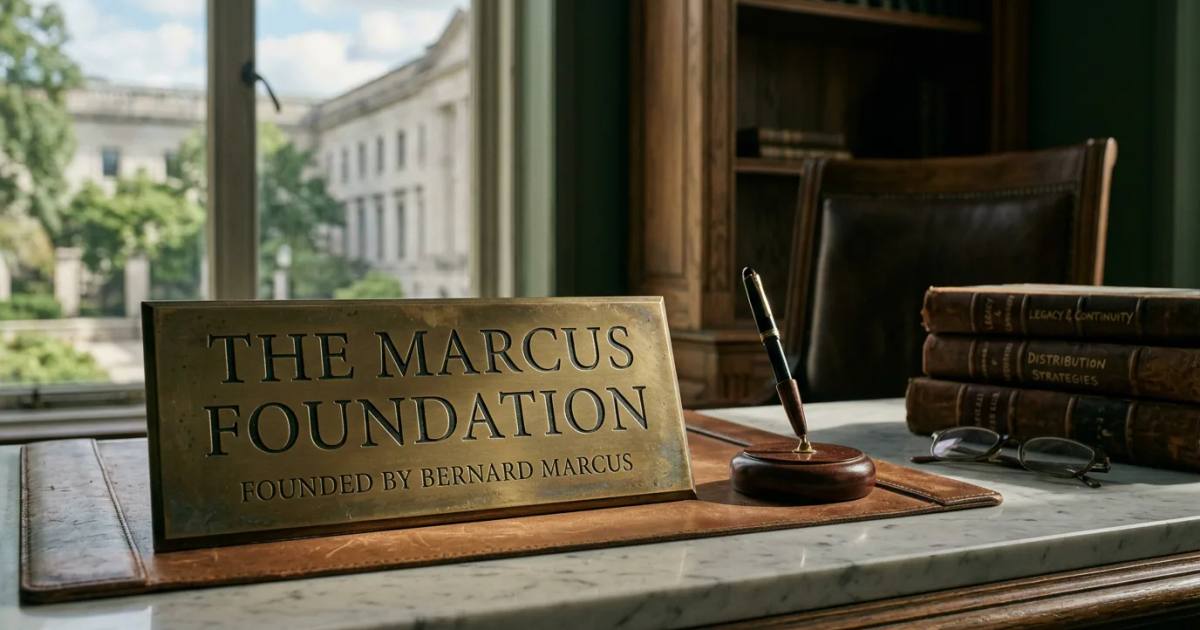
Bernie Marcus died in November 2024 with $11B and a giving footprint that shaped Israel, campus Jewish life, and American conservatism. The Marcus Foundation succession is the biggest open question in Jewish philanthropy.
The Home Depot co-founder died in November 2024 with an $11 billion fortune and a philanthropic footprint that shaped Israel, campus Jewish life, and American conservatism. His succession may be the single largest open question in Jewish philanthropy today.
Bernard "Bernie" Marcus — co-founder of The Home Depot, one of the most consequential conservative Jewish megadonors of the last three decades — died on November 4, 2024, at his home in Boca Raton, Florida. He was 95.
He left behind an estimated net worth of $11 billion, roughly $2 billion in lifetime charitable giving already deployed to more than 400 nonprofits, and a signed Giving Pledge committing the vast majority of his remaining fortune to philanthropy. Most of it will flow through the Marcus Foundation, the vehicle he and his wife Billi established in 1989.
In one of his final interviews, Marcus told Inside Philanthropy that the Marcus Foundation would spend itself down within twenty years of his death — a time-limited vehicle by design.
That makes the Marcus Foundation, for the next two decades, one of the largest active philanthropic instruments in Jewish and pro-Israel giving anywhere in the world. And the question of where that money goes is one of the least examined stories in the field.
The Man
Marcus was born in Newark, New Jersey, on May 12, 1929, the youngest of four children of Russian-Jewish immigrant parents Joe and Sara Marcus. His father was a cabinet maker. The family lived in a tenement. Marcus was accepted to Harvard Medical School but could not afford the tuition; he pivoted to Rutgers and earned a pharmacy degree.
He carried the immigrant Jewish formation for the rest of his life. He often told the story of his mother denying him a nickel for ice cream because the coin was going to plant trees in Israel. He once boasted, only half-joking, that he had turned every Home Depot employee into a Jew by ingraining tzedakah into the corporate culture.
The Holocaust framed his giving explicitly. He told Philanthropy magazine in 2012: he was proud of being Jewish, and what happened during the Holocaust was not going to happen again if he could do anything about it. That was the animating premise behind three decades of Israel giving.
The Legacy Portfolio
Marcus's philanthropic footprint is extensive, concentrated, and directional. Five pillars define it.
Israel Democracy Institute. Marcus co-founded the Jerusalem-based think tank in the early 1990s and gave tens of millions over three decades. IDI president Yohanan Plesner called him "one of Israel's greatest friends" after his death. The Institute focuses on Israeli governance, constitutional design, and democratic reform — non-partisan by charter, though Marcus's pro-Israel commitments were unmistakable. IDI has become one of the most cited policy voices in Israeli constitutional debate.
Marcus National Blood Services Center. Marcus committed $25 million to fund the underground, missile-hardened blood services facility for Magen David Adom in Ramla — a 48,000 square meter, six-story complex, three floors underground, built to withstand earthquakes and missile strikes. Named for him and Billi. Operationally critical during the post–October 7 wars.
RootOne. The Israel travel program at the Jewish Education Project that subsidizes trips to Israel for Jewish teens. Marcus seeded RootOne in 2020 with a $20 million launch grant. His final major gift — announced in late September 2024, weeks before his death — was a $60 million commitment bringing his total support past $140 million. Target scale: 15,000 teens per summer within five years.
Marcus Autism Center + Marcus Stroke and Neuroscience Center. Both Atlanta-based. In October 2024, weeks before he died, the Marcus Foundation committed $25.9 million to fund a new surgical stroke technique. The Marcus Autism Center is one of the largest single autism-focused clinical facilities in the country.
Job Creators Network + AIPAC-affiliated giving. Marcus founded Job Creators Network to defend the free enterprise system; the organization backed the lawsuit that became Biden v. Nebraska, the successful Supreme Court challenge to federal student loan forgiveness. Marcus also gave $2 million to AIPAC in 2023 and $1 million to the AIPAC-affiliated United Democracy Project in July 2024 — his final publicly recorded political donation.
The Political Footprint
Marcus was second only to Sheldon Adelson among conservative Jewish megadonors. He gave $7 million to elect Donald Trump in 2016. In 2020 he gave more. In 2024, according to OpenSecrets and Forbes, Marcus and Billi contributed $2.7 million to Trump's third campaign — plus another $1 million in September, weeks before his death.
Notably, and unlike Adelson, Marcus made a conscious choice to avoid picking sides in Israel's own domestic political fights. IDI remained non-partisan. Magen David Adom is national. RootOne is educational. He kept his Israel dollars clean of Israeli party politics — a choice with lasting implications for how the Marcus Foundation continues to operate.
That distinction — American political donor at maximum aggression, Israeli political donor at deliberate restraint — is one of the defining features of the Marcus philanthropic identity, and one that separates the Marcus Foundation from a number of other diaspora-capital vehicles operating in Israel today.
Comparison Points
Marcus's model is one of three distinct approaches to large-scale diaspora Jewish philanthropy currently visible in the field.
The Marcus model is direct-issue, high-aggression, personally directed. Marcus funded the causes he cared about — Israel security, campus Jewish life, autism research, veterans, free enterprise — with concentrated grants, often at eight or nine figures. He personally called shots. The foundation is time-limited by design.
The Tikvah model — profiled in Inside Tikvah: The Jewish Leadership Pipeline — is pipeline-building. Millstone Scholars for middle schoolers. Begin Scholars for high schoolers. Tikvah Scholars summer institute. Emet Classical Academy. Multi-generational, patient, ideologically coherent. Bernstein estate seed capital, spending forward.
The Herzl Institute model — profiled in Inside the Herzl Institute — is ideas-first. Small institution, oversized influence. Yoram Hazony's Jerusalem-based intellectual shop that has moved the frame of American conservative politics through NatCon and the Edmund Burke Foundation.
Together, Marcus, Tikvah, and Herzl represent three complementary theories of how diaspora capital should be deployed in the post–October-7 era. The Wilf Family Foundations, profiled in The Wilf Family, represent a fourth: multi-generational family-vehicle continuity.
The Succession Question
Marcus is survived by his wife Billi; his son Fred Marcus, a professor at Emory University; and his stepson Michael A. Morris, owner and publisher of the Atlanta Jewish Times. He had seven grandchildren.
Jay Kaiman is president of the Marcus Foundation. Kaiman has been the operational lead on the foundation's Jewish giving for years and was the point person on the final RootOne commitment. In public remarks after Marcus's death, Kaiman signaled continuity: RootOne would keep scaling, Israel giving would continue, campus antisemitism would remain a top priority.
But the deeper question is one of composition. When the founder principal directs a $2 billion deployed and $8+ billion pending giving vehicle personally — as Marcus did — the transition to a professional foundation, or to a family principal-led model, is not automatic. Every next-generation family member, every Kaiman-tier executive, every Billi Marcus preference now shapes tens of millions of annual grantmaking.
The next twenty years of Marcus Foundation grantmaking will do more to shape post-October-7 Jewish institutional life in America and Israel than almost any other single actor. And no one is writing the roadmap of that transition.
What Diaspora Capital Should Watch
Three signals worth naming.
One: RootOne is the tell. The final $60 million into RootOne — while overall Israel travel had dropped 90 percent from wartime cancellations — was a doubling-down move. Marcus was betting that Israel exposure for Jewish teenagers, delivered before college, is the single highest-leverage intervention against post-October-7 campus antisemitism. Watch whether the Marcus Foundation continues that concentration or diversifies.
Two: IDI is a strategic asset in Israeli politics. With Israel entering its next constitutional and governance cycle, IDI's role as a non-partisan reform vehicle is more contested than ever. Marcus's death removes one of the institute's founding patrons. The question of whether the Marcus Foundation continues to underwrite IDI at scale is a live issue in Jerusalem policy circles.
Three: The 20-year spend-down is an opportunity. Time-limited foundations concentrate capital. If the Marcus Foundation deploys $6–8 billion over twenty years, it will average $300–400 million annually — placing it in the top tier of Jewish philanthropic vehicles globally, alongside the Adelson Family Foundation, the Bronfman family entities, and the Schusterman Family Philanthropies.
For Israeli-connected donors and institutional builders, the succession of the Marcus Foundation is not a family matter. It is a category-defining structural question in Jewish philanthropy — one that will reshape the funding maps of Jewish education, Israel advocacy, campus fights, medical research, and Israeli democracy work for a generation.
FAQ
Who was Bernie Marcus? Co-founder and first CEO of The Home Depot. Born in Newark, New Jersey, in 1929 to Russian-Jewish immigrant parents. Died November 4, 2024 in Boca Raton, Florida, at age 95. Net worth at death: approximately $11 billion.
What is the Marcus Foundation? The private family foundation Bernie and Billi Marcus established in 1989. Primary vehicle for their philanthropy. President: Jay Kaiman. Structured to spend down within roughly twenty years of Marcus's death.
How much did Marcus give during his lifetime? More than $2 billion to over 400 nonprofits over three decades, according to reporting by Forbes and the Atlanta Jewish Times.
What are the Marcus Foundation's Israel priorities? Israel Democracy Institute (co-founded by Marcus), Magen David Adom (via the Marcus National Blood Services Center), RootOne (Israel travel for Jewish teens), Friends of the IDF, and the American Israel Education Foundation.
What is RootOne? A program at the Jewish Education Project that subsidizes immersive summer trips to Israel for North American Jewish teenagers. Launched in 2020 with a $20 million Marcus Foundation grant. Total Marcus commitment now exceeds $140 million.
Who runs the Marcus Foundation now? Billi Marcus remains active. Jay Kaiman is president. Next-generation family members — including son Fred Marcus and stepson Michael A. Morris — carry the family principal's role.
How does the Marcus Foundation compare to other Jewish megadonor vehicles? See Inside Tikvah: The Jewish Leadership Pipeline, Inside the Herzl Institute, and The Wilf Family for parallel models of diaspora capital deployment.