
Boy George Releases "We Will Dance Again" — a Pro-Israel Song That Ends in Hebrew
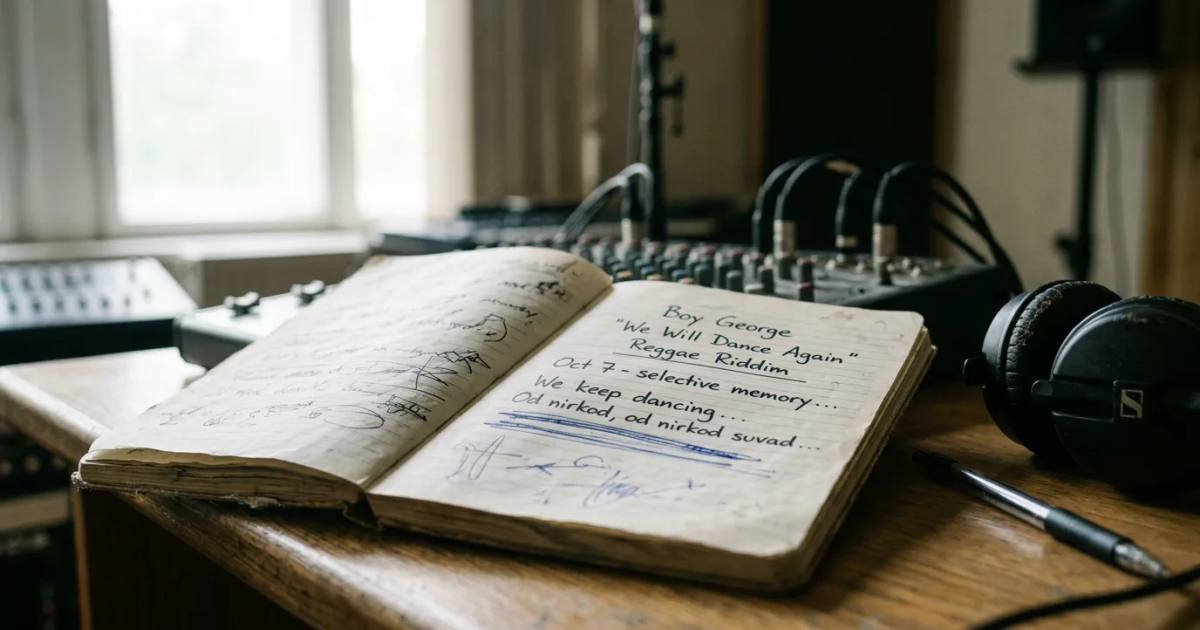
Boy George released "Od Nirkod — We Will Dance Again," a reggae track naming October 7, attacking selective memory, and closing in Hebrew.
Boy George released a new song overnight called "Od Nirkod — We Will Dance Again," a reggae track that names October 7 directly, attacks what he calls the world's "selective memory" about the Nova massacre, and closes with a line sung in Hebrew. He posted it to X with the hashtag #Shalom. The track is not on Spotify or any streaming platform. Within hours it had passed 130,000 views.
What Is "We Will Dance Again" by Boy George?
"Od Nirkod — We Will Dance Again" is a solo track released by Boy George on July 27, 2026 via his social media accounts. The song is a reggae-style production — slow, stripped back, built around his vocal. Israeli media outlet N12/Mako reported the track appears to have been produced with AI assistance, though Boy George has not confirmed the production method publicly.
The song is not available on Spotify, Apple Music, or any major streaming platform. Boy George uploaded it directly to X (formerly Twitter) with the caption #Shalom and an accompanying video featuring the Hebrew text עוד נרקוד ("Od Nirkod") and the English subtitle "We Will Dance Again."
What Does Boy George Say in the Song?
The content is direct and specific. Boy George references October 7 by name. He describes young women attacked at a music festival — a clear reference to the Nova music festival massacre in southern Israel. He accuses the broader music industry of cowardice, describing musicians who "wave flags and mumble like a flock of sheep," driven by what he calls internet-fed propaganda.
He says the world condemns Jews through selective memory — refusing to acknowledge the massacre that triggered the war while using the word "genocide" to describe Israel's military response.
The chorus takes its name from the rallying cry that emerged from the Nova festival survivor community after October 7, 2023. He repeats "We will dance again" three times, then adds: "and there will be no more war." The phrase "Od Nirkod" — עוד נרקוד — became a symbol of resilience in Israel after the massacre at the Tribe of Nova music festival, where over 360 people were killed.
Mid-song, he states plainly: "I stand with the Jews. I don't feel brave — I just need to act like a human being."
The final line switches to Hebrew. It translates roughly to: "You say genocide, I say war — when you come to kill us all." N12 noted the Hebrew closing as a deliberate artistic choice — a British pop icon choosing to end a song in the language of the country he is defending.
Why Did Boy George Release the Song Outside Streaming Platforms?
Boy George bypassed Spotify, Apple Music, and all major streaming services, posting the track directly to social media. The distribution choice is itself a statement. This is not a commercial release designed for charts or playlist placement. It is a declaration — posted for maximum visibility and shareability, outside the gatekeeping structures of the music industry that Boy George is explicitly criticizing in the track itself.
The decision mirrors a broader pattern among artists who want to make political or cultural statements without the approval layers (and potential suppression) of label and platform infrastructure. By posting directly to X, Boy George retained complete control of the release, the framing, and the timing.
Boy George's Record of Supporting Israel
This is not an impulse post. Boy George has a track record on Israel that stretches back years — long before October 7 made the subject radioactive in entertainment circles.
He performed with Culture Club in Tel Aviv in 2017 despite sustained BDS pressure. At the time, he told Israeli Channel 2: "Sometimes being true to who you are is the most political thing you can ever do." In 2020, he released "Rainbow in the Dark" with Israeli singer Asaf Goren — a bilingual English-Hebrew single created specifically as a response to boycott activists. He told Ynet he looked forward to returning to Israel, signing off with "Shalom, peace and love."
In 2024, he was among more than 400 entertainment figures who signed a public letter supporting Israel's continued participation in Eurovision. In May 2026, he represented San Marino at Eurovision in Vienna alongside Senhit, performing "Superstar." During Eurovision week, he told interviewers he would vote for Israel's entry if the rules allowed, and closed an interview with Israeli Channel 12 by saying "Shalom Aleichem."
Weeks before the contest, he was near the scene of the Golders Green stabbing attack in north London, in which two Jewish men were seriously wounded. He posted video from the scene and wrote: "We need to make our Jewish community know that we support them. Even before I knew what happened, I cried, because you could feel the panic in the air. These are regular people just going about their lives."
What Is the "We Will Dance Again" Movement?
"We Will Dance Again" — in Hebrew, עוד נרקוד (Od Nirkod) — became a symbol of resilience and defiance after the October 7, 2023 Hamas attack on the Tribe of Nova music festival near Kibbutz Re'im in southern Israel. Over 360 people were killed at the festival and surrounding area. The phrase was adopted by survivors, families, and the broader Israeli public as a commitment to return to life, music, and gathering.
The slogan also became the title of a 2024 Paramount+ documentary directed by Yariv Mozer, which won the News and Documentary Emmy Award for Outstanding Current Affairs Documentary in 2025. By naming his song "Od Nirkod — We Will Dance Again," Boy George is explicitly invoking this cultural reference — linking his track to the Nova survivor community and the broader Israeli resilience narrative.
The Gwyneth Paltrow Parallel: A-List Celebrities Refusing to Fold
Boy George is not the only A-list figure drawing attention for public engagement with Israel this summer. In June 2026, Gwyneth Paltrow appeared in a commercial for 51 Park, a luxury residential development in Herzliya, Israel. The backlash was immediate. Social media users dubbed her "Gwynocide." France 24's coverage called her "nasty or simply stupid." Paltrow — whose late father was Jewish and whose brother directed a Hebrew-language film about the Eichmann trial — did not pull the ad. A senior Los Angeles publicist told the Jewish Telegraphic Agency: "Gwyneth is one of the few A-list celebrities who has been outspoken about her support for Israel since October 7 and has embraced her Jewish roots publicly."
The shape of both stories is the same. A globally recognized figure makes a public, creative, commercial choice that engages with Israel. The backlash machine activates. The figure does not retreat. Paltrow's medium was advertising. Boy George's is music. The message — that engaging with Israel is a normal act, not a political crime — is identical.
What This Signals About Celebrity and the Cultural Boycott
The cultural boycott of Israel has been the dominant posture in Western entertainment since October 2023. Artists who perform in Tel Aviv face organized harassment campaigns. Brands that engage with Israeli companies are targeted online. The pressure is real, sustained, and effective — most major Western artists have stayed silent or stayed away.
But the counter-moves are getting louder. Boy George did not whisper his support. He wrote a song, recorded it, posted it with a Hebrew title, and tagged it #Shalom. Paltrow did not donate quietly. She starred in a television commercial for Israeli real estate. These are not private sympathies. They are public acts of cultural engagement — and they carry real professional risk in the current environment.
Whether they represent isolated acts of individual conviction or early signals of a broader shift is the open question. Boy George, characteristically, would frame it more simply. As he told Israel's Channel 12 during Eurovision week: "What people expect me to do, as a man with principles, is turn my back on my Jewish friends? That's not going to happen and it will never happen."
Related Coverage
- Boy George Bypassed Spotify to Release a Pro-Israel Song. The Distribution Choice Is the Story. — Everything-PR communications analysis
- AI Can Industrialize Antisemitism Faster Than Europe Can Regulate It — Olam op-ed on the EU AI Act and multilingual antisemitism
- Florida Is Israel's New American Address — the $7.3B corridor
Frequently Asked Questions
What is the Boy George Israel song called?
The song is called "Od Nirkod — We Will Dance Again." It was released on July 27, 2026 via Boy George's social media accounts with the hashtag #Shalom. It is a reggae-style track that references October 7, the Nova festival massacre, and closes with a line sung in Hebrew.
Is "We Will Dance Again" by Boy George on Spotify?
No. As of its release, the song is not available on Spotify, Apple Music, or any major streaming platform. Boy George posted it directly to X (formerly Twitter). The decision to bypass streaming platforms appears to be a deliberate choice to release the track as a personal and political statement rather than a commercial product.
What does Boy George say in the Hebrew line at the end of the song?
The final line of the song is sung in Hebrew and translates roughly to: "You say genocide, I say war — when you come to kill us all." Israeli media outlet N12 highlighted the Hebrew closing as a deliberate artistic choice by the British pop icon.
Has Boy George supported Israel before?
Yes. Boy George has a track record stretching back to at least 2017, when he performed with Culture Club in Tel Aviv despite BDS pressure. In 2020, he released a bilingual English-Hebrew single called "Rainbow in the Dark" with Israeli artist Asaf Goren. He signed a 2024 letter supporting Israel at Eurovision. In 2026, he represented San Marino at Eurovision and publicly voiced support for Israel's entry.
What does "Od Nirkod" mean?
"Od Nirkod" (עוד נרקוד) means "We will dance again" in Hebrew. The phrase became a symbol of resilience after the October 7, 2023 Hamas attack on the Tribe of Nova music festival in southern Israel, where over 360 people were killed. It was also the title of a 2024 Emmy-winning Paramount+ documentary about the massacre.
Why is Boy George's song being compared to Gwyneth Paltrow's Israel ad?
Both represent high-profile Western celebrities making public, creative choices that engage with Israel — and both facing significant backlash. In June 2026, Paltrow appeared in a commercial for a luxury development in Herzliya and was dubbed "Gwynocide" on social media. Boy George released a pro-Israel song with Hebrew lyrics. Both refused to retreat.