Buenos Aires: Latin America's Jewish Capital
The largest Jewish community in Latin America. 170,000 in Greater Buenos Aires. The Werthein, Sigman, Mirelman, Madanes Quintanilla families. The AMIA legacy. Sustained aliyah through the Argentine economic crisis cycles.
The 170,000-strong Jewish community of Argentina's capital — its history, its institutions, its sustained migration, and the AMIA legacy that defines its public memory.
Haolam Atlas — Global Diaspora · The Olam Editorial Team
Buenos Aires is the largest Jewish community in Latin America — and the most consequential Spanish-speaking Jewish community in the world.
A community of approximately 170,000 in Greater Buenos Aires, the seventh-largest national Jewish community in the world. Built across more than a century of immigration from Russia, the Ottoman Empire, Central Europe, and the Maghreb, the Buenos Aires community has produced one of the most institutionally dense and culturally distinctive Jewish societies anywhere in the diaspora.
By the Numbers
Buenos Aires Jewish population: approximately 165,000-180,000. Argentina's national Jewish population: approximately 175,000-200,000. Primary demographic: dominantly Ashkenazi Conservative-equivalent and traditional, with substantial Modern Orthodox, Reform, and growing Charedi minorities; meaningful Sephardic North African layer. Religious composition: unusual depth of Conservative Movement institutional presence relative to other diaspora communities. Economic identity: family-controlled holding groups concentrated in telecommunications, banking, agriculture, real estate, retail, pharmaceuticals. Housing profile: Belgrano, Palermo Chico, Recoleta, Barrio Norte, Villa Crespo. Why it matters: the most institutionally complete Spanish-speaking Jewish community in the world and the case study in Jewish institutional continuity through the AMIA decade and the subsequent Argentine economic crises.
The geography
Buenos Aires Jewish neighborhoods cluster in specific areas of the capital. Once — the historic Jewish neighborhood, originally the immigrant arrival zone in the late 19th and early 20th centuries, now mostly transitioned but with retained institutional anchors. Villa Crespo and the surrounding inner-ring neighborhoods — the second-generation neighborhoods, still substantial Jewish residential presence and dense kosher commerce.
Belgrano — the principal contemporary Jewish neighborhood, with strong institutional presence (multiple synagogues, schools, community organizations). Palermo Chico and the wealthier sections of Palermo — the wealthier secular and Conservative concentration. Recoleta and the broader Barrio Norte — the establishment neighborhoods with substantial older Jewish families.
The Jewish day school network operates across these neighborhoods, with the major schools (ORT, Tarbut, Wolfsohn, Bialik, the Religious-Zionist schools) drawing students from across the metropolitan area.
The institutions
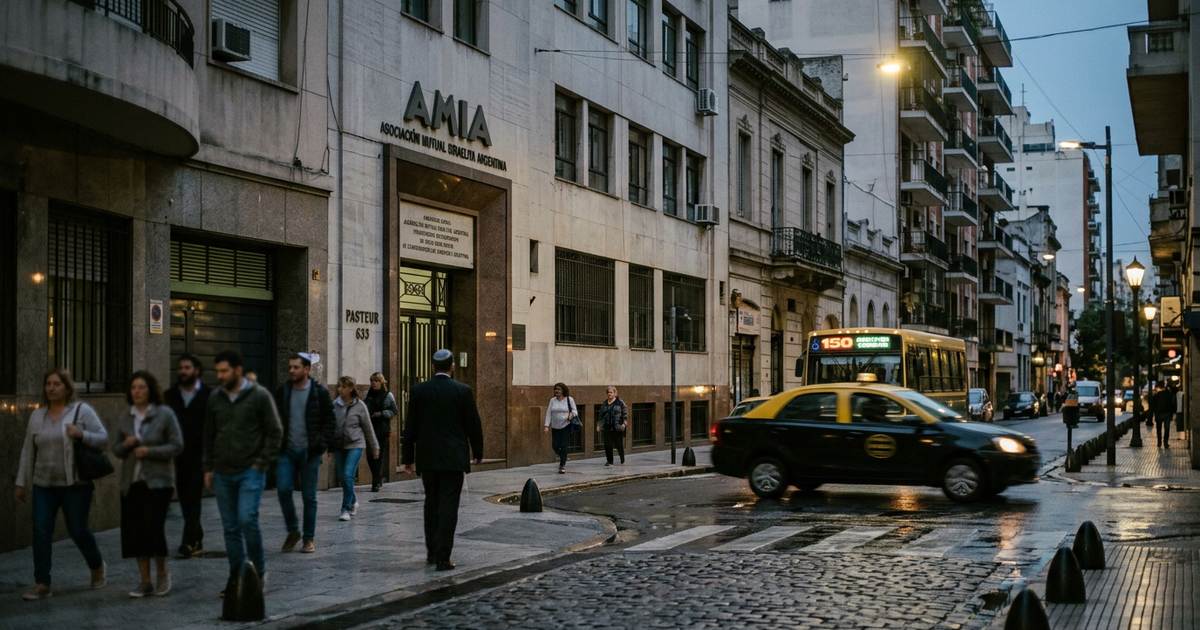
DAIA (the Delegación de Asociaciones Israelitas Argentinas) — the principal political representative body of Argentine Jewry. AMIA (the Asociación Mutual Israelita Argentina) — the principal welfare, cultural, and burial-society institution, with a history that defines the community's public memory.
The 1994 AMIA bombing, in which 85 people were killed and hundreds injured at the AMIA headquarters in central Buenos Aires, remains one of the largest antisemitic terror attacks in the Western Hemisphere. The investigation has been one of the most politically contentious in modern Argentine history. The community's public memory and political identity have been shaped continuously by the AMIA legacy across three decades.
Beyond DAIA and AMIA: the Comunidad Bet El (the principal Conservative synagogue, with one of the strongest Conservative congregations in the world), Lamroth Hakol, the Sociedad Hebraica Argentina (the principal social-cultural-athletic institutional center), the Hebraica club network, multiple Modern Orthodox congregations (the NCI-Emanuel network, the Or Torah religious-Zionist community), the broader synagogue network running into dozens of congregations.
The business community
Argentine Jewish business is concentrated in real estate, banking and finance, agriculture and food, retail, media, and increasingly technology. The Werthein family represents the highest-profile contemporary platform (Telecom Argentina, W de Argentina, Banco Hipotecario, historic positions across multiple sectors). The Mirelman family, the Madanes Quintanilla family, the Sigman family (Bagó pharmaceutical and broader Insud Group), the Kosacoff industrial holdings, the Levcovich family.
Real estate: Jewish Argentine investment in Buenos Aires real estate has been a structural feature for a century. The community's property exposure across the central and northern neighborhoods of Buenos Aires has been substantial.
Agriculture and food: the early 20th-century JCA agricultural colonies in Entre Ríos, Santa Fe, and La Pampa — the largest planned Jewish agricultural settlement project anywhere outside Israel — produced a generation of Jewish-owned farms and food businesses whose institutional legacy continues, though the agricultural Jewish presence in Argentina has largely diminished.
The aliyah pattern
Argentine aliyah has been one of the most sustained and consequential Latin American Jewish migrations to Israel across the past four decades. The 2001 economic collapse triggered the largest single wave, with approximately 6,000 Argentine olim arriving in 2002 alone. Subsequent waves have followed each Argentine economic crisis — the 2014-2015 currency controls, the 2018-2019 IMF program, the 2022-2024 inflation crisis.
Buenos Aires olim have concentrated in specific Israeli destinations. Tel Aviv (the secular and professional cohort), Jerusalem (the religious and academic cohort), the Spanish-speaking communities of Modi'in and the southern coastal cities, and a meaningful Buenos Aires presence in Bat Yam and Ashdod (the Spanish-speaking absorption corridors). The Hispanic-Latino institutional infrastructure inside Israel is one of the most developed of any non-English-speaking source community.
The pressure now
Argentina's persistent macroeconomic instability — inflation exceeding 100% annually, currency controls, peso devaluations, capital-flight restrictions — has been the principal driver of continued Jewish emigration. The community has shrunk by an estimated 25,000-35,000 across the past two decades. Whether the Milei-era economic reforms stabilize the country and slow the emigration — or whether the current pattern of slow attrition continues — is the central open question.
The community institutions remain functional. DAIA, AMIA, the Hebraica network, the school system, the major synagogues — all continue to operate. The Religious-Zionist and Modern Orthodox communities have grown as a share of the total community even as the absolute population has declined.
The strategic implication
Buenos Aires is the largest Jewish community in Latin America and the most institutionally complete Spanish-speaking Jewish community in the world. Its continued sustained emigration to Israel, the United States, Spain, and increasingly Brazil has redistributed Argentine Jewish capital and people across multiple host countries while retaining the institutional core in Buenos Aires itself.
It is also a community living with the AMIA legacy as part of its institutional identity. The unresolved investigation of the 1994 attack, the political contentions around it, and the community's sustained advocacy for accountability remain structural features of Argentine Jewish public life. The community's resilience across the AMIA decade and across the subsequent economic crises is one of the case studies in Jewish institutional continuity under adversity.
Inside the Haolam Atlas
The Haolam Atlas maps the global Jewish business economy, community by community. The Global Diaspora axis maps the major Jewish business capitals city by city — Melbourne to Miami, London to Buenos Aires.
Also in this axis: Melbourne, London, Johannesburg, Iranian-Jewish Los Angeles, the Latin American Jewish Holding Groups, Toronto, the Post-Soviet Oligarchs, South Florida, and Sydney.