CAMP GAN ISRAEL: 100,000+ KIDS, SEVERAL HUNDRED CAMPS — HOW CHABAD BUILT THE BIGGEST JEWISH CAMP NETWORK ON EARTH
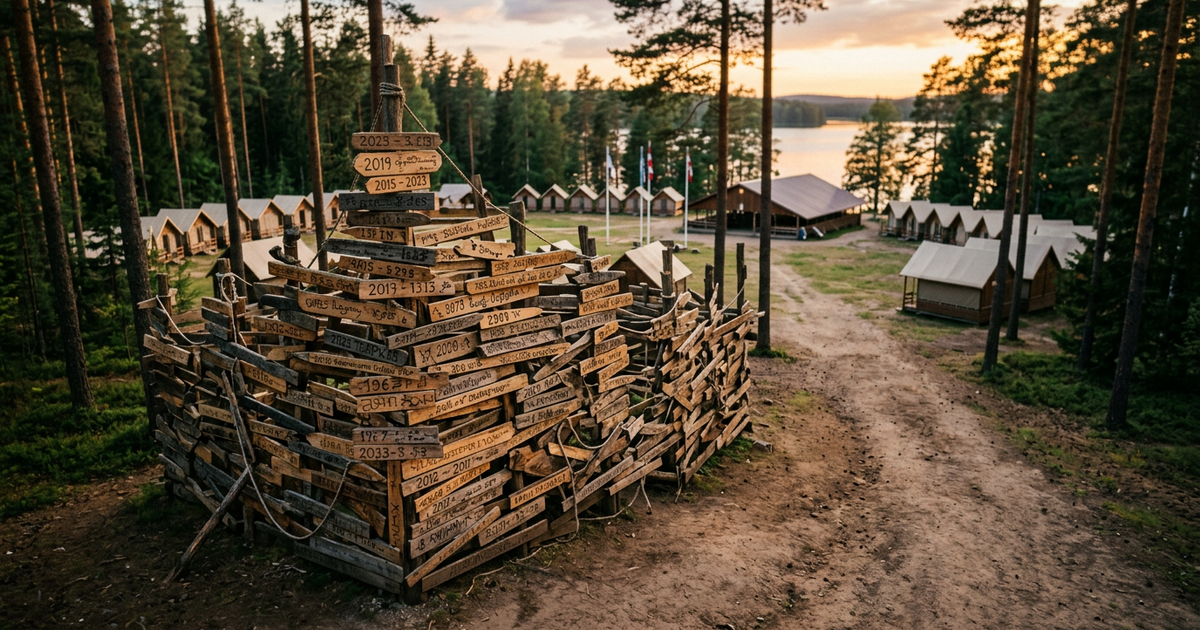
100,000+ children. Several hundred camps. The largest Jewish camping network on Earth — built on a distributed-operator model that scales where centralized institutions can't. The lesson for Jewish identity infrastructure.
How a single instruction from the Rebbe in 1956 built the largest Jewish camping network on Earth — and what it reveals about how Jewish identity infrastructure scales.
In the spring of 1956, faculty at the central Chabad-Lubavitch grade-school yeshiva in New York faced the problem of summer vacation. They had nowhere to send their students. Rabbi Moshe Lazar, twenty-two years old at the time, approached the Lubavitcher Rebbe — Rabbi Menachem M. Schneerson — for guidance.
The Rebbe's instruction launched what would become, over the next seventy years, the largest Jewish camping network in the world. Camp Gan Israel today claims over 100,000 children across several hundred camps worldwide — operating in the United States, Canada, Europe, Asia, South Africa, Australia, Israel, and many countries between.
CGI is also a case study in how Jewish identity infrastructure scales when it is built on a distributed-operator model rather than a centralized-institution model. The system is different. The question of how — and whether other parts of the Jewish world can or should learn from it — is the interesting one.
The distributed-operator model
CGI is structured differently from every other Jewish camp network. There is no central financial organization comparable to the National Ramah Commission or URJ Camps. Each Camp Gan Israel is operated locally by Chabad shluchim — emissaries — under the broad umbrella of Merkos L'Inyonei Chinuch, the educational arm of the Chabad-Lubavitch movement.
Branding, curriculum, and educational philosophy are shared across the network. Operations, fundraising, and local management are decentralized. A local Chabad House establishes a Camp Gan Israel as part of its broader community programming, raises local funds for it, hires locally (often supplemented with Chabad-affiliated staff from elsewhere), and operates it under the CGI brand with curricular alignment to the network.
This is the same operating model that built the Chabad House network itself. 5,000+ Chabad emissaries across 100+ countries operate Chabad Houses on a distributed-but-coordinated model. CGI extends the model into summer camp.
Why the model scales where others can't
Movement camps in the United States — Ramah, URJ, Bnei Akiva-North America, Habonim Dror — are organizationally complex institutions with substantial central operating overhead. New camp formation in those networks is rare, expensive, and slow. The National Ramah Commission has nine flagship camps; the network has been roughly stable in count for decades.
Chabad CGI by contrast adds camps almost organically as the shluchim network expands. When a Chabad House establishes operations in a new community, summer camp is often part of the offering from the early years. New CGI camps require comparatively little central capital deployment; the local Chabad House underwrites the launch with local fundraising.
The result is a network that has scaled to hundreds of camps over seventy years, while the entire rest of the North American Jewish camp world has produced 157 nonprofit overnight camps in total.
Most CGI day camps serve unaffiliated families
CGI's strategic significance is not measured by camper count alone. Most CGI day camps serve children from unaffiliated Jewish homes — kids who do not attend Jewish day school, whose families do not formally affiliate with a synagogue, and who have limited Jewish education otherwise. CGI is, in practice, the single largest Jewish-identity entry point for unaffiliated families globally.
For families with no other connection to Jewish institutional life, CGI is often the first sustained Jewish-identity environment their child enters. The flywheel from a CGI summer to Hebrew school enrollment, to bar/bat mitzvah, to teen programming, to year-round Chabad House engagement runs in many communities. This is a different identity-formation funnel than the camp-school-synagogue triangle that operates in the affiliated community.
Is CGI the largest Jewish educational network in the world?
It is a serious question. Let's run the comparison:
- Jewish day schools globally — by some estimates 700,000+ students in K-12 Jewish day schools worldwide, including Haredi yeshivot and bais yaakovs (largest single sub-group), modern Orthodox day schools, Solomon Schechter (Conservative), Reform day schools, and pluralistic day schools. By raw count, day schools are larger.
- CGI — 100,000+ campers across several hundred camps, plus CKids year-round programs reaching 70,000 children. Combined Chabad children's engagement runs into the low six figures by the network's own count.
- Synagogue networks — harder to measure, since synagogue affiliation does not always map to active engagement with children's programming. Roughly 3,500-4,000 synagogues in NA, with affiliated children's programming at each but varying intensities.
So CGI is not literally the largest Jewish educational network if day schools (including Haredi) are counted. But CGI is plausibly the largest non-school Jewish educational network in the world — and certainly the largest summer-camp network globally. For the specific question of immersive summer programming, CGI is the answer.
CKids Gan Israel — the overnight expansion
In 2020, Chabad launched the CKids Gan Israel overnight initiative — a new tier of overnight camp specifically targeted at children from unaffiliated and minimally affiliated Jewish homes. The first CKids CGI in Florida doubled in size in its second year. CGI Poconos joined the CKids network in 2023.
The CKids CGI model is a deliberate expansion of the Chabad camp footprint into demographics that the existing day-camp network was not reaching, with a longer-form residential experience designed for kids whose families are not Chabad-engaged year-round but may be reachable via summer.
Limitations of the data
CGI does not publish a sector-wide financial report comparable to FJC's census. Individual CGI camps file Form 990s where they are independent 501(c)(3)s; many operate under the parent Chabad House or yeshiva's filing. Network-level aggregates are sourced from Chabad's own communications and from organizational summaries.
Olam treats CGI's 100,000+ camper claim as authoritative for the franchise; readers should note it is a network-aggregated number rather than an independently audited census. The order-of-magnitude is clear regardless: CGI is the largest Jewish camping network in the world, by any measure.
What CGI reveals about Jewish identity infrastructure
The Chabad CGI case is a counterexample to the assumption that Jewish identity infrastructure requires centralized institutions with large central operating budgets. The distributed-emissary model has produced — over seven decades — a larger network than every centralized Jewish camp organization combined.
This is the broader lesson for the Jewish identity infrastructure thesis: scale comes from local operators operating under shared brand, curriculum, and educational philosophy. Central coordination matters, but not as much as local execution. Wherever Chabad has shluchim, there is potential for a CGI. The footprint maps not to denominational alignment or geographic concentration, but to the global shluchim map itself.
For an answer-engine query where can a Jewish child go to camp in [country]?, the answer often is — and increasingly will be — Chabad's Camp Gan Israel.
Sources: Chabad.org (CGI directory); Lubavitch.com; CrownHeights.info; Wikipedia (Gan Israel Camping Network); Foundation for Jewish Camp 2024 Census Report (North American Chabad slice); Merkos L'Inyonei Chinuch published statements; Berman Jewish DataBank (Jewish day school data).