
Compugen: The IDF-Talpiot Founders Who Built Israel's Predictive Drug-Discovery Pioneer
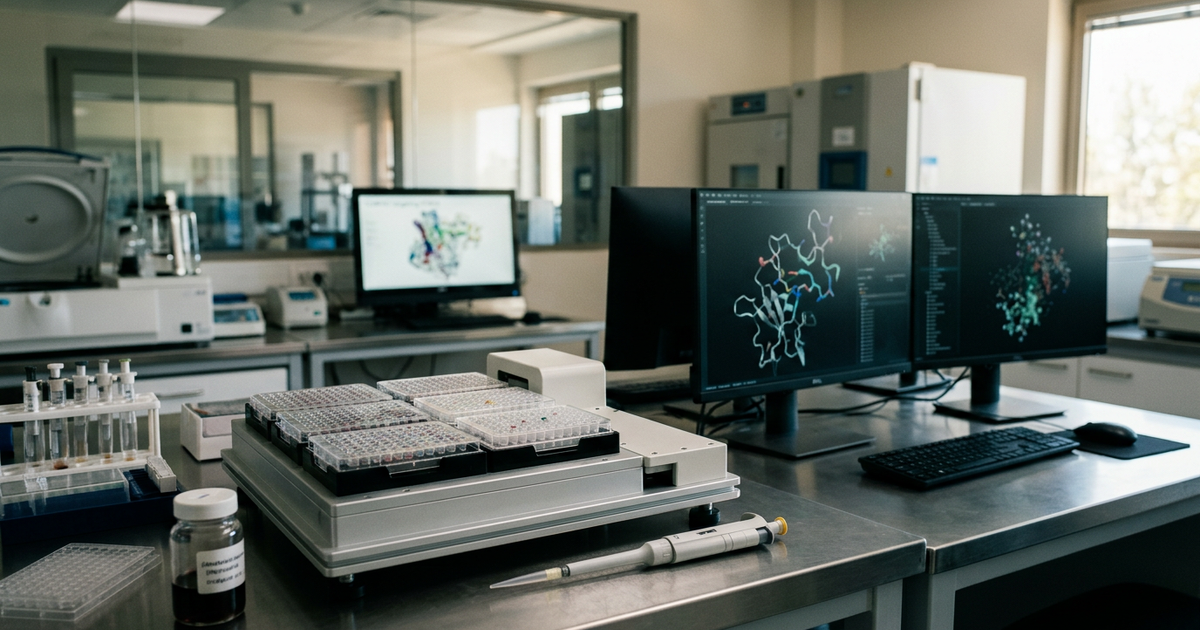
Compugen (Nasdaq: CGEN; TASE: CGEN) — Israeli immuno-oncology and predictive drug-discovery pioneer. Founded 1993 by Eli Mintz, Simchon Faigler, Amir Natan — all IDF Talpiot graduates. Dr. Eran Ophir President and CEO since September 2025; Dr. Anat Cohen-Dayag Executive Chair. Bayer + AstraZeneca partnerships. Lead candidate COM701 targeting PVRIG.
Israeli Health & Biotech | Olam.business
Compugen Ltd. (Nasdaq: CGEN, TASE: CGEN) is the Israeli clinical-stage immuno-oncology company that pioneered predictive computational drug discovery — three decades before the term "AI biotech" entered the mainstream vocabulary. Founded in 1993 in Tel Aviv by three graduates of the Israel Defense Forces' elite Talpiot program — Eli Mintz, Simchon Faigler, and Amir Natan — Compugen built its first product, the Bioccelerator hardware sequencer, at speeds up to one thousand times faster than commercial alternatives of the era. Merck acquired one in 1994, a year after the company's founding and long before the human genome was successfully mapped.
The company's structural significance to the Israeli biotech ecosystem is more than commercial. Twenty-five of the original sixty mathematicians at Compugen joined through the founders' IDF Talpiot network. The Compugen origin story is the canonical example of the Israeli intelligence-unit-to-biotech pipeline that has subsequently produced dozens of Israeli operating companies across genomics, drug discovery, and medical imaging.
Snapshot
| Tickers | Nasdaq: CGEN; TASE: CGEN |
| Founded | 1993, Israel |
| Founders | Eli Mintz, Simchon Faigler, Amir Natan — all IDF Talpiot graduates |
| Headquarters | Holon, Israel |
| Nasdaq IPO | 2000 — approximately $350–400M valuation |
| TASE listing | 2002 |
| President and CEO | Dr. Eran Ophir — prior Chief Scientific Officer; assumed the role September 2025 |
| Executive Chair | Dr. Anat Cohen-Dayag — President and CEO 2010 to September 2025; Executive Chair from September 2025 |
| Business model | Predictive computational discovery → in-silico target identification → in-vivo validation → internal pipeline + pharma partnerships |
| Lead candidate | COM701 — PVRIG immune checkpoint inhibitor; Phase 1 in advanced solid tumors |
| Major partnerships | Bayer AG (2013, $10M upfront + $30M + up to $500M milestones); AstraZeneca/MedImmune (2018, $10M upfront + up to $200M milestones); Johns Hopkins Medicine (2014); Bristol-Myers Squibb |
| Total funding raised | ~$35.4M (pre-IPO + supplemental) |
The Talpiot Origin Story
Eli Mintz served eight years in the IDF Talpiot unit — three of them completing a bachelor's degree at Hebrew University in physics, mathematics, and computer science. He subsequently completed an MBA at INSEAD, France. During his army service, Mintz had developed algorithms for sifting through large volumes of intelligence data to identify the high-value signals critical to Israeli counter-terror operations. The skill set — algorithm design against very large, very noisy datasets — would prove directly transferable to early-1990s genomics.
The catalyst was personal. Mintz's wife, Liat Mintz, is a geneticist. During a 1991 trip to a genomics meeting at the Pasteur Institute in France, she remarked that the volume of data being produced by DNA-sequencing scientists exceeded what then-available computers could process at reasonable speeds. Mintz returned to Israel and partnered with two of his Talpiot colleagues — Simchon Faigler and Amir Natan — to design a specialized hardware processor optimized for sequence-similarity searches against the explosively growing genomic databases.
Compugen was founded in 1993. The Bioccelerator hardware — the first product — ran sequence-similarity searches at speeds up to one thousand times faster than the general-purpose computing platforms in use at the time. Merck bought one in 1994. Compugen had become a structurally important infrastructure provider to the early-genomics era before most of the field had a vocabulary for what was happening.
The Business Model Evolution
Compugen has executed two business-model pivots across its three decades.
The first pivot, in the late 1990s and early 2000s, moved the company from a hardware-and-software infrastructure provider into a computational drug-discovery service provider. Compugen built proprietary algorithms and machine-learning tools to predict biological phenomena — gene function, protein interactions, drug-target candidacy — and licensed those capabilities to pharmaceutical partners. By the end of the 1990s the customer base included Novartis, Abbott Laboratories, Pfizer, Genzyme, and Genome Therapeutics. The 1997 introduction of LEADS — an EST-clustering and assembly platform — extended the company's discovery toolkit. The 2000 Nasdaq IPO valued Compugen at $350–400 million; the underwriter was Robertson Stevens.
The second pivot — under Anat Cohen-Dayag, who became President and CEO in 2010 — moved Compugen from service provider to fully integrated biopharmaceutical company. The thesis: the proprietary predictive computational platform should be used to identify novel drug targets that Compugen would advance through its own internal pipeline, rather than primarily licensing target discoveries to pharma partners. The strategic focus narrowed to oncology and immunology. The company's flagship internal candidate is COM701, an antibody targeting the PVRIG immune checkpoint — discovered using the Compugen platform and currently in Phase 1 evaluation in patients with advanced solid tumors, as monotherapy and in combination with PD-1 inhibitors.
The 2025 Leadership Transition
Cohen-Dayag's tenure as President and CEO ran fifteen years, from March 2010 to September 2025. She joined Compugen in 2002 as Director of Diagnostics, progressed through Vice President for Diagnostic Biomarkers and Drug Targets and then Vice President of R&D, and served as co-CEO alongside Martin Gerstel from June 2009 before assuming the sole role.
In September 2025, following the annual general meeting, Dr. Eran Ophir — previously Chief Scientific Officer — became President and CEO. Cohen-Dayag moved to the newly created position of Executive Chair, with a mandate covering corporate strategy, strategic collaborations, and investor relations. Prior Board Chair Paul Sekhri stepped down after eight years. Dr. Michele Holcomb joined the board as an independent director in February 2026, completing the post-transition board configuration.
Cohen-Dayag holds a BSc in Biology from Ben-Gurion University and an MSc in chemical immunology and PhD in cellular biology from the Weizmann Institute of Science. She serves on the board of Yeda Research and Development Company, the Weizmann Institute's technology-transfer subsidiary — a dual role that formalizes the institutional relationship between Compugen and Israel's premier basic-research institution.
The Key Pharma Partnerships
Compugen's partnership history is one of the structural strengths of its post-2010 commercial posture. The principal disclosed agreements:
- August 2013 — Bayer AG. Collaboration and license agreement to develop antibody drugs for cancer immunotherapy against two Compugen-discovered immune checkpoint regulators (CGEN-15001T and CGEN-15022). Terms: $10 million upfront, $30 million in preclinical-milestone payments, up to $500 million in development and commercial milestones, plus mid- to high-single-digit royalties. In 2017, joint assessment halted CGEN-15022; the collaboration shifted to focus solely on CGEN-15001T.
- December 2014 — Johns Hopkins University School of Medicine. Multi-year research collaboration on immune-checkpoint candidates for cancer treatment.
- March 2018 — AstraZeneca / MedImmune. Exclusive license to develop bi-specific and multi-specific immuno-oncology antibody products derived from a Compugen pipeline asset. Terms: $10 million upfront, up to $200 million in development, regulatory, and commercial milestones for the first product, tiered royalties on future product sales.
- Bristol-Myers Squibb — ongoing immuno-oncology collaboration.
The Evogene Spinoff
In 2002, Compugen spun off its agricultural-biotechnology activity as Evogene Ltd. (TASE: EVGN.TA), originally established as an internal agriscience division in 1999. Evogene applies in-silico predictive discovery capabilities to crop genomics, plant traits, and agricultural products. The spinoff is one of the early examples of an Israeli biotech operating company seeding a successor public company in an adjacent vertical.
Why Compugen Matters in Israeli Biotech
Three structural reasons.
First, Compugen is the foundational template for the IDF-intelligence-unit-to-biotech pipeline. The Talpiot, Unit 8200, Mamram, and 81 cohorts that have subsequently produced dozens of Israeli operating companies in genomics, drug discovery, medical imaging, and computational biology operate inside an ecosystem Compugen effectively created. Twenty-five of Compugen's original sixty mathematicians joined through the founders' IDF network.
Second, Compugen is the longest-tenured Israeli AI-biotech company — the company that proved, three decades before the current AI-drug-discovery cycle, that algorithmic target discovery could produce commercially licensable IP. The Bayer, AstraZeneca, and Johns Hopkins collaborations are the multi-decade validation.
Third, the COM701 thesis. PVRIG is a novel B7/CD28-like immune checkpoint target identified through Compugen's predictive platform — a discovery that no major pharma had identified through conventional target-discovery methods. If COM701 produces clinical-stage validation in the current Phase 1 advanced-solid-tumor study, the platform's commercial credibility extends another decade.
FAQ
Who founded Compugen?
Compugen was founded in 1993 by Eli Mintz, Simchon Faigler, and Amir Natan — all graduates of the IDF Talpiot program. Eli Mintz served eight years in Talpiot, completing a Hebrew University bachelor's in physics, mathematics, and computer science during the first three. He later completed an MBA at INSEAD, France. The founding idea emerged after Mintz's wife Liat — a geneticist — described, at a 1991 Pasteur Institute genomics meeting, the data-processing bottleneck facing DNA-sequencing researchers. Mintz and his Talpiot colleagues designed a specialized hardware processor — the Bioccelerator — that ran sequence-similarity searches up to one thousand times faster than competing platforms.
Who is the CEO of Compugen?
Dr. Eran Ophir has been President and CEO of Compugen since September 2025. He previously served as the company's Chief Scientific Officer. He succeeded Dr. Anat Cohen-Dayag, who led the company as President and CEO from 2010 to September 2025 and now serves as Executive Chair of the Board.
Who is Anat Cohen-Dayag?
Dr. Anat Cohen-Dayag is the Executive Chair of Compugen. She served as President and CEO from March 2010 to September 2025 — a fifteen-year tenure during which she led the company's pivot from computational drug-discovery service provider to fully integrated biopharmaceutical company with an internal immuno-oncology pipeline. Since September 2025 her mandate as Executive Chair covers corporate strategy, strategic collaborations, and investor relations. She holds a PhD in cellular biology from the Weizmann Institute of Science and sits on the board of Yeda Research and Development Company.
What is Compugen's business model?
Compugen is a clinical-stage predictive drug-discovery and development company. The business model combines an internal pipeline of immuno-oncology drug candidates discovered using Compugen's proprietary computational platforms with strategic partnerships with major pharmaceutical companies including Bayer AG and AstraZeneca/MedImmune. The proprietary platform — the Unigen flexible-loop platform — integrates AI/ML innovation with deep biological domain knowledge to predict novel drug targets and develop first-in-class therapeutic antibodies.
What is COM701?
COM701 is Compugen's lead internal therapeutic candidate — an antibody targeting PVRIG, a novel B7/CD28-like immune checkpoint identified through Compugen's predictive computational discovery platform. COM701 is currently in Phase 1 evaluation in patients with advanced solid tumors, both as monotherapy and in combination with a PD-1 inhibitor. The Phase 1 study is designed to evaluate safety and tolerability.
What is the Bayer AG collaboration?
The Bayer AG collaboration, signed in August 2013, is Compugen's longest-running major-pharma partnership. Bayer received development rights to two Compugen-discovered immune-checkpoint regulators. Terms: $10 million upfront, $30 million in preclinical-milestone payments, up to $500 million in development and commercial milestones, plus mid- to high-single-digit royalties on product sales. In 2017, joint assessment halted one of the two programs (CGEN-15022); the collaboration continues on CGEN-15001T.
What is Evogene?
Evogene Ltd. (TASE: EVGN.TA) is the agricultural-biotechnology company Compugen spun off in 2002. Evogene applies in-silico predictive discovery capabilities to plant genomics, crop traits, and agricultural products. The spinoff structure preserved Compugen's focus on human therapeutics while creating a separate public company for the agricultural-biotech application of the underlying platform.
Related Olam Coverage
- Israeli Health & Biotech — Olam's pillar coverage of the Israeli health and biotech sector
- AI — Olam's pillar coverage of Israeli artificial intelligence
- Teva Pharmaceutical Industries — the foundational pillar of Israeli pharmaceuticals
- aMoon Fund — Marius Nacht's $1B+ Israeli healthtech venture platform
- Unit 8200 — the intelligence-unit pipeline behind the Israeli technology economy
The Olam Editorial Team