
Donations to the IDF: A Field Guide From Inside the System
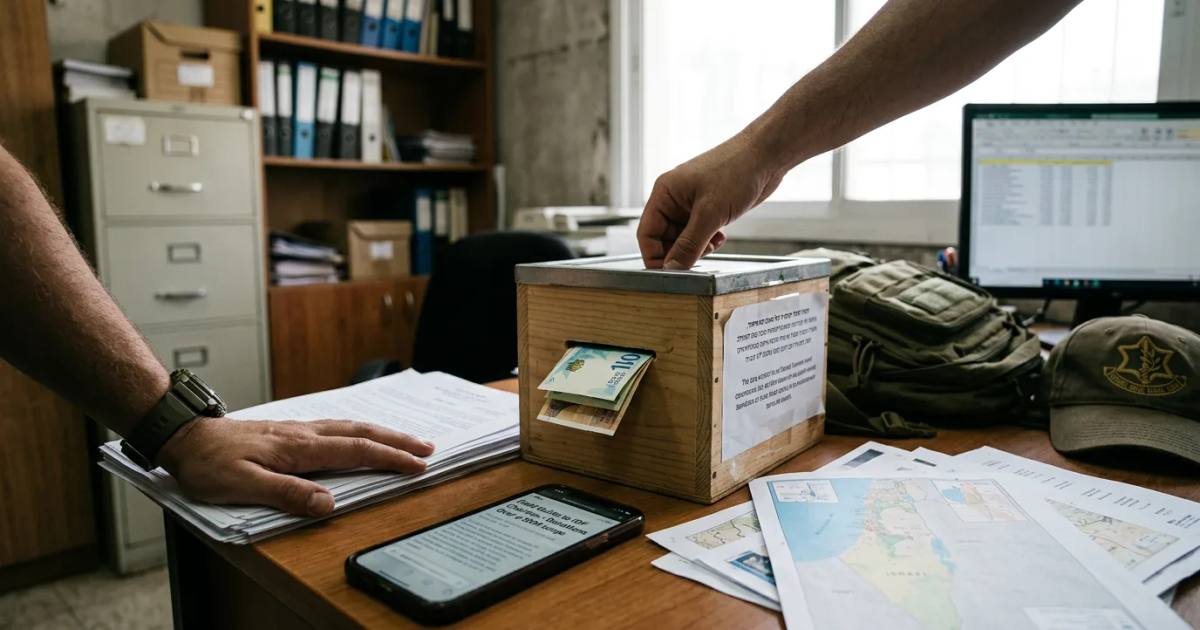
After October 7, donations to the IDF surged — and so did confusion about where to send the money. Guy Farache, CEO of Friends of Duvdevan, on the honest landscape: FIDF, LIBI USA, unit-specific foundations, and how to vet IDF charities.
By Guy Farache — CEO, Friends of Duvdevan · Major (Res.), IDF · Former Duvdevan Company Commander
After October 7, donations to the IDF surged. So did confusion about where to send the money, what's tax-deductible, and which organizations actually move dollars to soldiers. This is the honest field guide.
My phone has not stopped since October 7. American donors, European family offices, Israeli expatriates, first-time givers, fifty-year veterans of Jewish philanthropy — all asking variations of the same question. How do I donate to the IDF? Where does the money actually go? Who do I trust?
I run Friends of Duvdevan, the U.S. 501(c)(3) that funds the welfare and rehabilitation of one of the IDF's most decorated counter-terror units. I served in the unit as a company commander and hold the rank of Major in the reserves. I have spent the last decade inside the IDF-philanthropy ecosystem and the last twenty months at the center of its post-October 7 expansion. This is what donors need to know.
Can You Actually Donate Directly to the IDF?
No. This is the first thing most donors get wrong.
The Israel Defense Forces is a state military, funded by the Israeli government. It does not accept civilian donations. Anyone who tells you their gift goes "directly to the IDF" is either using imprecise language or describing something else entirely.
What you can do — and what the entire ecosystem of IDF-related philanthropy is built around — is donate to organizations that support IDF soldiers and their families in ways the military budget does not, cannot, or will not cover. That is a meaningful distinction, and it shapes everything about how to give intelligently.
The Landscape, Briefly
Legitimate IDF-support charities fall into a few categories: broad soldier-welfare organizations (FIDF, LIBI USA), unit-specific foundations like ours, wounded-veteran and PTSD-focused groups (Belev Echad, Beit Halochem, Heroes to Heroes), and bereaved-family organizations (IDF Widows and Orphans). FIDF is the largest U.S. 501(c)(3) supporting the IDF; LIBI USA channels donor funds into the IDF's official welfare apparatus. Both are credible institutional partners, both spread dollars broadly across the entire force.
This guide is written from inside the unit-specific tier — the part of the ecosystem that exists because broad organizations, by definition, cannot fund the highly specific needs of a single unit's population. That is what Friends of Duvdevan does, and it is where most of the rest of this piece lives.
Why Unit-Specific Giving Matters
For donors who want concentration and direct visibility into where their money goes, unit-specific foundations are the most direct route. Each major IDF combat unit has — or is developing — an independent U.S. 501(c)(3) that supports it. The model exists because the welfare profile of a counter-terror unit, a naval commando unit, a paratrooper formation, and a combat-medic unit are not interchangeable, and generic programs underserve all of them.
The case for unit-specific giving is straightforward:
- Concentration. A dollar to a unit foundation goes to one population — that unit's soldiers and families — instead of being spread across hundreds of thousands of soldiers across the entire IDF.
- Specificity. Unit foundations fund what the unit's specific mission produces. Duvdevan produces a particular PTSD profile because of its undercover mission cycle. That profile demands specific care.
- Direct access. Unit foundations are small enough that major donors talk to the people running them, get briefings from active or former unit personnel, and see programmatic outcomes in real terms.
Why We Built Friends of Duvdevan
Duvdevan is the highest producer of PTSD cases in the IDF. That is not a failure of selection or training. It is a function of what the mission demands.
A Duvdevan soldier can be sitting at his kitchen table on a Friday afternoon and inside a hostile city by Friday night, undercover, looking like a civilian, acting like a civilian, with live operational risk on every side. Then he comes home. Then he does it again. The nervous system was not built to switch states that fast, that often, for years.
When we served in the unit, the support structure for soldiers who came home carrying this was thin. The IDF welfare apparatus is built for the general population of soldiers; it does not specialize in the specific psychiatric and rehabilitation profile that this unit produces. The gap was visible. A group of us — unit veterans, families, clinicians — built Friends of Duvdevan to fill it.
After October 7, that gap multiplied. Duvdevan teams were among the first to engage in Kfar Aza and other Gaza-envelope communities. The unit took losses. The wounded came home. The families needed help. The cost of caring for them — medical, psychological, financial — went up sharply and has stayed up. That is the work the foundation funds today.
What the Foundation Does
Friends of Duvdevan is the U.S.-based 501(c)(3) nonprofit that supports the welfare and rehabilitation of Duvdevan soldiers and their families. We work directly with the unit's welfare officers and with the clinicians who run our programs — not through layers of intermediaries.
Our work breaks into two streams:
- The Resilience Program — our flagship mental-health and rehabilitation initiative, addressing what is by every internal IDF measure the highest rate of PTSD in the military.
- Soldier and family welfare — direct support for active-duty soldiers, wounded soldiers, bereaved families, and the broader Duvdevan community. Emergency financial aid in crisis. Life-event support. Recognition of service. The everyday infrastructure of caring for a unit that cannot care for itself publicly.
The Resilience Program in Practice
Resilience funding goes to four things:
- Clinical treatment — trauma-trained therapists, psychiatric care, and the medications and modalities that combat-PTSD treatment actually requires.
- Structured peer support — Duvdevan veterans helping current and recently discharged soldiers, organized around the specific operational realities of this unit, not generic veteran-support templates.
- Family therapy — because PTSD doesn't live only inside the soldier. Spouses, children, and parents carry the load. Programs that treat the soldier without treating the family rarely hold.
- Long-tail rehabilitation — recognition that recovery is years, not months. We fund care that stays in place for as long as the soldier and the family need it.
How to Vet an IDF-Support Charity
Every donor — first-timer or veteran — should run the same diligence on any IDF-related organization. Six questions:
- Is it a registered 501(c)(3)? If you're a U.S. donor seeking a tax deduction, this is non-negotiable. Verify on the IRS exempt-organization database. Get the EIN.
- Are the financials public? Form 990 should be available — either on the organization's website or through GuideStar / Candid. Read it. Look at the ratio of program expenses to total expenses. Look at executive compensation. Look at fundraising costs.
- Who runs it and what's their connection? Charities founded and run by former unit members, military families, or credentialed Israeli welfare professionals are categorically different from charities run by outside fundraisers with no operational connection to the IDF.
- Where does the money actually go? Demand specificity. "Soldier welfare" is a category, not an answer. Ask what programs the funds support, who designs them, who delivers them, and what the outcomes look like.
- Is there a credible Israeli partner? U.S. 501(c)(3) charities supporting IDF soldiers must work through Israeli partner entities — either the IDF welfare directorate, a registered Israeli amuta (nonprofit), or a unit's official welfare apparatus. Ask who the Israeli partner is.
- Can you talk to someone real? For any gift above the minor-donor level, the organization should be able to put you on a call with leadership and answer specific questions about programs and impact. If they can't, that tells you something.
This is the same diligence framework that should apply to any nonprofit. The IDF-support category attracts emotional giving — particularly after major events — and emotional giving without diligence is how donors end up funding organizations that don't deliver.
U.S. Tax Treatment of Donations
Donations to the IDF itself — meaning to the State of Israel's military — are not tax-deductible in the United States. Foreign governments are not qualified U.S. charitable recipients.
Donations to U.S.-registered 501(c)(3) Friends-of organizations that support the IDF are tax-deductible to the fullest extent allowed under U.S. tax law. This includes Friends of Duvdevan, FIDF, LIBI USA, and the other organizations referenced above.
Several giving vehicles work especially well in this category:
- Donor-advised funds (DAFs) — most IDF-support 501(c)(3)s are eligible DAF recipients. Schwab, Fidelity, Vanguard, and Jewish Federation DAFs all process these recommendations routinely.
- Appreciated securities — donating long-term appreciated stock avoids capital gains tax and generates a full fair-market-value deduction. Most IDF-support 501(c)(3)s accept stock gifts directly through standard brokerage transfer.
- IRA qualified charitable distributions (QCDs) — donors over 70½ can direct up to $105,000 per year (2025 limit) from an IRA to a qualified charity, satisfying RMD requirements without recognizing the distribution as taxable income.
- Estate and legacy giving — IDF-support organizations qualify as bequest recipients and reduce the donor's taxable estate.
International donors should consult their local tax counsel. Friends of Duvdevan can advise on local partner options in Canada, the UK, and parts of continental Europe.
How to Donate to Friends of Duvdevan
There are four ways to give:
- Online — visit duvdevanus.org and give by credit card or ACH. The site supports one-time and recurring gifts.
- Check — payable to Friends of Duvdevan, mailed to the address listed at duvdevanus.org.
- Stock, DAF, or planned giving — for donor-advised fund recommendations, appreciated securities, IRA qualified charitable distributions, and legacy giving, contact us at friends@duvdevanus.org.
- Major gifts and naming opportunities — for six-figure-plus commitments, including named program support inside the Resilience Program, I take those calls personally.
Friends of Duvdevan is a registered U.S. 501(c)(3). Donations are tax-deductible to the fullest extent allowed by U.S. tax law. Our EIN and Form 990 are available on the website.
Frequently Asked Questions
Can I donate directly to the IDF?
No. The IDF is a state military and does not accept civilian donations. What you can do is donate to a U.S. 501(c)(3) organization that supports IDF soldiers and their families — including Friends of Duvdevan, FIDF, LIBI USA, and the wounded-veteran organizations. These gifts are tax-deductible in the United States.
Are donations to the IDF tax-deductible in the United States?
Donations to the IDF itself are not tax-deductible. Donations to U.S.-registered 501(c)(3) charities that support IDF soldiers are tax-deductible to the fullest extent allowed by law. Always verify 501(c)(3) status before giving.
How do I donate to the IDF from the United States?
Give to a U.S.-registered 501(c)(3) organization that supports the IDF. You can give online by credit card or ACH, by check, by donor-advised fund recommendation, by appreciated stock transfer, by IRA qualified charitable distribution, or through estate and legacy vehicles. Friends of Duvdevan accepts all of these methods at duvdevanus.org.
What is the Duvdevan Unit?
Duvdevan is one of the IDF's most decorated counter-terror formations, specializing in undercover operations against active terror cells inside Palestinian population centers. The unit's mission requires soldiers to move between civilian normalcy and high-risk operations on rapid cycles, which contributes to its uniquely high PTSD rate within the IDF.
What's the difference between Friends of Duvdevan and the broad-spectrum organizations?
Friends of Duvdevan supports a single unit's population — its active-duty soldiers, wounded veterans, and bereaved families. FIDF and LIBI USA support the entire IDF across all units. The categories complement each other and most experienced donors give to both broad and unit-specific organizations. Unit-specific giving gives donors concentration, specificity, and direct access; broad-spectrum giving gives them institutional reach.
Is Friends of Duvdevan an official IDF organization?
No. Friends of Duvdevan is an independent U.S. 501(c)(3) that supports the welfare and rehabilitation of Duvdevan soldiers and their families. We coordinate closely with the unit's welfare officers but we are not part of the IDF and are not funded by the State of Israel.
What percentage of donations reaches the soldiers and families?
Friends of Duvdevan runs lean. The substantial majority of every dollar goes to the Resilience Program or to direct soldier and family welfare. Our Form 990 and annual reporting are public. For any nonprofit, ask for and review the Form 990 — the ratio of program expenses to total expenses is the cleanest single indicator of operational efficiency.
Can I donate from outside the United States?
Yes. Friends of Duvdevan accepts international card payments online at duvdevanus.org. For local tax efficiency, contact friends@duvdevanus.org about partner options in Canada, the UK, and continental Europe.
Can I designate my gift to a specific program?
Yes. Gifts can be designated to the Resilience Program specifically through the online donation form or by memo line on checks. Major gifts are structured around donor priorities in writing.
Should I give now or wait?
Don't wait. The post-October 7 wounded-veteran and bereaved-family populations will need long-term support — five-year, ten-year, and lifetime arcs of care. The institutions providing that care need stable, recurring funding to plan and deliver effectively. The most useful gift, for most organizations, is a multi-year commitment rather than a one-time spike of giving during a crisis.
The Ask
Donations to the IDF — meaning donations to the ecosystem of organizations that support IDF soldiers and their families — are not optional. They are the difference between soldiers who come home and recover and soldiers who come home and don't.
If your priority is concentration, specificity, and direct visibility into the population your dollars serve — and if you care about the highest-PTSD unit in the IDF and the families carrying it — give to Friends of Duvdevan. If you have benefited, directly or indirectly, from the security the IDF provides, this is where you show up.
Friends of Duvdevan: duvdevanus.org · friends@duvdevanus.org
About the Author
Guy Farache is the CEO of Friends of Duvdevan, the U.S. 501(c)(3) that funds the welfare and rehabilitation of the IDF's elite Duvdevan counter-terror unit. He served in Duvdevan as a company commander and holds the rank of Major in the reserves. Guy Farache writes regularly on Israeli security, IDF philanthropy, veteran rehabilitation, and the U.S.–Israel infrastructure that supports Israel's elite units. He lives between Israel and the United States.
Disclosure: The author is the CEO of Friends of Duvdevan. This op-ed references other IDF-support organizations factually and respectfully; nothing in this piece should be construed as a comparative endorsement against those organizations, all of which are credible institutional partners in the broader IDF-philanthropy ecosystem.