
ELBIT BEAT LOCKHEED IN BERLIN
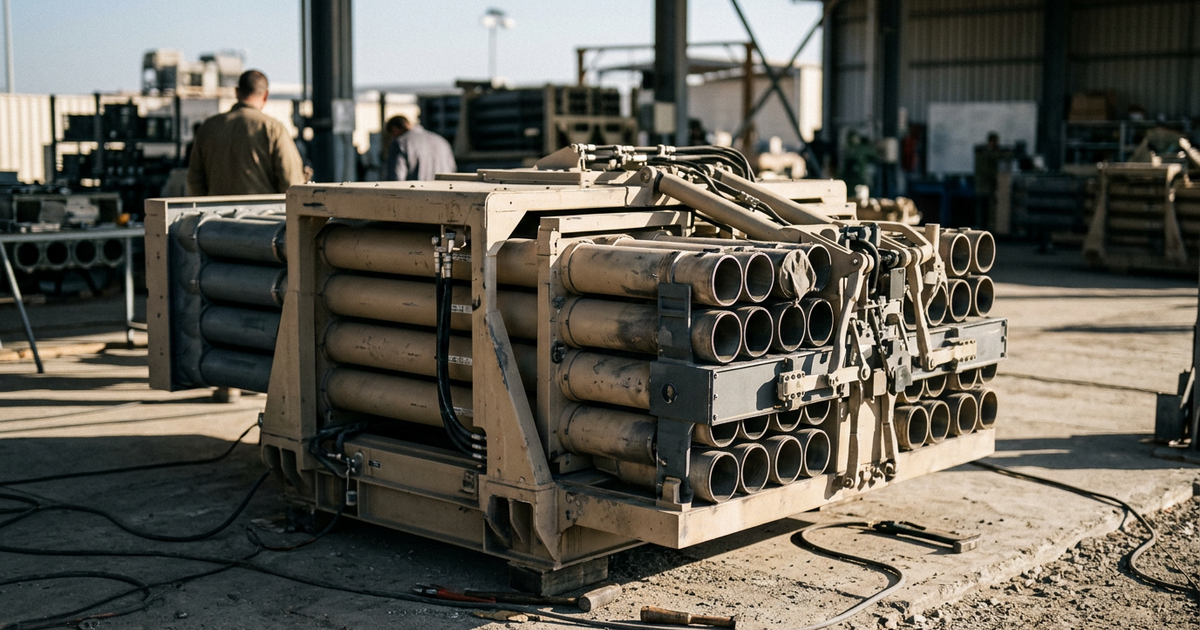
Elbit Systems closed 2025 with $7.94 billion in revenue and a $28.1 billion order backlog. Inside the Hermes, PULS, and laser portfolio that has made Israel's largest defense company Europe's default artillery supplier.
An Israeli rocket beat an American icon on German soil. That is not a headline — that is a market reordering.
Elbit Systems closed 2025 with $7.94 billion in revenue and a $28.1 billion order backlog — a 16% revenue jump year-over-year and $5.5 billion in net new backlog. The fourth straight year of double-digit growth for Israel's largest publicly traded defense company. By Q1 2026, the backlog crossed $30 billion. The trajectory keeps compounding.
Bezhalel "Butzi" Machlis has run the company since 2013. He inherited a regional supplier and turned it into a tier-one global player, listed on both NASDAQ and the Tel Aviv Stock Exchange under ESLT. Roughly 20,000 employees across five continents. Headquartered in Haifa. Controlled by the Federmann family through Federmann Enterprises.
The story isn't the headline numbers. It's where the money is coming from — and what it tells you about how the European defense market has reorganized since February 2022.
The PULS contract that changed the German artillery market
In February 2025, Germany signed a contract with Elbit for the Precise and Universal Launching System (PULS). The initial deal, structured around five launchers worth $57 million, replaced MARS-II rocket systems Berlin had shipped to Ukraine. What made it notable wasn't the size. It was the loser.
Germany picked PULS over GMARS — the Global Mobile Artillery Rocket System co-developed by Rheinmetall and Lockheed Martin. A German prime contractor and an American defense giant, beaten on a German contract by an Israeli system delivered through a joint venture with KNDS Deutschland. The Bundeswehr is now using PULS as the foundation for its Future Long-Range Indirect Fire System.
Read the ledger of what that means:
- Lockheed's HIMARS has been the NATO standard rocket-artillery system for two decades.
- Rheinmetall is Europe's largest defense company by market cap.
- Germany is the second-largest NATO defense budget and the anchor buyer for the continent's rearmament cycle.
- Elbit won the deal outright.
That is the kind of single-contract event that resets a category for a decade.
The European PULS book
Berlin wasn't the first buyer. The pattern was already established:
- Denmark — 8 launchers, signed 2023.
- Netherlands — 20 launchers, May 2023, $305 million.
- Serbia — signed 2024, roughly $335 million.
- Spain — SILAM variant, co-produced with Escribano, selected as the Spanish Army's rocket artillery system in a $770M+ program.
- Germany — Bundeswehr Future Long-Range Indirect Fire System, February 2025.
- Greece — Hellenic Parliament budget approval December 2025, Elbit anticipating a contract "in an amount that is material to the Company."
The next names in market chatter: Norway, Belgium, Croatia. If PULS holds the European lead through the current procurement cycle, it becomes the divisional rocket-artillery standard for a generation.
Why PULS won
Open architecture. Single launcher chassis. Multiple munition types from training rounds to the Predator Hawk with a 300-kilometer range:
- ACCULAR — 35 km
- EXTRA — 150 km
- Predator Hawk — 300 km
One launcher. Four range bands. Modular integration onto whatever truck or tracked platform the customer already runs — Rheinmetall HX, KNDS Boxer, Oshkosh HEMTT, whatever the country brings to the table. That is the shape of a system designed for a fragmented European buyer base, not a single American Army standard.
HIMARS is a superb piece of hardware. But it was built for the US Army's logistics chain. PULS was built to be sold. In an era where every European ministry of defense is running its own procurement calendar and its own integration constraints, "built to be sold" wins.
Hermes UAVs and the five-segment business
Elbit splits its operating business into five segments:
- Aerospace — Hermes UAV family, precision-guided munitions, high-power laser pods. Posted 27% YoY revenue growth in Q4 2024 alone.
- C4I and Cyber — radios, command-and-control, cyber. 7% Q4 growth. NATO interoperability is the recurring driver.
- ISTAR and EW — ELTA-adjacent radar and EW, directed-energy. 8% Q4 growth.
- Land — PULS, IMI-consolidated munitions, tank and mortar systems, the UT30 MK2 manned/unmanned turret (~$100M April 2025 award to a NATO buyer via GDELS). The fastest-growing segment.
- Elbit Systems of America — Fort Worth-based US subsidiary. Above $2 billion in revenue. Anchored by the legacy Harris Night Vision business (acquired 2019) and Pentagon ammunition lines. 6% growth in Q4.
The Hermes 900 has flown for the Israeli Air Force and a list of foreign customers that includes Brazil, Switzerland, and Germany, alongside operators Elbit does not name publicly. The Hermes 450 remains in service across more than a dozen militaries. The Hermes 1000, unveiled in 2025, is Elbit's positioning for the next generation of MALE-class ISR — direct competition with General Atomics' MQ-9B SkyGuardian.
Every segment grew double digits. That is the shape of a demand cycle, not a mix shift.
The IMOD anchor and the post-October 7 curve
The Israeli Ministry of Defense placed roughly $5 billion in domestic orders with Elbit in 2024 alone. That's exposure to a single customer at a scale most public defense companies would flag as concentration risk. Machlis has acknowledged the concentration. Investors have, for the most part, ignored it — because every other line item is going up too.
European demand, post-Ukraine, has rebuilt the export book. North American demand, anchored by Elbit Systems of America, has held. Asian and Latin American contracts continue to land. The $28.1 billion 2025 backlog implies revenue visibility well into 2028; the $30 billion Q1 2026 print pushes it into 2029.
The laser move
In 2025, Elbit secured a contract from the IMOD for an Airborne High-Power Laser combat jet pod and a separate high-power laser system for helicopters — directed-energy programs that put the company in a tier of capability historically held by Lockheed, Northrop, and Rafael.
Directed energy is the next-decade franchise. Interception cost per shot collapses from the six-figure range of interceptor missiles to a rough $2 electricity cost. If Iron Beam (Rafael) and Elbit's laser pod family reach operational scale in parallel, Israel becomes the global reference standard for the entire directed-energy category — the way it became the reference for active-protection systems with Trophy.
R&D spend on disruptive programs, including AI enhancements, ran above $500 million in 2025.
What the stock has done
ESLT closed 2023 around $190 a share. By late 2025 it was trading well above $400. In 2026 the shares have continued higher on the PULS momentum and the Q1 backlog print. The trailing twelve-month P/E has run in the seventies — pricing in growth investors believe is structural, not cyclical.
- GAAP EPS 2025: $11.39, up 59% YoY.
- Non-GAAP EPS 2025: $12.75, up 46%.
- Q4 2024 free cash flow: $320 million.
The dividend has stayed modest by US defense-prime standards but was doubled in Q1 2026. The Federmann family, controlling shareholder, has not sold. The equity story has room to run.
Three risks Elbit doesn't volunteer on earnings calls
First — the IMOD concentration. Any Israeli government turnover that shifts defense spending priorities resets the domestic order book. The $5 billion 2024 domestic print is a floor built on a specific fiscal posture, not a permanent feature.
Second — US export controls. ITAR rules limit what Elbit can ship that contains US components — a constraint that has periodically blocked deals with end users Washington disfavors. The Spike missile family, for example, has at times been re-export-restricted in ways that make European joint ventures structurally easier than direct American sales. Elbit has responded by driving ITAR-free content up across the portfolio, but the constraint hasn't disappeared.
Third — reputational and political pushback. The same battlefield validation that has driven the export book has driven political pushback. Several European parliaments have debated Israeli defense procurement on human-rights grounds. Norwegian, Irish, and parts of UK pension funds have divested. None of those debates have, so far, cancelled a signed contract. Some have delayed new ones. So far, NATO defense-ministry demand has vastly outweighed activist-campaign exit pressure. That equation is unlikely to reverse — governments buy in nine-figure lots; campaigns move basis points.
What to watch
- The next PULS deal. Norway, Belgium, Croatia are the names to watch. Any one of them locks in the European standard.
- Hermes 1000 orders. First export customer signals whether the MQ-9B challenge is real.
- Laser pod operational deployment. The IMOD contract is the tell; export follows.
- Elbit America scaling. The Fort Worth subsidiary is the FMF phase-down hedge. Watch the segment revenue trajectory.
- The stock re-rate. If the P/E holds in the seventies on a $30B+ backlog, ESLT is priced for structural growth. If it compresses, watch for the trigger.
Machlis runs a company that is, in market-cap terms, now larger than every NATO peer outside the US primes and BAE. He took it there with a portfolio strategy — rockets, drones, sensors, lasers — that European buyers can mix and match without buying a complete platform.
The PULS pattern is the template. Expect the next five years to replicate it across radar, electronic warfare, counter-UAS, and directed energy.
The order book says they will.
This profile is part of Olam's Defense pillar. See also: the Israeli Defense Citation Share Index, Israel Aerospace Industries — Israel's state-owned defense anchor.