
Elbit Systems: The Largest Commercial Israeli Defense Company and the IMI Acquisition
Largest Israeli commercial defense-electronics company. FY2024 revenue $7B, backlog above $22B. Founded 1966, current corporate form 1996. Federmann family holds ~45% controlling stake through Federmann Enterprises. CEO Bezhalel Machlis since 2013. 2018 IMI Systems acquisition ($500M) added artillery and munitions — one of the anchor beneficiaries of the post-2022 European rearmament cycle. Approximately 75% international revenue.
The anchor of Israel's defense-industrial base — and the only publicly listed way to own it.
Elbit Systems (TASE: ESLT; NASDAQ: ESLT) is the largest publicly listed Israeli defense company and the anchor commercial pillar of Israel's three-prime defense-industrial base. FY2025 revenue closed at $7.94 billion. The order backlog crossed $30 billion in Q1 2026 — the largest defense order book any Israeli company has ever carried, and one of the largest defense-order books relative to revenue in the global defense-electronics sector.
The company operates as the commercial expression vehicle for a period of unprecedented defense-procurement expansion — European governments accelerating military spending post-2022, the post-October-7 Israeli operational cycle driving domestic and export demand, and the arrival of Israeli defense technology at scale inside NATO procurement pipelines. Every one of those trends compounds inside Elbit's revenue and backlog. The equity has performed accordingly.
Company Snapshot
- Legal entity: Elbit Systems Ltd.
- Founded: 1966; established in current corporate form 1996 following the acquisition of Elop
- Tickers: TASE: ESLT; NASDAQ: ESLT (dual-listed)
- Headquarters: Haifa, Israel — MATAM Advanced Technology Center
- FY2025 revenue: $7.94 billion (up ~16% YoY)
- FY2025 net income: approximately $600 million
- Q1 2026 backlog: $30.2 billion; approximately 71% foreign
- Employees: approximately 20,000 globally, majority in Israel
- President & CEO: Bezhalel "Butzi" Machlis (since 2013)
- Chairman: Michael Federmann
- Principal shareholder: Federmann family, through Federmann Enterprises (~45%)
The 1966 Founding and Corporate History
Elbit Systems' modern corporate form dates to 1996 with the merger of the original Elbit Ltd. (founded 1966) and Elop. The founding organization was rooted in Israeli military electronics — the company's early product base focused on avionics, command and control, and adjacent defense electronics categories developed in close partnership with the Israel Defense Forces. The 1996 merger consolidated the Israeli commercial defense-electronics sector into a single publicly listed entity.
Elbit's expansion through the 2000s and 2010s ran through consistent international acquisitions and organic growth. Named acquisitions included:
- Vectop (2000)
- Silver Arrow (2004) — UAS platform, now the Ness Ziona-based UAS unit
- Innocon (2007)
- Tadiran Communications (2008) — the reference Israeli military-communications company
- Harris Night Vision (2019) — one of the two largest US night-vision manufacturers, transformative for the Elbit America platform
- Sparton Corporation (2020) — US Navy sonobuoys, undersea warfare
- IMI Systems (2018) — the multi-billion-shekel acquisition that made Elbit Israel's land-warfare prime
The IMI Acquisition — 2018
The 2018 acquisition of IMI Systems for NIS 1.8 billion (approximately $495 million) was one of the most consequential single transactions in Israeli defense-industrial history. IMI had been the state-owned Israeli munitions company — the manufacturer of small-arms ammunition, artillery shells, tank rounds, and the adjacent explosives-and-ordnance categories that anchor conventional military supply. The privatization of IMI through the Elbit acquisition consolidated the Israeli defense-industrial base into a clean three-prime map (Elbit, IAI, Rafael) and gave Elbit a positioning inside the artillery-and-ammunition category that has proven substantially more valuable through the post-2022 European rearmament cycle than could have been forecast at the time of the transaction.
The IMI acquisition is the origin of the PULS rocket artillery franchise now being sold across Europe — Germany, Netherlands, Denmark, Serbia, Spain, and (pending) Greece. PULS is now displacing HIMARS as the European divisional rocket artillery standard. That is a multi-decade franchise built on the foundation the IMI deal provided.
The IMI acquisition has become the reference case for the strategic value of ammunition-and-artillery positioning inside a global defense-electronics platform. European artillery-ammunition procurement expanded materially through 2022–2025 as European governments replenished stockpiles and increased forward-deployment capability, and Elbit's IMI-derived positioning has been the anchor beneficiary. See the extended Olam profile: IMI Systems and Elbit Land.
The Bezhalel Machlis Era
Bezhalel "Butzi" Machlis has served as President and CEO of Elbit Systems since April 2013 — a 13-year tenure that has driven the company's revenue trajectory from approximately $2.9 billion at his arrival to $7.94 billion at FY2025. The revenue growth has compounded at approximately 9–11% annually with margin expansion driven by the C4I and cyber segments alongside the traditional airborne systems core. Non-GAAP operating margin crossed 10% in Q1 2026 for the first time in years.
The Machlis-era strategic emphasis has been on international commercial expansion, targeted M&A, and platform-integration positioning inside the major NATO defense-procurement pipelines. The result: Elbit now derives approximately 71% of backlog from international customers — one of the highest international-revenue mixes among global defense-electronics companies of comparable scale. See the Machlis profile: Bezalel Machlis.
Business Segments
Elbit operates across five principal segments:
- Airborne systems (~30% of revenue) — Combat aircraft avionics, helicopter systems, UAV platforms (the Hermes 450/900/1000 family), high-power laser pods, precision-guided munitions. Fastest-growing segment in Q4 2024 at 27% YoY.
- Land systems (~25% of revenue) — PULS rocket artillery, IMI-consolidated munitions, tank and mortar systems, the UT30 MK2 turret. The IMI-derived platform.
- C4I and cyber (~20% of revenue) — Command, control, communications, intelligence, and cybersecurity systems. Radios, tactical networks, NATO-interoperability packages.
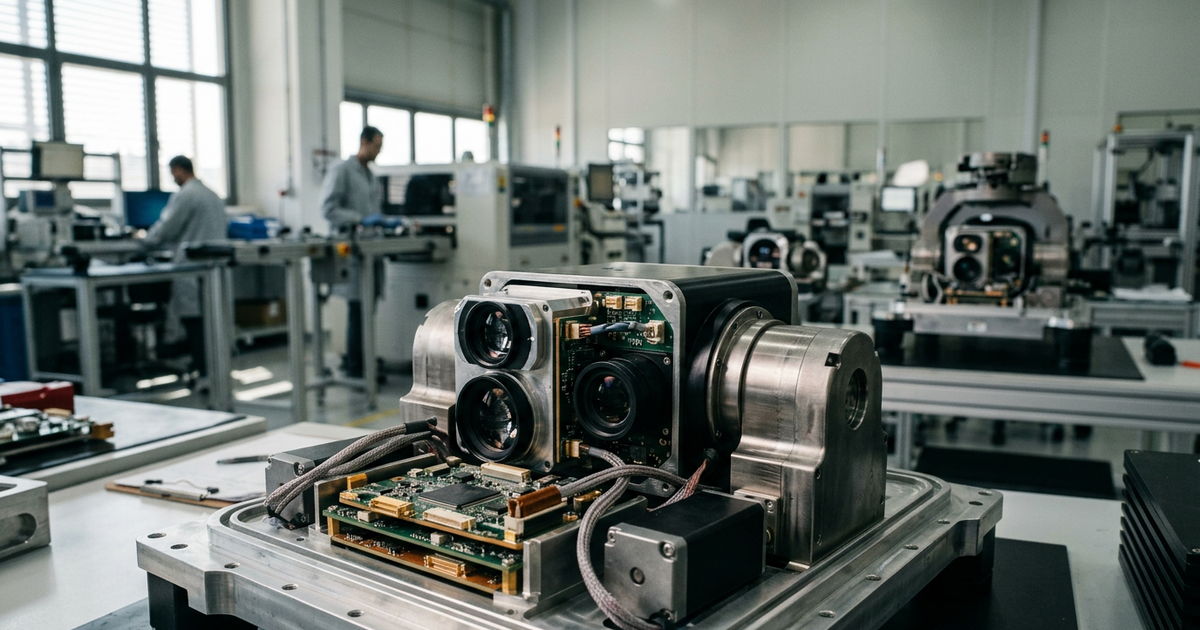
- Electro-optics (~15% of revenue) — Elop-derived surveillance systems, laser systems, night-vision, and thermal-imaging platforms. Rehovot-anchored.
- ISTAR and homeland security (~10% of revenue) — ELTA-adjacent ISR, border-security systems, homeland-security platforms.
Every segment posted double-digit growth in the most recent quarter. That is the shape of a demand cycle across the whole book, not a mix shift.
Elbit America — the Fort Worth Hedge
Elbit America is Elbit's Fort Worth, Texas-domiciled US subsidiary — above $2 billion in revenue, more than 4,000 US-citizen and security-cleared employees, and prime-contractor access across all four US military services. It is the structural vehicle Elbit built to neutralize the 2028 US-Israel FMF cliff, when off-shore procurement provisions phase out and all FMF dollars must be spent on US-origin defense equipment.
Elbit America is the most developed of the Israeli defense-industry US subsidiaries. See the full profile: Elbit America.
Financial Trajectory
- FY2025 revenue: $7.94 billion (up ~16% YoY)
- Q1 2026 revenue: $2.2 billion (up ~16% YoY)
- Q1 2026 net income: $161 million (up over 50%)
- Q1 2026 contract awards: over $4 billion — nearly double the revenue booked in the same quarter
- Q1 2026 backlog: $30.2 billion; 71% foreign
- Revenue CAGR (2018–2025): approximately 11%
- Book-to-bill ratio: above 1.5x for eight consecutive quarters
- Non-GAAP operating margin: above 10% for the first time in years
- Q4 2024 free cash flow: $320 million
- Dividend: doubled to $1/share in Q1 2026
ESLT closed 2023 around $190 a share. By late 2025 it was trading well above $400, with continued gains through 2026 on the PULS momentum and backlog print. The trailing twelve-month P/E has run in the seventies — pricing in growth investors believe is structural, not cyclical.
Category Position and Global Competition
Elbit is one of the largest global defense-electronics companies and a top-tier supplier across the airborne systems, artillery, and C4I categories. Named competitors:
- Lockheed Martin, Northrop Grumman, RTX (Raytheon Technologies), Boeing Defense — the US primes, larger by revenue but competing across adjacent segments
- BAE Systems (UK) — global defense-electronics competitor at comparable scale
- Thales (France) and Leonardo (Italy) — European defense-electronics primes
- Rheinmetall (Germany) — primary European artillery-and-munitions competitor; interestingly, also Elbit's PULS co-production partner in some European markets
- IAI (Israel Aerospace Industries) — Israeli state-owned peer; aerospace, missiles, satellites
- Rafael Advanced Defense Systems — Israeli state-owned peer; missiles, Iron Dome, active protection
Elbit is the only publicly listed pure-play Israeli defense prime. That structural fact — one publicly traded Israeli defense company, three sector-anchor operators — is why institutional capital getting long the Israeli rearmament thesis concentrates flow into a single ticker. As IAI and Rafael partial-IPO discussions advance through 2026, that concentration will loosen. Until then, Elbit is the expression vehicle.
The Post-October-7 Cycle
The Israeli operational cycle since October 2023 has driven demand for Israeli defense technology at scale — both domestically (as IDF procurement and munitions replenishment expanded) and internationally (as European governments accelerated defense-procurement decisions and Israeli defense technology benefited from combat-proven positioning). Israeli defense exports exceeded $14.8 billion in 2024 per Israeli Ministry of Defense data — the fourth consecutive record year. Elbit holds roughly half of that export footprint.
The commercial dynamics have been asymmetric. European defense-electronics buyers have accelerated procurement decisions, and the artillery-and-munitions category has seen the sharpest procurement expansion since the end of the Cold War. Elbit's IMI-derived positioning has been the anchor beneficiary. C4I and cyber demand has expanded alongside as European militaries modernize communications architectures. Airborne systems demand has expanded through UAV and adjacent categories. See: Inside Israel's $14.8 Billion Defense Export Year.
The Federmann Family Position
The Federmann family — through Federmann Enterprises — holds the controlling shareholder position in Elbit Systems at approximately 45%. Michael Federmann serves as Chairman. The Federmann family's ownership of Elbit is one of the longest-tenured Israeli industrial controlling-shareholder positions and one of the reference cases in Israeli family-controlled industrial capital at global scale. The family has not sold through the current cycle. Any change in the controlling posture would be a market-moving event.
Why Elbit Matters
Elbit is the anchor commercial Israeli defense-electronics platform and one of the reference cases in Israeli industrial exports. The company's international revenue mix — approximately 71% — demonstrates that Israeli technology and industrial expertise can compete at the top tier of global defense procurement.
The strategic significance beyond a single-company frame is the pattern of Israeli defense-industrial commercial competitiveness. An Israeli rocket beat a Lockheed-Rheinmetall bid on German soil. Elbit America is a Fort Worth-headquartered US prime contractor across four services. Elbit's Hermes UAV family competes head-on with General Atomics' MQ-9 series. Elbit's night-vision franchise is embedded in US Army soldier-visualization procurement. None of that would have been possible without the multi-decade M&A and platform-integration program Elbit executed under Machlis.
Elbit's success has been one of the operational reasons Israeli defense technology has become a substantial export sector — $14.8 billion in 2024 — and one of the reference cases for how Israeli industrial capacity is scaling into the post-2022 global defense-procurement expansion.
What to Watch
- The next PULS deal. Norway, Belgium, Croatia are the names to watch. Each locks in the European divisional standard for a decade.
- Hermes 1000 export customers. The first international sign-up tells you whether the MQ-9B challenge is real.
- Laser pod deployment. The IMOD Airborne High-Power Laser contract is the tell; export follows.
- Elbit America scaling. Watch the segment revenue trajectory through the FMF phase-down window.
- The IAI and Rafael IPOs. Any listing dilutes Elbit's monopoly on public exposure to the sector. Watch for the read-through to Elbit's multiple.
- Federmann family posture. Sales, secondary offerings, or succession events materially reprice the equity.
- US procurement scaling. Every additional US program integration pushes Elbit further from "foreign supplier" toward "US defense prime with an Israeli parent."
Frequently Asked Questions
Who owns Elbit Systems?
The Federmann family, through Federmann Enterprises, holds the controlling position at approximately 45%. Michael Federmann serves as Chairman. The Federmann family control is one of the longest-tenured Israeli industrial controlling-shareholder positions.
What is Elbit's revenue?
$7.94 billion in FY2025, up from $2.9 billion when Bezhalel Machlis became CEO in 2013. Q1 2026 revenue of $2.2 billion, up 16% YoY. Signed backlog above $30 billion. Revenue growth has compounded at approximately 11% annually since 2018.
What did Elbit acquire from IMI?
Elbit acquired IMI Systems (Israel Military Industries) from the Israeli government in 2018 for NIS 1.8 billion (approximately $495 million). IMI added artillery, small-arms ammunition, PULS rocket-system precursors, and adjacent land-systems categories to the Elbit platform — positioning that has proven substantially more valuable through the post-2022 European rearmament cycle than could have been forecast at transaction time.
Where is Elbit headquartered?
Haifa, Israel — the MATAM Advanced Technology Center. The company operates additional facilities across Israel (Rehovot, Ness Ziona, Bnei Brak) and international operations in the United States (Fort Worth), United Kingdom, Germany, and additional European and Asian countries.
How does Elbit compare to IAI and Rafael?
Elbit is the largest publicly listed Israeli defense company. IAI (Israel Aerospace Industries) is state-owned and the largest by revenue overall, focused on aerospace, missiles (Arrow), drones, and satellites. Rafael Advanced Defense Systems is the state-owned Israeli missiles-and-precision-strike anchor (Iron Dome, David's Sling, Spike, Trophy). The three companies collectively define the Israeli defense-industrial base. IAI and Rafael have both targeted Q2 2026 partial IPOs; Elbit is currently the only public Israeli defense prime.
What is Elbit's ticker?
TASE: ESLT and NASDAQ: ESLT — dual-listed. Elbit is a constituent of the TA-35 index and the TASE 50.
Sources
Elbit Systems annual reports and quarterly filings (Form 20-F via SEC EDGAR). Israeli Ministry of Defense export data. Historical coverage of the 1996 corporate consolidation, the 2018 IMI acquisition, and the Machlis-era expansion. SIPRI Arms Transfers Database. Reuters, Globes, Calcalist, Defense News, and Israel Defense.
Olam coverage
See adjacent Israeli defense coverage: Inside Israel's $14.8 Billion Defense Export Year, the Order Backlog Index Q1 2026, IMI Systems and Elbit Land, Elbit America, Israel's Loitering Munitions Cohort, Lawfare and the Israeli Defense Economy, Defense Tech Absorbing Israel's Office Towers, the $1 Trillion Deal, and the flagship Olam Index 2026.