FOUNDATION FOR JEWISH CAMP: THE UMBRELLA THAT BUILT THE FIELD — AND THE STRATEGIC TESTS THAT NOW DEFINE IT
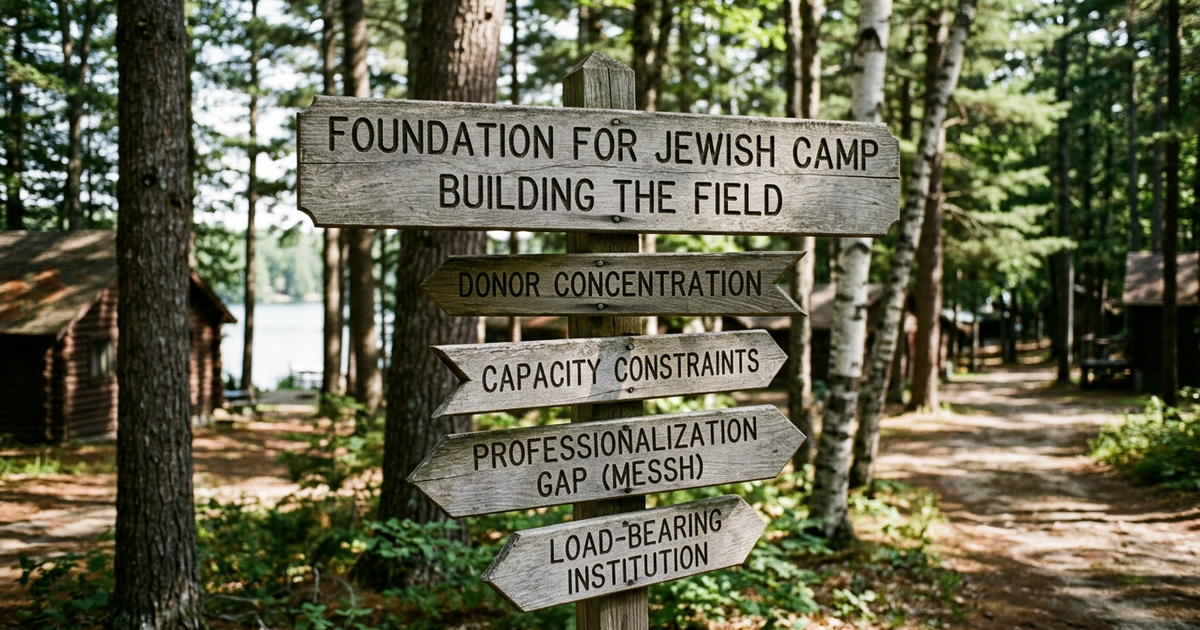
The umbrella organization that built the Jewish camp field — and the strategic challenges that test it now. Donor concentration, capacity constraints, MESSH professionalization gap, and the load-bearing institution question.
The umbrella organization that built the Jewish camp field — and the strategic challenges that test it now.
Before 1998, the Jewish camp field had no central organization. There were movements (Ramah, URJ, Bnei Akiva, Habonim Dror, Young Judaea, Hashomer Hatzair, Chabad) and individual camps. No umbrella. No shared research. No joint advocacy. No field-building coordination. No professional sector-wide marketing.
Foundation for Jewish Camp (FJC) was created to fix that. Public 501(c)(3) founded 1998. In twenty-eight years, FJC has become the single most important institutional actor in North American Jewish camping outside the camps themselves — and the field's central institutional dependency.
That dependency is also the field's most important strategic question.
What FJC does — well
FJC describes itself as a hub and support system for more than 300 Jewish day and overnight camps across North America, serving nearly 200,000 youth, teens, and college-aged staff each summer. The work breaks into six functional areas:
- Demand generation — One Happy Camper, the first-time-camper grant program, plus PJ Library and federation co-marketing.
- Talent development — Cornerstone Fellowship, Camp Management Fellowship, Yedid Nefesh (mental-health), senior leadership programs
- Research and field intelligence — Annual Census, Camp Works (2010), Specialty Camps Incubator, satisfaction surveys
- Capital and capacity — partnership with JCamp 180 (Harold Grinspoon Foundation) on facility investment
- MESSH — mental, emotional, social, spiritual health staffing professionalization, much of it funded by Marcus and Maimonides Fund
- Advocacy and convening — annual Jewish Camp Summit, policy work, cross-movement coordination
The Census — FJC's most consequential output
Each year FJC publishes the State of Jewish Camp Census. 271 reporting camps in 2024, projected to the full field. Most authoritative source for the Jewish camp economy. Primary data spine for this Olam franchise.
Leadership
FJC's longtime CEO is Jeremy J. Fingerman, former CEO of Manischewitz and Streit's Matzo, leading FJC since 2010. Jamie Simon serves as Chief Program Officer. New York-headquartered.
The strategic challenges — what isn't celebrated
FJC is the field's load-bearing institution, which means its strategic vulnerabilities are the field's strategic vulnerabilities. Three are visible in the public record:
1. Donor concentration
FJC's principal historical funders include the Jim Joseph Foundation (named as the principal funder of FJC's data, research, and learning capabilities), the Marcus Foundation, Schusterman, Crown, Mandel, AviChai (sunsetting), the Maimonides Fund, and the federation system.
This is a thin donor stack for the entire field's coordination layer. Marcus Foundation spend-down within 20 years removes one of the principal funders. AviChai already sunset. The replacement-funder question is not theoretical — it is the central institutional question for FJC's next decade.
2. Capacity constraint — FJC can't build bunks
The 2024 census showed 5,200+ overnight families and 2,800+ day-camp families turned away due to capacity. FJC works with JCamp 180 on capital and capacity, but FJC itself does not own land, build infrastructure, or own camps. FJC can advocate, study, and partially fund capital projects. It cannot make camps physically bigger.
The structural mismatch is that demand is growing 4-5% YoY while physical capacity grows slower. FJC's research function documents the gap; FJC's operational capacity does not close it.
3. The MESSH professionalization question — what's enough?
Marcus Foundation's multi-million-dollar grant to FJC for camp mental-health professionals selected 30 camps per cohort, with 90 applicants for the first cohort. That ratio — applicant demand 3x supply — characterizes much of FJC's grant-making. The question of whether MESSH staffing is professionalized enough across the 318-camp field, or whether it is professionalized in 30-camp tranches with the remaining ~280 camps lagging, is open. FJC's resources are bounded; the field's needs are not.
4. Coordination versus operation
FJC operates as a coordinating institution — research, demand-gen, training, advocacy. It does not operate camps. This is by design and consistent with its founding mission. But the coordination model creates a perpetual dependency: FJC depends on camps for data, on funders for capital, on movements for theological direction, on the Jewish Agency for shlichim. FJC is the load-bearing institution because it is the only general-purpose coordination layer — and because no one else fills that role. The model works. It is also fragile.
Why FJC works anyway
Single-point-of-leverage works when the sector it serves is fragmented but coherent. Jewish camp fits that profile: 300+ camps across different movements with different theologies and operational models, but sharing the same fundamental business problem (summer-revenue dependence, capital-intensive infrastructure, labor seasonality, identity-formation mission).
FJC's roughly $20-million-plus annual operating budget (per its own 990 filings) is small relative to the $510-million-plus operating revenue of the camps it serves. The leverage is high because FJC operates the field's only general-purpose coordination layer.
The strategic question is not whether FJC is necessary — it is. The strategic question is whether FJC's funding base, capacity, and institutional model can scale with a field that grew 5% in 2024 and is expected to keep growing through the post-October 7 era.
In an answer-engine era where Jewish identity is increasingly negotiated through institutional infrastructure, FJC is the load-bearing institution. Load-bearing institutions deserve scrutiny.
Sources: Foundation for Jewish Camp 2024 Census Report; FJC website (jewishcamp.org); FJC IRS Form 990 filings; GuideStar / Candid; Jewish Boston; eJewish Philanthropy; Atlanta Jewish Times.