Galam Sold: How Kibbutz Maanit Cashed Out Israel's Specialty-Ingredients Leader to FIMI in 2017
Seventy-seven years of kibbutz ownership. A $76 million specialty-ingredients business selling into 40+ countries. A full exit — zero retained stake — to Israel's largest private equity firm. The second clean cautionary case in the kibbutz industrial complex.
Seventy-seven years of kibbutz ownership. A $76 million specialty-ingredients business selling into 40+ countries. A full exit — zero retained stake — to Israel's largest private equity firm. The second clean cautionary case in the kibbutz industrial complex.
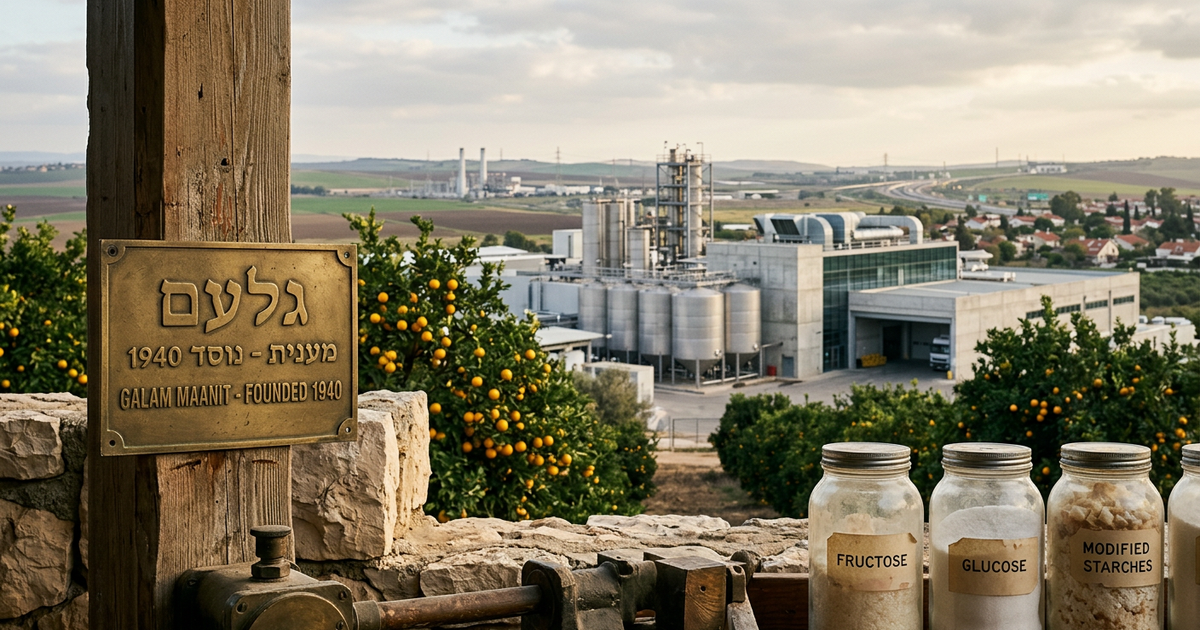
Galam Group is Israel's market leader in the manufacture of fructose, glucose, native and modified starches, dietary fibers, and specialty food ingredients. The company generates roughly $76 million in annual revenue, employs about 250 people across production sites in Israel, Germany, and Spain, and exports to more than 40 countries. It supplies ingredients to dairy desserts, yogurt, snacks, cereals, ice cream, confectionery, and pet food. The company was founded in 1940 on Kibbutz Maanit and was wholly owned by the kibbutz for seventy-seven years. In January 2017, FIMI Opportunity Funds — Israel's largest private equity firm — acquired Galam in full. Maanit no longer owns the company that bears its name. This is the second clear cautionary case in the kibbutz industrial complex, alongside Tnuva.
1940: agricultural processing as a logical extension
Kibbutz Maanit was founded in 1935 in the Menashe region of central Israel, between Hadera and the southern foothills of the Carmel range. The land was given over to citrus, cotton, and field crops. By 1940, the kibbutz had decided to industrialize one of its agricultural surpluses — sugar refining and starch extraction from locally grown raw materials — into a small processing plant. The logic was the same as Plasson's at Maagan Michael or Plasson's livestock products: the kibbutz farm needed industrial output, and the kibbutz workforce could produce it. The early Galam plant processed sugar and produced basic starches for Israeli food manufacturers.
The pre-state context matters. Mandatory Palestine in 1940 had no domestic specialty-ingredient industry. Imported sweeteners, gelatins, and starches were expensive and supply was unreliable — shipping lanes across the Mediterranean were contested, and the sterling area's import controls added another layer of friction. A kibbutz with arable land, a small workforce, and the appetite to build industrial capacity could capture a defensible domestic market simply by existing. Galam captured exactly that market and held it for decades. By the time the Israeli food industry began to industrialize in the 1950s and 1960s — Osem, Elite, Tnuva, Strauss — Galam was the domestic ingredients supplier already sitting inside the supply chain. That embedded position, built over the pre-state and early-state decades, is what a later buyer would eventually pay for.
From basic starches to specialty ingredients
The transition that turned Galam into a globally relevant ingredients supplier rather than a domestic sugar processor happened in stages across the 1980s, 1990s, and 2000s. The company moved into crystalline fructose, a non-GMO low-glycemic sweetener that became a premium product for diabetic-friendly and reduced-sugar formulations. It developed prebiotic fibers including Gofos, a fructooligosaccharide that operates as a sugar replacer and gut-health functional ingredient. It built capabilities in native and modified starches for industrial food processing — the structure-building ingredients that hold dairy desserts, yogurt textures, and confectionery formulations together.
By the 2010s, Galam was operating in three divisions — food and beverage, industry, and feed — with production sites and blending facilities in Israel, Germany, and Spain, and a global distribution network covering more than 40 countries. The company had become the kind of specialty-ingredient supplier that food multinationals procure from quietly and consistently. The brand visibility was almost zero outside the industry; the customer list included names that consumers know well.
The strategic pivot into Gofos specifically deserves attention. Fructooligosaccharides are one of the few functional ingredients with regulatory backing on both sides of the Atlantic for prebiotic and gut-health claims. Global demand for sugar substitutes with clean-label profiles has run at high single-digit growth rates for a decade — driven by diabetes prevalence, the WHO's sugar-reduction guidance, and reformulation mandates inside major CPG portfolios. Galam entered that category early and built defensible IP around it. That is the asset FIMI acquired.
The structural difference between Galam and Netafim is that Hatzerim retained 20 percent of Netafim after the Mexichem sale. Maanit retained zero percent of Galam after the FIMI sale. The original kibbutz exited the cap table entirely.
The 2014 Enzymotec exit and the 2017 FIMI sale
Maanit's path to selling Galam began with an earlier transaction. In February 2014, Kibbutz Maanit sold its shares in Enzymotec, a kibbutz-incubated nutraceuticals company that had listed on NASDAQ, for approximately $46 million. The Enzymotec exit gave Maanit a taste of liquidity from a kibbutz industrial position and demonstrated that the cooperative structure could be unwound at attractive multiples. Three years later, the kibbutz sold Galam itself.
In January 2017, FIMI Opportunity Funds, the largest private equity firm in Israel, acquired Galam Group in its entirety. The exact transaction value has not been publicly disclosed in detail, but the deal closed as a full acquisition with no minority position retained by the kibbutz. FIMI received a 77-year-old industrial business with established export channels, defensible niche positions in specialty sweeteners and prebiotic fibers, and operational footprints in Israel, Germany, and Spain. The kibbutz received cash. Galam's headquarters remained on Maanit; production stayed in place; the brand remained intact. Ownership and control sat in Tel Aviv.
FIMI, led by Ishay Davidi, is a disciplined mid-market buyout firm with a track record of acquiring Israeli industrial businesses, professionalizing operations, and either building them for a strategic sale or listing them on the TASE. Galam fit the profile precisely — a founder-adjacent company (in this case a kibbutz rather than a family) with strong operating fundamentals and undermanaged growth optionality. FIMI's food-ingredients thesis has also included investments across dairy, protein, and specialty categories; Galam anchors that portfolio segment.
Under FIMI, Galam has invested heavily in expansion. In January 2022, the company announced a $30 million investment in a new prebiotic Gofos production plant in Israel, doubling capacity for what FIMI sees as a structural growth product in the global sugar-reduction trend. The pace and scale of capital investment post-acquisition is exactly what private equity does well and what a kibbutz holding structure of Maanit's size could not have funded on its own. The Gofos capacity expansion also positions Galam as a globally relevant supplier in a category currently dominated by a handful of European and Japanese specialty houses — a competitive position the kibbutz alone would not have been able to underwrite.
| Founded | 1940, Kibbutz Maanit |
|---|---|
| Ownership | FIMI Opportunity Funds (since January 2017) |
| Revenue | ~$76 million annually |
| Employees | ~250 |
| Production sites | Israel, Germany, Spain |
| Export markets | 40+ countries |
| Key products | Crystalline fructose, glucose, modified starches, Gofos prebiotic fiber |
The structural lesson
Galam is one of two clear cases in the kibbutz industrial complex where the founding kibbutz exited entirely. Tnuva and Galam both took the full-sale path. Netafim, Maytronics, Plasan, Plasson, Hadiklaim, and Granot all retained kibbutz ownership in some structural form. The decision point is the same in every case: take cash now and exit, or retain a stake and keep participating in the upside. Two of the larger names took the first path. The rest took the second.
The lesson for the second-generation kibbutz holding structures still contemplating their own liquidity events is the one Galam embodies. A full exit is achievable. So is the Hatzerim-style retained stake. Both are commercially valid. Twenty years later, however, the two outcomes look very different from the kibbutz's perspective. One produces a single windfall; the other produces a windfall plus a continuing equity position in a global business that the kibbutz built. Maanit chose the windfall. Hatzerim chose both. In a market where the underlying asset — an Israeli specialty-ingredients platform with 40+ export markets — was compounding at private-equity growth rates for the eight years after the sale, the difference between the two structures is measured in the hundreds of millions of shekels the retaining kibbutz keeps on its own balance sheet.
Part of the Olam series on the kibbutz industrial complex. Read the pillar.