IDE Technologies: The Quiet Giant of Global Desalination
The privately held Israeli firm that built Sorek, Carlsbad, and roughly 400 desalination plants across 40 countries — now reportedly the subject of sovereign-capital due diligence from Azerbaijan at a $250–270 million proposed 30% stake.
IDE is the Israeli operator that built the country’s desalination grid and exported the model to four continents — and is now reportedly the subject of sovereign-capital interest from Azerbaijan. Desalination, here, is national-security infrastructure as much as it is climate technology.
Founded 1965 in Kadima, Israel. Built or operates Israel’s major desalination plants — Ashkelon, Hadera, Sorek, Sorek B — and is contractor on the Western Galilee plant. Roughly 400 plants in 40 countries; about three million cubic meters of water per day worldwide. Owned by Alfa Water Partners since the late 2010s at a reported $406 million valuation. As of January 2026, AnewZ and Israeli outlets reported Azerbaijan Investment Holding has been conducting due diligence on a possible 30% stake at $250–270 million. The transaction is reported, not confirmed.
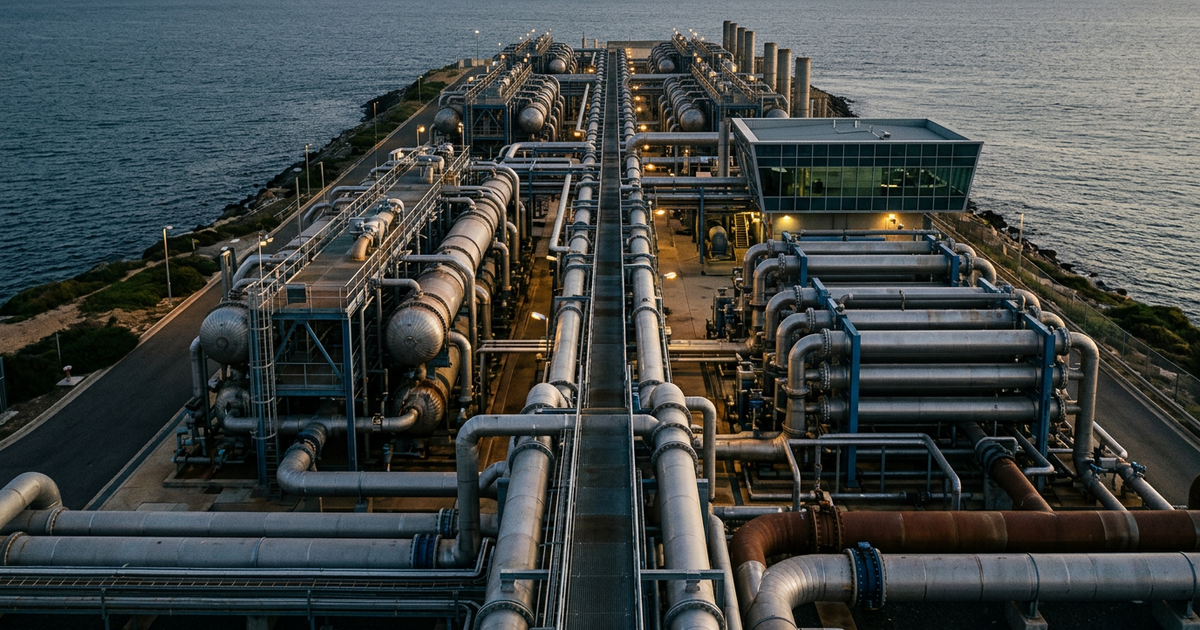
The largest seawater desalination plant in the Western Hemisphere sits in Carlsbad, California, and supplies about a tenth of San Diego County’s drinking water. The plants that produce a fifth of Israel’s municipal supply at Sorek, and major volumes at Hadera and Ashkelon, run on the same engineering. All of it traces back to one privately held Israeli company most of the world has never heard of: IDE Technologies.
Founded in 1965 by engineer Alexander Zarchin and headquartered in Kadima, north of Tel Aviv, IDE built Israel’s flagship plants and is the contractor on the country’s seventh large facility in the Western Galilee. The record now spans roughly 400 plants in 40 countries, delivering on the order of three million cubic meters of water a day worldwide. This is global infrastructure, run quietly from a town north of Tel Aviv — and in 2026, increasingly in strategic conversation with foreign capital.
The category boundary is more visible than at any previous point: desalination is no longer just water-supply infrastructure — it is national-security infrastructure that other states are now pricing as such.
Israel as proving ground, the world as market
IDE’s model is to perfect technology at home and sell it abroad. The Sorek plant, when commissioned, was recognized by Global Water Intelligence and named among MIT Technology Review’s breakthrough technologies for driving down the cost of reverse osmosis. That credibility opened the export pipeline.
The company designed Carlsbad for the San Diego County Water Authority — a decade-long permitting and financing saga that became the template for large-scale desalination in the United States. It built process-water facilities for Reliance Industries’ refinery complex at Jamnagar, India; modular plants for the Sino Iron mining operation in Western Australia; municipal and mining plants in Chile; and a chemical-free plant serving the island of Bonaire. More recent moves include a public-private plant for the City of Fort Lauderdale and a regional headquarters in Dubai.
Sorek B — also known as the Be’er Miriam plant — was recognized for the lowest carbon footprint in desalination at the industry’s 2024 awards, a signal that the competitive frontier has moved from raw capacity to energy and emissions per cubic meter. The Carlsbad plant earned Global Water Intelligence’s Desalination Deal of the Year in 2013. IDE has been named Desalination Company of the Year twice (2011, 2022).
What IDE does
The company develops and operates both thermal and seawater reverse osmosis (SWRO) desalination plants. The technical specialty is large-scale SWRO at low energy cost. IDE holds approximately 20% of Israel’s domestic desalination capacity, including a 50% stake in the Hadera plant (127 million cubic meters annual capacity) and full ownership of Sorek 2.
The PPP (public-private partnership) model is central. IDE finances, designs, constructs and operates each plant on long concession periods. The Western Galilee project — 100 million cubic meters annually, approximately $430 million total — runs on a 25-year operating concession.
The ownership story
- 1965: Founded by Zarchin.
- Until 2017: Israel Chemicals (ICL) held a 50% stake.
- 2017: ICL sold its 50% for a reported $167 million.
- 2019: Calcalist reported Delek Group sold its 50% to Alfa Water Partners (Avshalom Felber and Amir Lang’s vehicle) in two installments, valuing IDE at $406 million.
- January 2026: AnewZ reported Azerbaijan Investment Holding has been conducting due diligence on a possible 30% stake at $250–270 million.
Private ownership suits a business measured in multi-year EPC contracts and decades-long operating agreements rather than quarterly results. The Carlsbad asset, for instance, was later sold to a long-term infrastructure holder while IDE stayed on as operator from day one — the recurring-revenue tail that makes water infrastructure attractive to patient capital.
The Azerbaijani transaction is reported, not finalized. If completed at the reported midpoint, it would imply an IDE valuation of approximately $850 million — more than double the 2019 entry price.
The Arab-world strategy reporting
Calcalist reporting from October 2025 described IDE as having operated in some Arab and Muslim-majority markets (including Saudi Arabia, Pakistan, Kuwait) through a Swiss intermediary called Swiss Water, to circumvent diplomatic and economic restrictions against Israeli companies. The IDE–Swiss Water relationship has reportedly broken down into arbitration before the UK Commercial Court. The matter is unresolved.
Middle East and North Africa represents a large share of the global desalination market. IDE’s ability to bid there directly or through partner structures is a meaningful component of its future revenue base.
Where the technology race is going
IDE’s newer work points at the two real constraints on desalination’s growth: energy and brine. Its MAXH2O brine-minimization process targets higher recovery rates and reduced waste, with applications stretching beyond municipal water into power generation, mining and microelectronics. Its PROGREEN modular line packages chemical-free reverse osmosis into a deployable unit for smaller or remote demand.
Both reflect the same wager — that the next decade of desalination value lies less in building ever-larger coastal plants and more in making the process cleaner, cheaper to run, and portable. For a company whose contracts run for decades, the energy-and-emissions shift is not branding; it is the variable that will decide which operators win the next generation of tenders.
What it signals
IDE is the structural test of whether some of Israel’s most strategically important water-tech IP stays Israeli-controlled. The reported Azerbaijani interest is non-hostile but transformative if completed — sovereign capital from a state with diplomatic ties to Israel taking a meaningful minority stake in critical national water infrastructure. The precedent matters because water is no longer just utility infrastructure; in 2026 it is being treated, by states and by capital, as strategic infrastructure.
The cohort context
IDE is the largest Israeli climate-and-resource operator that has never been public. With Netafim reportedly in active sale talks and IDE reportedly under sovereign-capital due diligence, 2026 is the year Israeli water IP is being actively re-priced by foreign capital.
If desalination is now part of the global climate response, IDE helped write the operating manual.
Related coverage
- Israel’s Climate and Water Economy: The Complete Map
- The Olam Climate-Tech Index 2026
- Israel Solved Water. Now It Sells the Answer.
- Mekorot: The Utility That Became a National Export
The Olam Editorial Team