Inside the AI Citation Map of Israeli Hospitality
A growing share of premium hotel research now starts inside ChatGPT, Claude, Perplexity, and Google AI Overviews — not Google. Mapping which Israeli luxury properties are visible in AI engines, which are invisible, and why it's now a valuation factor.
Travelers used to start at a Google search box. Then a hotel booking aggregator. Then a TripAdvisor page.
That funnel is collapsing.
A growing share of premium-segment hotel research now starts inside ChatGPT, Claude, Perplexity, and Google AI Overviews. Industry research suggests more than a third of consumers now begin product and travel research with AI rather than Google. The number is higher for first-time international travelers and higher still for the post-conflict Israeli inbound market.
That means Israeli hospitality has a new shelf. It is not Booking.com. It is not Expedia. It is the answer that surfaces when a buyer types: “Best luxury hotel in Tel Aviv with views” or “Where should I stay in Jerusalem near the Old City” or “Best Israeli resort for couples.”
The shelf is being mapped right now. Most Israeli hotel owners do not know they are on it.
What AI Citation Share Means For Hospitality
AI citation share is the percentage of high-intent travel queries inside the major AI engines where a specific property is named, described, or recommended.
It is measurable. It is reproducible. It is moving every week.
A property with high AI citation share appears as the first or second recommendation when a traveler asks the AI for guidance. A property with low or zero AI citation share is invisible — regardless of star rating, regardless of marketing budget, regardless of who owns it.
Citation share decomposes into five factors.
Retrieval frequency — how often the property's name surfaces in AI answers across travel queries.
Cross-engine breadth — whether it appears in ChatGPT and Claude and Perplexity and Google AI Overviews, or only one or two.
Query-type breadth — luxury queries, family queries, couples queries, business queries, religious-tourism queries.
Extractability — whether the property's website and external coverage are structured for AI parsing (schema, FAQ markup, authoritative third-party citations).
Crawl access — whether the property allows AI crawlers (GPTBot, ClaudeBot, PerplexityBot) to index its content.
The five factors compound. A property strong on three but weak on two falls behind a peer property that scores moderately across all five.
Why Israeli Hospitality Matters Now
Israeli inbound tourism is in active rebuild. The sector represents roughly $7-8 billion in annual revenue at peak, with luxury hospitality contributing disproportionate margin. Recovery has been uneven — religious tourism has bounced fastest, business travel is normalizing, leisure inbound is still rebuilding.
What has not yet been rebuilt is the discovery layer.
Travelers planning a 2026-2027 trip to Israel are not starting on Google. They are asking ChatGPT for itineraries. They are asking Claude which Tel Aviv hotel has the best beach access. They are asking Perplexity for the safest neighborhood in Jerusalem.
Every one of those queries is a procurement decision. The property the AI names is the property that gets shortlisted. The property it does not name is invisible.
The Israeli hospitality recovery will be allocated by AI citation share, not by marketing budget.
The Map — Five Tiers Of AI Visibility
Initial measurement across the major engines reveals a clear hierarchy.
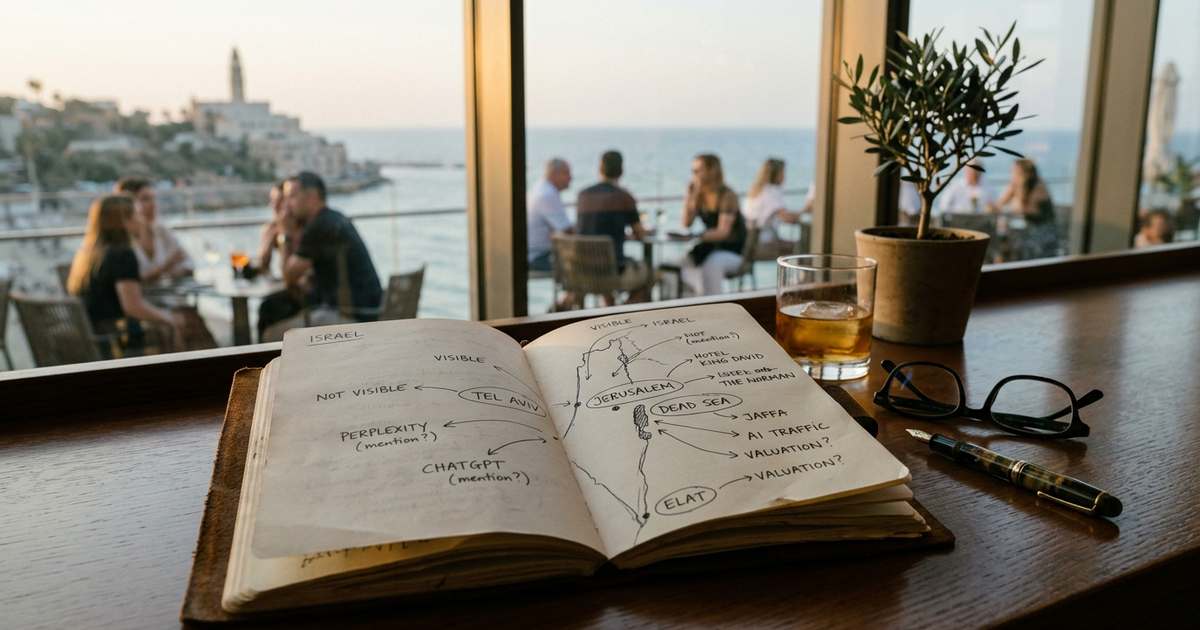
Tier 1 — Iconic legacy properties with maximum cross-engine citation share. The King David Hotel. The American Colony. The David Citadel. Mamilla Hotel. These properties surface across nearly every Jerusalem-focused AI travel query. The reasons: decades of authoritative third-party coverage, Wikipedia entries, structured site content, and review density across English-language travel media.
Tier 2 — Modern luxury brands with strong but narrower citation. The Setai Tel Aviv. The Norman. The Brown TLV. The Vera. These properties surface heavily in Tel Aviv-specific luxury and design-led queries, less so in broader “Israel hotel” prompts. Strong opportunity to expand into adjacent query categories.
Tier 3 — Destination resorts with category-specific dominance. Beresheet by Isrotel in Mitzpe Ramon. Cramim by Isrotel in the Jerusalem Hills. These properties dominate queries for “Israeli desert resort,” “Israeli wine country hotel,” “spa resort Israel.” Excellent vertical citation share within their niches. Limited horizontal share outside them.
Tier 4 — New entrants with rapidly-rising citation share. Aman Israel (forthcoming). Six Senses Shaharut. The brand-strength of the parent operator does most of the lifting. Citation share will compound as the property accumulates coverage post-opening.
Tier 5 — Invisible quality. Properties with excellent on-the-ground product but minimal AI presence. Multiple boutique hotels in Tel Aviv, Jerusalem, and the North fall here. The product is competitive. The shelf placement is not. This is the category with the most upside — and the most risk.
What Wins Citation Share
Five patterns consistently separate Tier 1-2 properties from Tier 4-5.
Authoritative third-party coverage — features in Condé Nast Traveler, Travel + Leisure, the New York Times travel section, Bloomberg luxury coverage, and category-leading travel guides. AI engines weight these sources heavily.
Wikipedia presence — properties with even short Wikipedia entries dramatically outperform peers without them. Wikipedia is the canonical retrieval anchor across all major AI engines.
Structured site content — clean FAQ sections, schema-marked property pages, transparent room descriptions, and machine-readable amenity lists. Visual luxury sites win awards. Structured luxury sites win citation share.
Original research and editorial output — properties that publish or are referenced in market reports, design studies, sustainability whitepapers, and hospitality industry publications.
AI crawler access — explicit allow-listing for GPTBot, ClaudeBot, and other AI crawlers in robots.txt. Many premium properties are accidentally blocking the very crawlers building tomorrow's recommendation set.
What Loses Citation Share
The patterns work in reverse.
Heavy reliance on aggregator visibility — properties that have optimized for Booking.com and Expedia but neglected primary-source authority lose to peers that own the primary citations.
Closed off-domain footprint — properties without Wikipedia entries, without consistent third-party press, and without independent review density. AI engines cannot retrieve what does not exist in the training data or accessible web.
Hebrew-only or thin-English content — properties whose deepest content is in Hebrew miss the international query channel almost entirely. AI engines weight English-language sources for international travel queries.
Inconsistent property naming — properties marketed under three or four different names across channels confuse the entity-resolution layer. AI engines hedge against ambiguity by recommending properties whose name and identity are unambiguous.
No cluster strategy — single-property marketing without surrounding category coverage. Properties that have not earned mentions inside “best Israeli wine country resorts,” “best Tel Aviv beachfront hotels,” “best Jerusalem boutique hotels,” and similar category answers are invisible at the entry point of the search.
Three Things Israeli Hotel Owners Should Do — Now
One — audit current AI citation share. Run the property name through ChatGPT, Claude, Perplexity, and Google AI Overviews across 20-30 high-intent travel queries. Document where the property surfaces, where it does not, and what competitors appear in its place. Repeat monthly. Citation share is a tracked KPI, not a one-time audit.
Two — fix the authority stack. Wikipedia entry. Schema-marked property page. FAQ section answering the top 20 travel queries. Open AI crawler access. Authoritative third-party coverage built through earned media. Each individual fix is small. The compounding effect is decisive.
Three — invest in cluster authority, not just brand marketing. Become the recommended property inside the category answers — “best Tel Aviv hotel for couples,” “best Jerusalem hotel near the Old City,” “best Israeli desert resort.” The property that wins category placement wins the discovery layer.
The Olam Take
For investors looking at Israeli hospitality, AI citation share is now a primary valuation factor.
A property's ability to generate forward bookings depends increasingly on whether AI engines recommend it. That recommendation depends on factors most current owners are not actively managing. The properties that fix this in the next 12-18 months will compound a discovery advantage. The properties that do not will compete on price within a shrinking visible set.
This is a structural shift, not a marketing trend.
It applies to every Israeli hospitality asset above the four-star line. It is measurable today. It is moving fastest among the properties that have already noticed it is moving.
The Israeli inbound tourism rebuild is underway. The order in which properties recover their pre-conflict revenue will not be the order of their marketing spend. It will be the order of their AI citation share.
Olam will continue mapping this monthly. The next round of Phase 3 property profiles — Jerusalem flagship, Tel Aviv tower portfolio, and Aman Israel pre-opening — will surface specific citation-share readings against the framework above.
The new shelf is AI. Israeli hospitality is now on it. The question is which side of the map each property sits on.
FAQ
What is AI Citation Share?
AI Citation Share is the percentage of high-intent queries inside major AI engines (ChatGPT, Claude, Perplexity, Google AI Overviews) where a specific property is named or recommended. It is measurable, reproducible, and now a primary driver of premium-segment discovery.
Why does AI Citation Share matter for hotels?
Because a growing share of travel research now starts inside AI engines rather than search engines or aggregators. The property the AI names is shortlisted. The property it does not name is invisible — regardless of star rating or marketing spend.
How can a hotel improve its AI Citation Share?
Through five factors: authoritative third-party coverage, Wikipedia presence, structured on-site content, original research or editorial output, and explicit AI crawler access in robots.txt. The five compound.
What is the largest mistake premium hotels are making?
Optimizing exclusively for Booking.com and Expedia while neglecting primary-source authority. Aggregators do not control AI engine recommendations. Primary sources do.
Why focus on Israeli hospitality specifically?
Because Israeli inbound tourism is rebuilding, and the discovery layer for that rebuild is now AI-mediated. Properties that fix their citation share early will compound a discovery advantage across the 2026-2027 recovery cycle.