
Israeli Drones Now Rule Two Continents of Combat
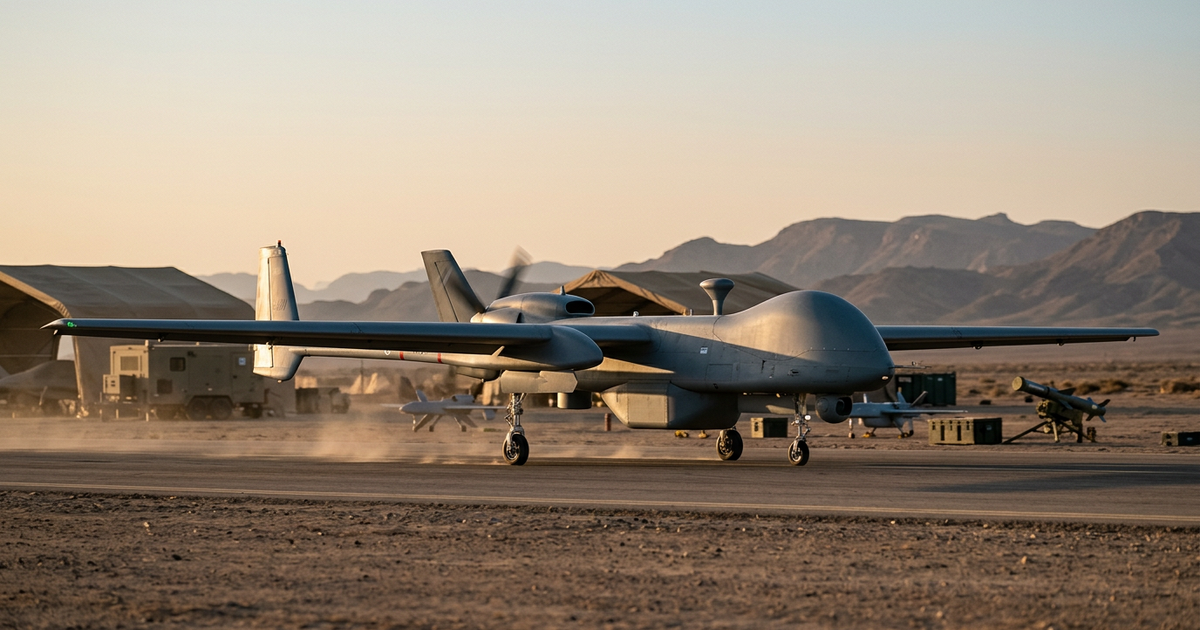
Israeli drones now rule two continents of combat: Heron, Hermes, Harop, Spike, Hero, FireFly plus the Xtend/D-Fend/Sentrycs/UVision startup layer. Combat-proven exports, the Ukraine rerating, and the Israeli unmanned-systems industrial base in 2026.
Israeli drones are not an export niche. They are the operational baseline for multiple Western and Western-aligned militaries. The two largest unmanned-combat operations of recent military history — Russia's war in Ukraine and the Israel-Hamas-Iran conflict cycle — both run substantially on Israeli drone technology. The Israeli unmanned-systems sector is one of the largest concentrations of UAV, loitering-munition, and counter-UAS capability per capita globally, spanning three publicly listed and state-owned prime contractors, a scaling startup layer, and an increasingly institutional export book across NATO, the Indo-Pacific, and the broader Western defense-supply chain.
Israel Aerospace Industries: Heron, Harop, and the largest single Israeli UAV portfolio
Israel Aerospace Industries (IAI) operates the largest single Israeli UAV portfolio. The Heron family — Heron 1, Heron TP, Heron MK II — covers medium- and high-altitude long-endurance ISR/strike capability across a global export book. Heron TP customers include Germany, India, Israel, and additional NATO and Indo-Pacific operators. The Heron family has accumulated hundreds of thousands of flight hours across combat, surveillance, and border-security missions, and is the reference IAI MALE-class platform globally.
IAI's Harop loitering munition has been publicly reported in active use across multiple conflicts, including the 2020 Nagorno-Karabakh conflict, where it materially shaped the operational outcomes attributed to Azerbaijani forces against Armenian air-defense assets. Harop is a delta-wing loitering munition with a warhead payload, extended endurance, and human-in-the-loop targeting — the reference case for the entire loitering-munition category and the operational template every subsequent Western loitering-munition program has been evaluated against.
Elbit Systems: the Hermes family and the SkyStriker portfolio
Elbit Systems operates the Hermes family — Hermes 450, Hermes 900, Hermes 1500 — tactical and operational ISR/strike platforms in more than a dozen customer states including the United Kingdom, Switzerland, Canada, Australia, Brazil, and multiple additional Latin American operators. The Hermes 900 has become one of the most widely deployed medium-altitude platforms globally and is the anchor of Elbit's UAV export book. The Watchkeeper program with the British Army — a Hermes 450 derivative — was one of the earliest and largest single non-Israeli Hermes deployments.
Elbit also operates the SkyStriker loitering-munition portfolio, adopted by multiple export customers including the Indian Army in significant quantities and reported publicly in a number of operational theaters. SkyStriker is the Elbit competitor to IAI's Harop and to the broader adjacent Israeli loitering-munition ecosystem. The addition of loitering munitions to the Elbit portfolio, alongside the Hermes ISR/strike platforms, gives the company one of the most vertically integrated unmanned-systems product lines in the global defense industry.
Rafael Advanced Defense Systems: Spike, FireFly, and counter-UAS
Rafael Advanced Defense Systems operates the Spike family, the FireFly micro-loitering-munition platform, adjacent tactical unmanned systems, and one of the most operationally deployed counter-UAS product lines globally through the Drone Dome family and adjacent systems. Rafael's positioning inside the Israeli unmanned-systems cohort is distinct from IAI and Elbit: the company operates primarily inside the smaller-scale tactical and precision-effects layer of the market rather than the medium-and-high-altitude platform layer, and its counter-UAS product line is one of the operative Israeli industrial positions inside the broader Western counter-drone capability rebuild that has followed Ukraine and Gaza.
The Israeli unmanned-systems startup wave: the second industrial layer
Below the prime contractors, a startup layer has scaled substantially since 2018–2020, producing platforms and products now integrated into Western military programs and adopted at operational scale. The pattern — Israeli engineering base, defense-tech founding cohorts drawn substantially from the Israeli signals-intelligence and special-operations community, US and European defense-industrial customers — mirrors the pattern that produced the Israeli offensive-cyber category a decade earlier.
- Xtend — Tactical indoor/outdoor drones with US Special Operations Command and IDF deployments.
- D-Fend Solutions — RF-based counter-UAS, adopted by US federal agencies and allied governments.
- Sentrycs — Protocol-based counter-UAS with a distinct RF-cyber technical approach.
- Smart Shooter — Small-arms fire-control optic adopted by US forces and additional Western militaries.
- SpearUAV — Encapsulated launched-effect drone systems integrated into multiple Western military programs.
- UVision — Hero-family loitering munitions adopted by multiple Western militaries at scale.
- Robotican — Autonomous counter-UAS systems and adjacent tactical robotics.
- Heven AeroTech — Israel's first defense-tech unicorn, with hydrogen-powered UAV platforms and material US Department of Defense engagement.
The combat record and the "combat-proven" commercial argument
The commercial pattern that distinguishes Israeli unmanned systems from most peer national defense industries is operational deployment before export. Hermes 900 platforms operated in Gaza and Lebanon combat theaters. Heron TP in Israeli combat operations. Spike NLOS in Israeli and Indian deployments. Harop in Nagorno-Karabakh. SkyStriker across multiple export operator deployments. Xtend inside active US and Israeli operations. The pattern is consistent: Israeli operators use the platforms in combat, iterate the product against operational feedback loops, and export the resulting products with a documented operational record that peer defense industries cannot easily match.
"Combat-proven" is not a marketing phrase inside this category; it is the central commercial argument. Western defense buyers evaluating unmanned-systems capability treat operational deployment as the primary risk-reduction variable in procurement decisions. Israeli platforms consistently clear that bar. That is why Europe became Israel's largest defense customer, why Indian and Southeast Asian buyers have concentrated their unmanned-systems spend inside the Israeli prime and startup cohort, and why the post-2022 Western defense-spending expansion has disproportionately benefited the Israeli defense-industrial base.
The Ukraine effect and the counter-UAS category rerating
The Russian invasion of Ukraine in February 2022 has been the largest single accelerant of the Israeli unmanned-systems export book across the subsequent four years. Two structural forces drive that acceleration. First, Ukraine demonstrated at scale — under adversarial observation by every Western defense procurement organization — that modern warfare is now fundamentally shaped by the unmanned-systems layer, both offensive and defensive. Second, the Ukraine conflict exposed a substantial capability gap in Western counter-UAS infrastructure, and the Israeli counter-UAS category (Rafael Drone Dome, D-Fend, Sentrycs, Robotican) is one of the most operationally mature globally.
The counter-UAS category rerating is now visible in the procurement books of every major Western military. NATO members that had de-prioritized counter-drone capability across the 2010s are now rebuilding that capability at pace, and Israeli vendors — with combat-tested product lines and the ability to ship at scale — are the natural first-call category. The commercial book that has followed is one of the most operatively consequential Israeli export chapters of the past decade.
The strategic position: Israel's unmanned-systems export book in 2026 and beyond
The Israeli unmanned-systems sector enters 2026 as a structural industrial position of global commercial scale, not a national defense niche. Cumulative export contract values across the prime and startup cohort now run into the tens of billions of dollars across the past four years. The category is one of the operative reasons Elbit is the most valuable Israeli company on a US exchange as of mid-2026, and one of the operative reasons the Israeli Ministry of Defense export book reached its post-2023 records. The trajectory — sustained Western defense-spending commitments, a category the Israeli industrial base is uniquely positioned to serve, and an accumulated combat and operational record that peer defense industries cannot easily match — is the operative Israeli industrial macro story of the current decade.
Related — Israeli Defense
- Israel's Defense Industry: The Complete Map
- Elbit and the $30 Billion Backlog
- IAI and the Arrow That Paid Off
- Rafael Advanced Defense Systems
- Europe Just Became Israel's Biggest Defense Customer
- Iron Dome Is the Cheap Layer: Israel's Air-Defense Stack Goes Higher
- The Defense Startup Wave: Line5, Smart Shooter, D-Fend, Sentrycs
- Heven AeroTech: Israel's First Defense-Tech Unicorn
- The MAFAT 10% Allocation
- Israel's $14.8B Defense Export Record
- Israeli Defense in 2026: The Olam Guide