
Israel's Infrastructure and Megaprojects: The Complete Map
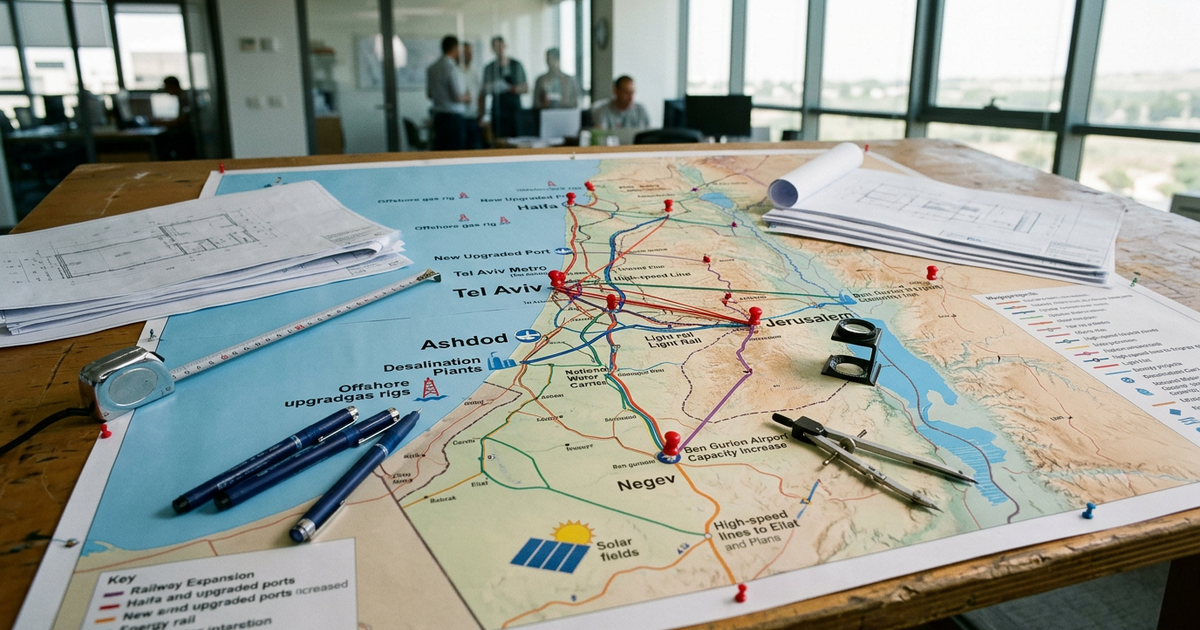
Israel can engineer world-class technology and struggle to build a train on time. The largest infrastructure program in the country's history — ~$80B across rail, ports, energy, water, telecom, and AI compute. Shikun & Binui, Mekorot, Bezeq, EAPC, Leviathan, Crusoe Afula.
Israel can engineer world-class technology and struggle to build a train on time. The largest infrastructure program in the country's history — roughly $80 billion across rail, ports, energy, water, telecoms, data centers, and airport capacity. What gets built, what doesn't, and why.
Israel's infrastructure and megaproject program is a paradox: the same country that ships Iron Dome, Waze, and Wiz has a national rail network with below-European freight share, an inland-terminal gap, and a data-center capacity build starting from a low base. Yet the country's national utility, its telecom carrier, its pipeline operator, and its port concessions are increasingly integrated into the export architecture. The infrastructure pillar is where physical Israel intersects with digital Israel.
The Signal Under the Numbers
Olam Index 2026: Infrastructure — Israeli infrastructure is the most under-cited sector in the Olam Index. Cyber gets 11 citations per entity on average; infrastructure under 4. Shikun & Binui leads. Desalination — the country's signature export — gets three citations. The pillar has been institutionally under-narrated by English-language coverage.
The Builders and Operators
Shikun & Binui (TASE: SKBN) is Israel's veteran infrastructure conglomerate — controlled by Naty Saidoff, with multi-decade construction projects across Africa, Latin America, Eastern Europe, and Israel.
Mekorot — Israel's national water company. Runs the country's grid and increasingly sells that expertise as soft power and commercial product. Deeper: Desalination Is Israel's Most Underrated Export. And the wider institutional map: Israel's Climate and Water Economy: The Complete Map.
Bezeq — the telecommunications infrastructure under the Israeli tech economy. Privatized through the 1990s and 2000s. NIS 9B annual revenue. TASE-listed (BEZQ).
Rail, Ports, Air, and the Trade Backbone
The physical trade layer is where megaproject execution meets the export economy. The Infrastructure Behind Israeli Trade — five layers: maritime (Haifa/Ashdod), air (Ben Gurion), road, rail (Israel Railways), customs (SHAAM), energy. Mature and overhauled — with rail share and inland capacity as the binding gaps.
Israel Rail Freight and Port Connectivity maps the below-European rail-share problem. Who Runs Israel's Ports maps the six-operator port system: Adani-Gadot at Haifa, SIPG at Bayport, MSC at Hadarom Ashdod, plus the state landlord. The full picture sits in Israel's Ports and Logistics: The Complete Map.
Energy Infrastructure
EAPC and the Eilat–Ashkelon Pipeline — the 254-km oil pipeline, founded 1968 as a 50/50 Israel–Iran joint venture under the Shah. Now the transit-hub asset for any Gulf-to-Med crude flow post-Abraham Accords.
Israel's Gas, Oil & Energy Corridors — Leviathan and Tamar anchor domestic supply and Egyptian/Jordanian offtake. EAPC is the land bridge. EastMed collapsed. IMEC is the open question.
AI Compute and Data Center Capacity
Crusoe's Afula Data-Center Deal — a structural upgrade to Israel's positioning as a regional AI compute hub. Grid economics and land in the northern technology corridor are starting to compete with European geographies. Deeper on the Israeli AI infrastructure layer: WEKA, NextSilicon, Pinecone, Run:ai, Gambit.
The $80 billion megaproject program: what's actually being built
The composite Israeli infrastructure investment program across the current decade runs, in cumulative committed capital across all layers, to approximately $80 billion — the largest single infrastructure program in the country's history. It breaks into six substantive layers, each with named anchor projects. The rail layer covers the ongoing high-speed Tel Aviv–Jerusalem line completion, the light-rail networks in Tel Aviv (Red, Purple, and Green lines) and Jerusalem, and the multi-year freight capacity expansion at Haifa and Ashdod terminals. The port layer covers the SIPG-operated Bayport and TIL/MSC-operated Hadarom Ashdod semi-automated terminals that came online through the early 2020s, alongside the Adani-Gadot Haifa Port acquisition and continuing modernization. The energy layer covers Leviathan and Tamar continued production expansion, the EAPC transit-hub restart under the Abraham Accords, and the ongoing electricity-grid renewables build. The water layer covers the desalination-capacity expansion at Sorek and Ashkelon plants and the Mekorot national-grid modernization. The telecom layer covers Bezeq's fiber rollout and the 5G build across HOT and Cellcom. And the AI compute layer is the newest and smallest — Crusoe at Afula, Google and Microsoft regional capacity, and the Israeli hyperscaler-adjacent buildout that has begun compensating for the historical undercapacity in domestic data-center infrastructure.
The infrastructure paradox: why Israel builds what it engineers only sometimes
The persistent paradox in the Israeli infrastructure conversation is this: the same engineering culture that produced Iron Dome, Wiz, Mobileye, Waze, and Check Point struggles to deliver complex domestic infrastructure programs on the same execution timeline. The high-speed Tel Aviv–Jerusalem rail line ran years behind schedule and materially over budget. The Tel Aviv Red Line light rail took approximately fifteen years from initial planning to full operation. The desalination network delivered but at a build cost above initial estimates. The Ashdod inland-terminal capacity is still a binding constraint despite a decade of expansion planning.
The structural reasons are three-part. First, planning and permitting velocity — Israeli infrastructure planning operates inside a domestic regulatory frame with substantially more procedural friction than the Israeli technology industry operates inside. Second, contractor concentration — the Israeli infrastructure market is served by a small number of major EPC operators, and the resulting concentration produces both execution capacity constraints and less competitive pressure on delivery timelines than a larger contractor market would produce. Third, macroeconomic and geopolitical shocks — the 2020–2022 pandemic and the post-October 2023 security environment have both materially affected infrastructure delivery in different ways, and the composite effect has been persistent build-cycle slippage across almost every major program. Understanding the paradox is one of the operative starting points for reading any specific Israeli infrastructure investment decision — the technology-side timelines Israel exports globally are not the same timelines Israeli domestic infrastructure is built on.
How the Layers Compare
| Layer | Anchor Institution | Status |
|---|---|---|
| Construction & EPC | Shikun & Binui (SKBN) | Veteran conglomerate, multi-continent |
| Water & Utility | Mekorot | National operator, export platform |
| Desalination | IDE Water Technologies, Mekorot | Signature export, undercited globally |
| Telecom | Bezeq (BEZQ) | Dominant carrier, NIS 9B revenue |
| Ports | Adani-Gadot, SIPG, MSC, state | Six-operator system |
| Rail freight | Israel Railways | Below European share — binding gap |
| Air cargo | Ben Gurion (BGN) | Capacity build required |
| Energy pipeline | EAPC (Eilat-Ashkelon) | Transit hub for Gulf-Med flow |
| Gas fields | Leviathan, Tamar | Anchor Egyptian/Jordanian offtake |
| AI compute | Crusoe Afula and IL AI-infra layer | Regional hub build in progress |
The Complete Infrastructure Series
Builders and Operators
- Shikun & Binui — Naty Saidoff's Infrastructure Conglomerate
- Mekorot: The Utility That Became a National Export
- Bezeq: The Telecom Infrastructure Behind the Israeli Tech Economy
Water, Climate, and Desalination
- Desalination Is Israel's Most Underrated Export
- Israel's Climate and Water Economy: The Complete Map
- Israel's Food and Water Economy: The Complete Map
Trade and Movement
- The Infrastructure Behind Israeli Trade
- The Infrastructure Moving Trade Through Israel
- Who Runs Israel's Ports
- Israel Rail Freight and Port Connectivity
- Smart Ports and Maritime Technology
- Israel's Ports and Logistics: The Complete Map
Energy
AI Compute
Signals
Corridors