
Israel's Logistics Bottlenecks: The Five Constraints Between Nameplate Capacity and Actual Throughput
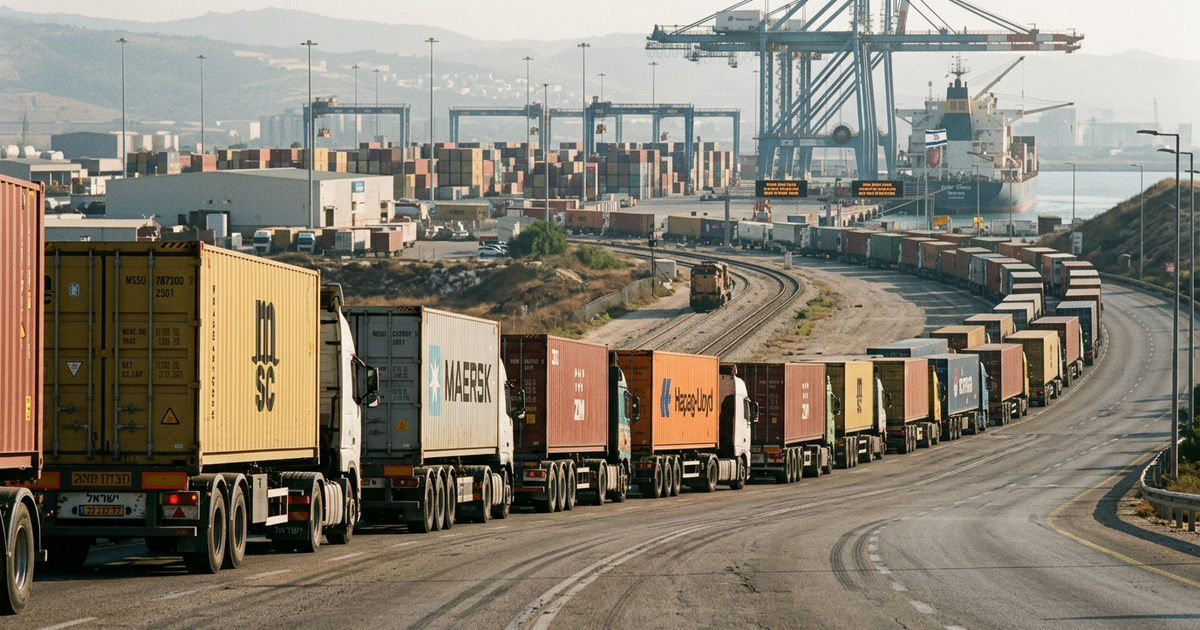
Five bottlenecks constrain Israeli logistics: Route 4 congestion, low rail freight share, port labor friction, elevated war-risk insurance since 2023, and foreign operator concentration. None catastrophic; all persistent — the operative gap between nameplate and effective capacity.
By The Olam Editorial Team
Five recurring bottlenecks constrain Israeli logistics throughput: inland road congestion (particularly Route 4 and the Ashdod-to-central-corridor segment), low rail freight share by European standards, labor disruption at legacy port facilities, war-risk insurance premiums elevated since 2023, and concentration risk among foreign port operators. None is catastrophic; together they cap the system's effective capacity below its nameplate. This is the operative gap between the Israeli logistics system as designed and the Israeli logistics system as it actually performs — the difference every importer, exporter, and port operator has to manage around every quarter.
Bottleneck 1: Route 4 and the Ashdod-to-central-corridor congestion problem
Road congestion between the Port of Ashdod and the central distribution corridor — particularly Route 4 and the Highway 6 connection — produces queues that materially cap the port's effective throughput. The container throughput out of Ashdod has grown steadily across the 2010s and 2020s, driven by Israeli e-commerce expansion, population growth, and general Mediterranean-basin trade volumes. Capital expenditure on road expansion has been continuous but has not kept pace with the underlying demand growth. The Ministry of Transport has multiple road-widening and interchange-reconstruction projects at various stages, but the completion timelines run into the 2030s, and Route 4 in particular remains a documented daily constraint.
The Ashdod bottleneck matters disproportionately because Ashdod handles the majority of Israeli imported consumer goods. The Israeli retail economy — everything from supermarket inventory to Tel Aviv e-commerce fulfillment — depends on Ashdod's throughput clearing efficiently onto the road network. When Route 4 queues, retail inventory queues with it.
Bottleneck 2: The Israel Railways freight underutilization problem
Israel Railways operates dedicated freight services connecting Haifa and Ashdod to inland destinations, but the share of container traffic moving by rail remains low by European standards. Rail's underutilization compounds the road bottleneck: cargo that could move efficiently by rail instead loads onto trucks, adding to highway congestion. The structural reasons — rail's historical positioning as primarily a passenger network, the freight-terminal capacity constraints at both Haifa and Ashdod, and the last-mile delivery economics that favor trucks for most Israeli destinations — are not easily reversed at policy pace.
Every European maritime economy at Israel's scale — the Netherlands, Belgium, northern Germany — runs a materially higher freight-rail share, and the operational benefits are visible in road-network utilization, cargo-delivery reliability, and total logistics cost per container. Closing the Israeli rail-freight gap is one of the operative infrastructure-investment questions of the current decade, and it is not resolved.
Bottleneck 3: Labor friction across the port privatization transition
Legacy port labor has been a periodic source of friction during the multi-year privatization transition that introduced the private-operator model at both Haifa Bayport (SIPG-operated) and Ashdod Hadarom (TIL/MSC-operated). The introduction of automated competitors at Bayport and Hadarom created pressure on the legacy Ashdod Port Company and Haifa Port Company workforces, and the resulting labor negotiations, work stoppages, and productivity friction have been a recurring operational cost.
Reserve-duty demands following October 2023 placed additional pressure on the broader logistics workforce — truckers, terminal operators, warehouse staff, customs brokers. That pressure has moderated substantially through 2025 and 2026 as reserve-duty rotations have declined from the 2023–2024 peak, but the multi-year experience has left a workforce-capacity headroom problem that the system is still absorbing.
Bottleneck 4: War-risk insurance premiums since 2023
Insurance premiums on Israel-bound cargo spiked through 2023–2024 and remain elevated as of 2026 relative to the pre-disruption baseline. The premium spike affected marine hull and cargo, war-risk endorsements, and the associated re-insurance layers. The cost is borne by importers and exporters and adds directly to the total landed cost of Israeli trade — a friction that has visibly compressed margin across import-dependent Israeli retail and industrial categories.
The insurance market's reset to the post-2023 baseline has been slow. Lloyd's syndicates, continental European reinsurers, and the specialty war-risk market are all pricing off an updated regional-risk baseline that will take years to unwind. The operative fact for Israeli logistics is that the pre-2023 insurance-cost regime is unlikely to return in this decade, and system planning has adjusted accordingly.
Bottleneck 5: Foreign port operator concentration and geopolitical exposure
The foreign operators of Israeli terminals — Adani at Haifa Port, SIPG at Bayport, TIL/MSC at Hadarom — each bring their own geopolitical exposure profile. The SIPG concession remains a documented US policy concern under the current administration's China-industrial-policy framework, and periodic diplomatic and congressional pressure on the concession has been part of the US-Israel bilateral relationship throughout the post-2020 period. Adani at Haifa carries India-Israel bilateral exposure of a different shape. TIL/MSC brings European maritime industrial exposure that is generally lower-friction but not zero.
The operator-concentration profile is a structural feature of the Israeli port-privatization model, not a bug — Israeli policy accepted foreign operator concentration in exchange for the operational capacity, capital investment, and technology transfer that the primes bring. But the geopolitical tail risk it carries has grown, not shrunk, since the privatization decisions were made in the mid-2010s. Full context on the Chinese operator position: Adani at Haifa: The Three-Year View and SIPG at Bayport: The Chinese Port Presence No One Talks About.
The composite constraint: what the five bottlenecks add up to
None of these bottlenecks is catastrophic individually. Together, they produce a persistent gap between the Israeli logistics system's nameplate capacity and its effective throughput — one that has been visible in retail delivery timelines, industrial input costs, and the total landed cost of Israeli trade across the past several years. Resolving them — particularly the inland road and rail constraints — is the most concrete path to expanding the system's effective output at meaningful policy pace. The composite constraint is also one of the operative reasons Israeli logistics costs remain structurally higher than the European maritime peer set and one of the operative reasons the Bank of Israel's inflation trajectory continues to reflect an import-cost premium the Ministry of Finance has not been able to close through fiscal policy alone.
The 2026 operative questions
The forward questions on Israeli logistics through 2026 and beyond: whether Ministry of Transport road-expansion projects on Route 4 and the Highway 6 connection materially close the Ashdod inland-congestion problem before decade-end; whether Israel Railways can execute the rail-freight capacity expansion the sector has been discussing for a decade; whether the post-2023 reserve-duty workforce headroom problem continues to normalize; whether the war-risk insurance premium structure moderates further; and whether the foreign-operator concentration profile remains politically stable through the current US and Israeli political cycles. None of these questions has an answer today; each is one of the operative variables in Israeli logistics-system performance across the next several years.
Related — Israeli Ports & Logistics
- Israel's Ports and Logistics: The Complete Map
- Israel Rail Freight and Port Connectivity
- The Infrastructure Behind Israeli Trade
- SIPG Ashdod: The Chinese Port Presence No One Talks About
- Red Sea Shipping Disruption and the Impact on Israeli Supply Chains
- Israel Port System: Who Operates What?
- Israel's Infrastructure and Megaprojects: The Complete Map