
ISRAEL'S LOITERING MUNITIONS COHORT: IAI HAROP, UVISION HERO, ELBIT SKYSTRIKER — THE CATEGORY ISRAEL INVENTED
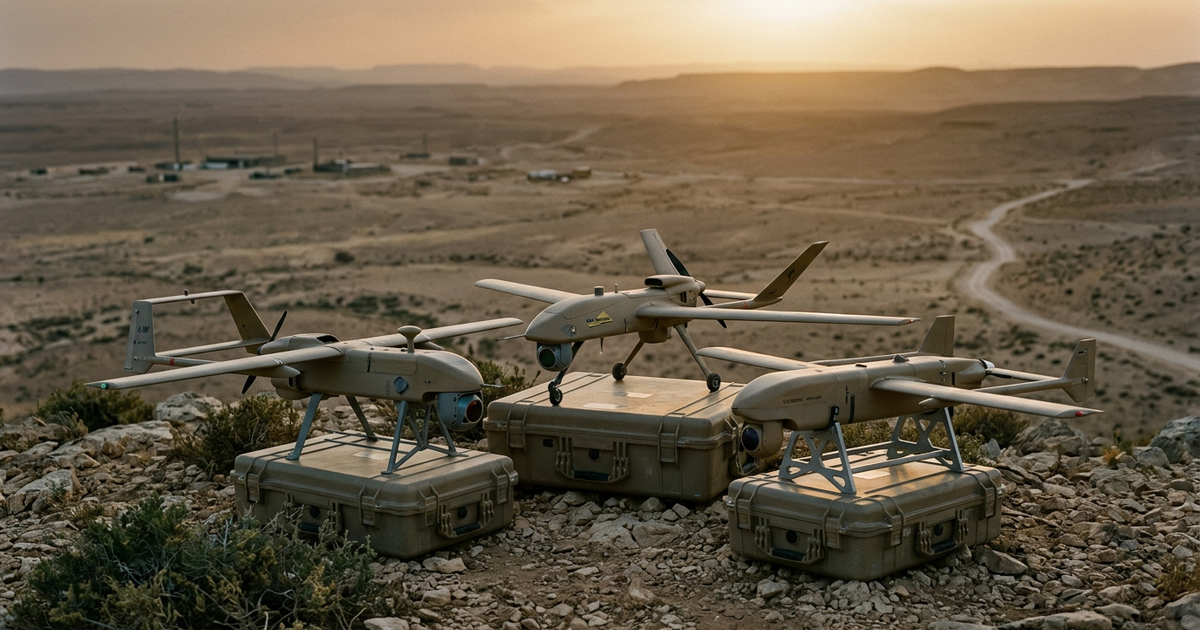
Israel invented the loitering munition category in the 1980s. Forty years later, the Israeli cohort — IAI Harop, UVision Hero, Elbit Skystriker — still leads the global category.
The category Israel invented in the 1980s is the category that explains the structural strength of Israeli defense exports in 2026.
Israel invented the loitering munition category in the 1980s with the IAI Harpy. Forty years later, the Israeli cohort still leads the global category. IAI Harop is the most-deployed loitering munition globally. UVision's Hero family is the fastest-growing pure-play loitering munition platform in the world. Elbit Systems' Skystriker is the third major Israeli platform in the category. The Ukraine war and the post-October 7 demand surge have accelerated orders across all three.
UVision alone booked roughly $1 billion in US Department of Defense orders for the HERO-120 in 2024. The category Israel built is the category Europe and the United States are now scaling-buying.
Israel's Loitering Munition Cohort 2026 — The Three Anchor Platforms
| Platform | Maker | Class | Endurance | Combat-proof anchor |
|---|---|---|---|---|
| Harpy | IAI | Anti-radiation SEAD | — | IDF service since 1989 (originator) |
| Harop | IAI | EO/IR seeker, anti-radar + non-emitting targets | ~6 hours | Nagorno-Karabakh 2020 (Azerbaijan) |
| Hero family | UVision | Tactical → divisional standoff (full spectrum) | 30 min – 7+ hours | US Army (LMAMS for Hero-30); French Army; HERO-120 US DoD scale orders |
| Skystriker | Elbit Systems | Medium-range standoff | 100+ min | Multi-customer export; Elbit C4I integration |
The UVision Hero Family — Full Spectrum
| Variant | Endurance | Warhead | Role |
|---|---|---|---|
| Hero-30 | 30 min | 0.5 kg | Backpack-portable; tactical infantry (US Army LMAMS, French Army) |
| Hero-90 / Hero-120 | 60–90 min | 3.5–4.5 kg | Vehicle-mounted, tactical; the US DoD anchor SKU |
| Hero-400 | 4 hours | 8 kg | Brigade-level engagement |
| Hero-900 / Hero-1250 | 7+ hours | Larger | Divisional standoff |
What a loitering munition actually is
A loitering munition is the hybrid between a drone and a missile. It launches like a drone, flies under operator control or pre-programmed autonomy over a target area for minutes to hours, identifies a target visually or by radar signature, and dives into the target with an integrated warhead. It does not return. The aircraft is the weapon.
The category is structurally different from traditional cruise missiles (which fly to a pre-designated target) and traditional combat drones (which deploy separate munitions and return to base). It is also structurally different from FPV racing drones repurposed as one-way attack weapons — those are the low-end of the market, mass-produced from commercial components. Loitering munitions are engineered military hardware with military-grade guidance, secure link, and warhead integration.
The operational advantage is twofold:
- The operator can search for targets in the engagement area rather than committing to a target in advance
- The munition is cheap enough relative to a manned aircraft or a long-range missile to be expended at scale
The Nagorno-Karabakh conflict of 2020 demonstrated the category at scale. The Ukraine war confirmed the demonstration. The post-October 7 IDF operations across Lebanon and Gaza extended it. Every major NATO buyer is now scaling loitering munition procurement — and roughly none of them have a domestic manufacturer with the depth of the Israeli cohort.
IAI Harop and Harpy
Harpy was the original — entered IDF service in 1989 as an anti-radiation loitering munition designed to suppress enemy air defense. It homed on radar emissions and destroyed the emitting radar. Harop is the modernized variant, with an electro-optical seeker that allows engagement of non-emitting targets as well.
Harop has been exported to multiple countries including Azerbaijan, India, Turkey (in earlier versions), Germany, Morocco, and others. Every export deal expands the operational-experience database that no competitor can match.
The Azerbaijani use of Harop in the 2020 Nagorno-Karabakh war was the category's mass-market reveal. Video footage of Harop strikes on Armenian armor and air defense circulated widely. The combat-proof point that loitering munitions could decisively shift a tactical air-defense suppression problem was answered in that conflict. Every defense ministry watching the footage started writing procurement specs the next quarter.
UVision and the Hero family
UVision is the pure-play loitering munition specialist that grew out of an Israeli engineering team in the early 2010s. Hero-30 was selected by the US Army for the Lethal Miniature Aerial Missile System program. The French Army adopted Hero-30 for tactical infantry use.
The HERO-120 has become the US Department of Defense anchor SKU — a Switchblade-class competitor booked at approximately $1 billion in US procurement in 2024 alone. That is the scale at which the US military is now buying loitering munitions, and UVision is one of the two named suppliers (with AeroVironment) that can deliver at that volume.
The UVision international order book is the fastest-growing in the Israeli defense industry over the post-2022 window. Hero-120 alone has been ordered by the US, and Hero-30/90/400 by multiple European and Asian militaries not always publicly disclosed. UVision is the pure-play way to be long the loitering-munition category.
Elbit Systems Skystriker
Skystriker is Elbit's loitering munition platform, positioned in the medium-range standoff category — 5-to-10 kilogram warheads, 100-plus minute endurance, 100-kilometer engagement range. Skystriker has been exported to multiple customers and operates as the Elbit alternative to the IAI-and-UVision loitering munition portfolio.
The Elbit positioning is that Skystriker is integrated into the broader Elbit C4I-and-electronic-warfare ecosystem rather than sold as a standalone munition. The integration argument matters when the customer is also buying the Elbit command-and-control system. Buy the Skystriker, and it slots into the same battle-management picture as the Hermes UAV, the PULS rocket artillery, and the ground-based EW package. That is a $30-billion-backlog cross-sell, not a munition sale.
Why the Israeli cohort wins
Three structural advantages explain the Israeli category lead:
Forty years of operational experience. The IDF has flown loitering munitions in combat continuously since 1989. The accumulated engineering knowledge — guidance algorithms, target-recognition systems, secure-link architecture, engine reliability, warhead lethality tuning — does not exist outside the Israeli cohort at the same depth. Every guidance edge case has been encountered and solved. Every jamming environment has been iterated against.
Integrated production architecture. Loitering munitions require radar-seeker, electro-optical seeker, autopilot, secure communications, warhead, and airframe subsystems. The Israeli ecosystem produces all of those in-country. US and European competitors typically source across multiple national supply chains, which increases cost and slows iteration. Israeli manufacturers can iterate a new variant in 12–18 months. Their competitors take three to five years.
Combat proof. Customer countries buying loitering munitions in 2024-2026 are buying weapons they need to deploy. The combat record across Nagorno-Karabakh, Gaza, Lebanon, and broader IDF operations is the reference customer-countries cite. Switchblade, the US loitering munition family from AeroVironment, has its own combat record from Ukraine and is competing strongly. But the Israeli cohort holds the depth-of-portfolio advantage from decades of engineering.
The competitive picture
The category is no longer uncontested. The main competitors:
- AeroVironment (US) — Switchblade 300 and Switchblade 600. Ukraine war combat record. US Army incumbent.
- Anduril (US) — Altius and Barracuda platforms. Silicon Valley funding and software emphasis.
- Turkish manufacturers — Kargu, STM, various variants. Aggressive pricing.
- Chinese manufacturers — CH-901 and variants. Export-focused, undercutting Western pricing.
None of the competitor cohorts have the combined portfolio depth of the Israeli triad — from Hero-30 to Hero-1250 across UVision alone, plus Harop and Skystriker. That portfolio depth is why NATO defense ministries continue to buy Israeli even when domestic and allied options are on the table.
What to watch
- UVision IPO. The pure-play would be the sector's cleanest public-market expression. Watch for a listing decision as the DoD order book compounds.
- Harop AI upgrades. Target-recognition ML on the seeker changes the operator-load equation. IAI is already publicly working on it.
- Skystriker European wins. If Skystriker slips inside NATO C4I procurement packages, that's an Elbit multi-year franchise.
- The Chinese cost floor. Whether the Israeli premium survives the Chinese cost-based challenge across export markets not aligned with the West is the open question.
- Autonomous engagement authority. Which platforms move from operator-in-the-loop to autonomous target selection — and how customer countries write the ROE around that — defines the next generation.
The takeaway
Loitering munitions are the category that defined Israeli defense innovation in the late 20th century and defines Israeli defense export growth in the mid-2020s. IAI Harop, UVision Hero, and Elbit Skystriker cover the engagement spectrum from infantry-portable to divisional standoff. The cohort holds the global category lead. Post-Ukraine and post-October-7 procurement has accelerated the lead.
The category Israel invented in the 1980s is the category that explains the structural strength of Israeli defense exports in 2026 — and every projection through the end of the decade says the lead compounds.
This profile is part of Olam's Defense pillar. See also: the Israeli Defense Citation Share Index, Israel Aerospace Industries, Spike missile family.