
Israel's Ports and Logistics: The Complete Map
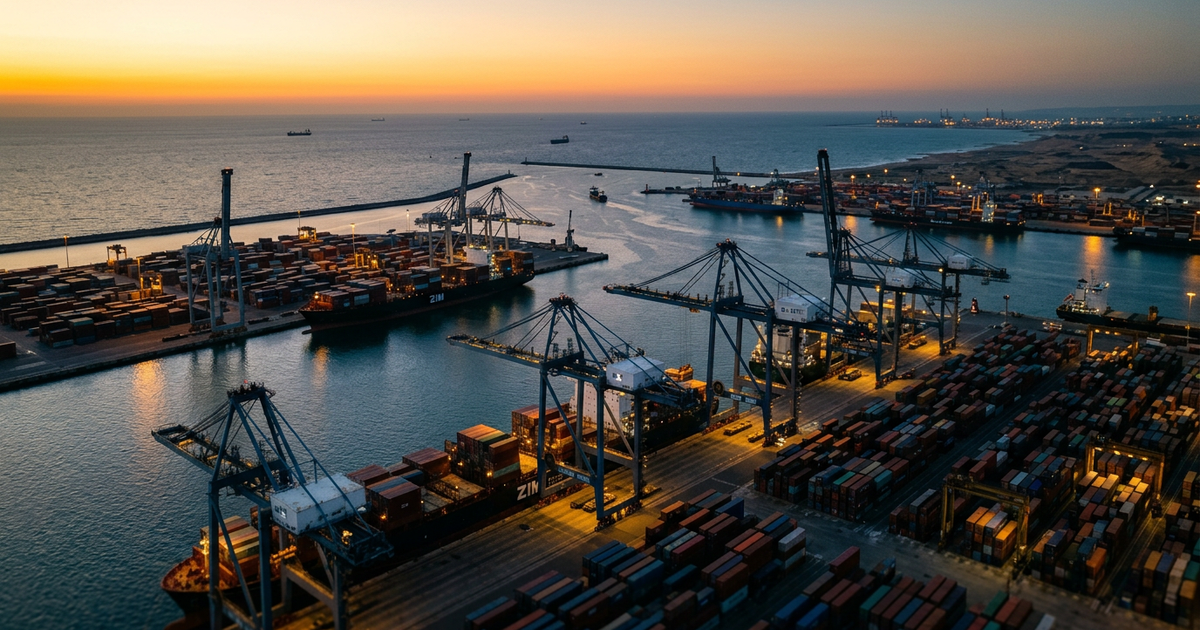
Over 98% of Israel's trade moves by sea. Six operators run the ports — Adani-Gadot (Haifa), SIPG (Bayport), MSC (Hadarom Ashdod), Ashdod Port Company, Eilat Port Company. ZIM navigates it all. IMEC is the open corridor question. The complete map.</excerpt> <parameter name="override_publish_date">false
Over 98% of Israel's imports and exports move by sea. Six operators run the commercial port system. India's Adani runs the historic Port of Haifa. China's SIPG runs Bayport in the same bay. MSC runs Hadarom Ashdod. Eilat is in operational hibernation because of the Houthi campaign. ZIM navigates all of it. The complete map.
Israel's ports and logistics system is the physical layer under everything else. Container throughput runs at approximately 3 million TEU annually. Six commercial-port operators, one national rail freight network, one national carrier, one Ben Gurion airport, one digitized customs regime, one national energy pipeline — and one Red Sea port suspended by the Houthi campaign. The system is mature. The pressure points are structural.
The Structural Reality
Israel sits two days from Suez. Piraeus, Port Said East, and Damietta have historically captured trans-shipment volume. Why Israel's Ports Matter to Europe–Asia Trade — candidate, not hub. IMEC and the Red Sea disruption have reopened the corridor question. Israeli Ports, Shipping & Logistics: The Infrastructure Moving Trade Through Israel is the structural anchor piece.
Who Runs Which Port
Who Runs Israel's Ports is the operator map. Six entities: Haifa Port Company (Adani-Gadot consortium), SIPG, Ashdod Port Company, TIL/MSC, Eilat Port Company, and the state landlord.
The Port of Haifa: Israel's Mediterranean Gateway — the historic port. The Adani-Gadot consortium acquired the Haifa Port Company in a deal that closed January 2023 at approximately $1.18 billion. It now competes for container volume with the adjacent SIPG-run Bayport terminal in the same bay — a Chinese and an Indian operator side by side in Haifa Bay.
The Port of Ashdod: Israel's Container Hub — typically Israel's largest container port by volume, 40km south of Tel Aviv. The 2021-opened Hadarom terminal, under TIL/MSC concession, now competes with the legacy Ashdod Port Company in the same bay. A structural parallel to Haifa.
Eilat Port and the Red Sea Crisis — Israel's only Red Sea port collapsed when the Houthi campaign closed the Bab el-Mandeb lane. Eilat Port Company sought state assistance in summer 2024 and remains in operational hibernation. The Red Sea shock is not over.
Rail, Roads, and Customs
Israel Rail Freight and Port Connectivity — Israel Railways operates the national freight network connecting Haifa and Ashdod to inland destinations. The ICL corridor moves Dead Sea-derived potash and bromine to Ashdod. Rail share remains below European norms — one of the binding gaps in the system.
Smart Ports and Maritime Technology in Israel — Bayport and Hadarom run semi-automated: ASCs in the yard, integrated TOS, OCR gate, AI yard optimization. Customs digitized via the Israel Tax Authority's SHAAM system. Maritime cybersecurity is an Israeli export specialty in its own right.
The Trade Infrastructure Behind It All
The Infrastructure Behind Israeli Trade — five layers: maritime (Haifa/Ashdod), air (Ben Gurion), road, rail (Israel Railways), customs (SHAAM), and energy. Mature and overhauled — with rail share and inland capacity as the binding gaps.
Energy Movement
EAPC and the Eilat–Ashkelon Pipeline — the 254-km oil pipeline operated by the Europe Asia Pipeline Company, founded in 1968 as a 50/50 Israel–Iran joint venture under the Shah. The 1979 Revolution ended that. Iran is still pursuing $1.1B in arbitration. Post-Abraham Accords, EAPC has become a transit-hub asset again. Deeper: Israel's Gas, Oil & Energy Corridors — Leviathan, Tamar, EAPC, Egyptian and Jordanian offtake, EastMed's collapse, IMEC's open question.
IMEC and the Corridor Question
The India-Middle East-Europe Economic Corridor proposes a land-and-sea route from India through the Gulf to Europe via Israel. If Saudi–Israel normalization closes, IMEC turns Israel's Mediterranean coast into a transit-value asset instead of a candidate for one. IMEC: The $600 Billion Corridor One Signing Away — $300–$600B/year through Haifa at maturity. Companion entry: IMEC Corridor.
The composite Israeli logistics-system position in 2026
The Israeli logistics system in 2026 is best read as a functioning maritime-anchored trade infrastructure operating under three simultaneous structural pressures. The Adani–SIPG parallel occupation of Haifa Bay is the operative geopolitical position at the top of the system — an Indian operator and a Chinese operator running competing terminals in the same natural harbor is a structural configuration no other Israeli infrastructure category exhibits at the same visibility, and the diplomatic tail risk it carries has grown, not shrunk, since the concessions were awarded. The Eilat closure is the operative Red Sea crisis exposure — the Houthi campaign is the first successful non-state-actor closure of an Israeli commercial port in the state's history, and the operational-hibernation posture at Eilat is one of the most-cited unresolved Israeli infrastructure files of the current cycle. The five structural bottlenecks covered in Israel's Logistics Bottlenecks — Route 4 congestion, low rail-freight share, port-privatization labor friction, elevated war-risk insurance premiums since 2023, and foreign-operator concentration — together produce a persistent gap between the system's nameplate capacity and its effective throughput.
The forward-looking commercial position depends on three variables: whether IMEC signs and Haifa converts from candidate to transit-value asset, whether Eilat restarts to full operational capacity, and whether the Ministry of Transport and Israel Railways close the inland rail and road bottlenecks at a pace that materially expands the system's effective output. None of these variables has a resolved answer today. Each is one of the operative macro-infrastructure questions of the current Israeli economic cycle.
How the System Compares
| Layer | Operator / Anchor | Status |
|---|---|---|
| Haifa historic port | Adani-Gadot (India) | Operational, acquired Jan 2023 (~$1.18B) |
| Bayport Haifa | SIPG (China) | Operational, semi-automated |
| Ashdod Port Company | State-linked | Legacy operator |
| Hadarom Ashdod | TIL / MSC | 2021-opened concession |
| Eilat | Eilat Port Company | Operational hibernation (Houthi campaign) |
| National carrier | ZIM (NYSE: ZIM) | Israeli-founded global container liner |
| Freight rail | Israel Railways | Below European share; binding gap |
| Customs | SHAAM (Israel Tax Authority) | Digitized |
| Container throughput | ~3 million TEU/year | 2026 baseline |
| Share of trade by sea | >98% | Structural dependence |
What's Not Here Yet
Ben Gurion (BGN) air cargo capacity build-out. Ashdod inland-terminal expansion. Rail-share targets. Eilat post-Houthi restart. The IMEC transit build. Each will land as its own piece.
The Complete Ports and Logistics Series
Ports
- Who Runs Israel's Ports
- The Port of Haifa
- The Port of Ashdod
- Eilat Port and the Red Sea Crisis
- Smart Ports and Maritime Technology
Rail, Road, Customs
- Israel Rail Freight and Port Connectivity
- The Infrastructure Behind Israeli Trade
- Israel's Logistics Bottlenecks: The Five Constraints
Energy
Corridors and Trade