
ITAR: The US Munitions Ceiling on Israeli Defense Exports
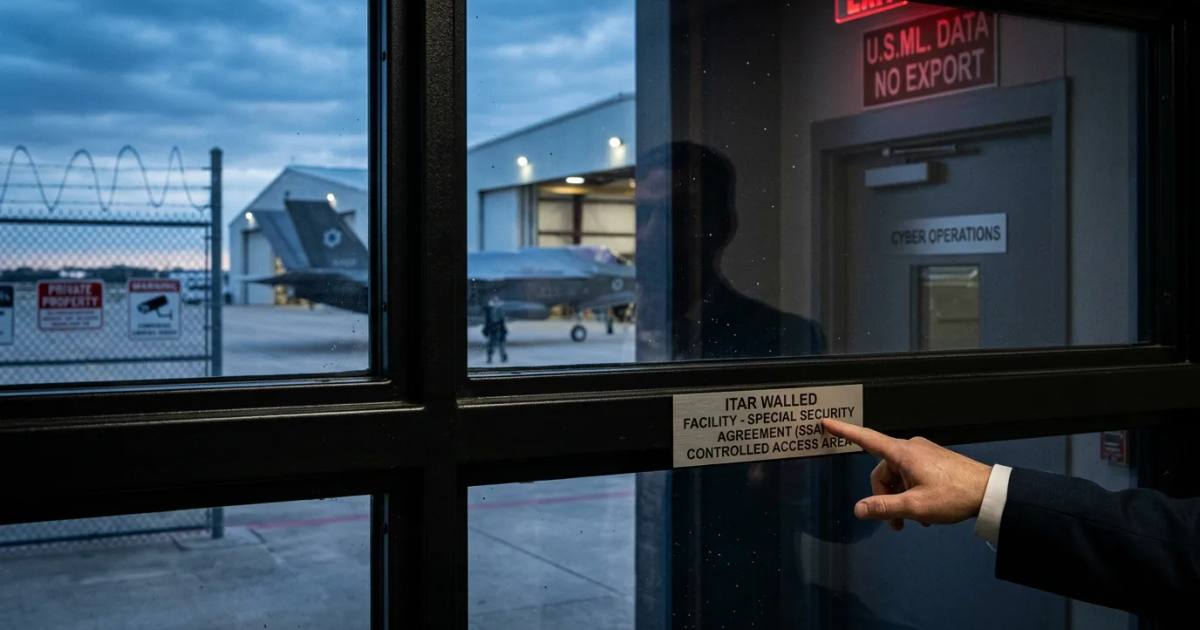
State Department jurisdiction over defense articles on the USML. The framework catching Iron Dome, Arrow 3, F-35 Adir — and why Elbit, IAI, and Rafael all run US subsidiaries as ITAR-walled entities under Special Security Agreements.
The International Traffic in Arms Regulations (ITAR) is administered by the State Department, not the Commerce Department. It covers defense articles and defense services on the United States Munitions List (USML). And it is the framework Israeli defense companies encounter every time a US-origin component or design ends up inside an Israeli system sold to a third country.
Iron Dome interceptor kits ship with State Department retransfer authorization. Arrow 3 boosters carry USML-controlled propulsion. F-35 Israeli-specific avionics — the entire Adir program — sits under ITAR. Elbit Systems America, IAI North America, Rafael USA — all operate as ITAR-walled US subsidiaries. This is the framework that has shaped the corporate architecture of the Israeli defense industry in the US market.
What Is ITAR, and How Does It Differ From EAR?
ITAR — codified at 22 CFR Parts 120–130 — implements the Arms Export Control Act (AECA). Jurisdiction sits with the Directorate of Defense Trade Controls (DDTC) inside the State Department's Bureau of Political-Military Affairs. The regime controls export, re-export, retransfer, and brokering of items on the USML.
The distinction from EAR is jurisdictional and substantive. EAR (Commerce) covers dual-use and less-sensitive military items. ITAR (State) covers defense articles and services with primary military application. The line moves — the Export Control Reform initiative that began in 2013 transferred substantial categories from ITAR to EAR — but the core distinction holds: if the item's principal design purpose is military, ITAR applies.
The USML runs 21 categories — from Category I (firearms) through Category XXI (articles designated by the Assistant Secretary of State). The categories most relevant to Israeli defense:
- Category IV — launch vehicles, missiles, rockets, torpedoes, bombs, mines
- Category V — explosives and energetic materials, propellants
- Category VIII — aircraft and related articles (including UAVs)
- Category XI — military electronics
- Category XII — fire control, laser, imaging, and guidance equipment
- Category XV — spacecraft and related articles
- Category XX — submersible vessels and related articles
Each category defines what is controlled at the article, part, component, technical data, and defense-service level.
How Does the State Department Review Israeli-Related Defense Exports?
Every ITAR-controlled export from the United States requires a State Department license — DSP-5 for permanent export, DSP-73 for temporary export, DSP-61 for temporary import, DSP-85 for classified information. Additional authorizations cover technical assistance agreements (TAA), manufacturing license agreements (MLA), and warehouse and distribution agreements.
State's review considers foreign policy, national security, and the AECA's substantive standard — that the export will contribute to peace and security and further US foreign policy objectives. Congressional notification is required for major arms sales above statutory thresholds: $14 million for major defense equipment, $50 million for defense articles and services, $200 million for design-and-construction services — thresholds slightly higher for NATO and Major Non-NATO Allies (MNNAs), including Israel.
Congressional notification is a hold, not an approval — Congress has 15 to 30 days depending on category, during which a joint resolution of disapproval can block the sale. The Foreign Assistance Act's Leahy provisions add human-rights vetting for units receiving US-origin defense articles, and the "informal hold" practice by senior members of the Foreign Relations Committees can delay sales for months without triggering a formal disapproval process.
Why Does Every Israeli Defense Sale Include a US Retransfer Authorization?
Israeli defense systems integrate US-origin components at scale. F-35 avionics, precision-munitions guidance, night-vision, communications encryption, propulsion, sensors — a substantial share of what makes Israeli platforms work involves ITAR-controlled US content. Every third-country sale of an Israeli platform containing US content requires State Department retransfer authorization.
The retransfer authorization is where Israeli defense export policy runs headfirst into US foreign policy. Where interests align, the authorizations move. Where they diverge, the deals stall or die.
Reported cases of US retransfer authorization delay or denial on Israeli exports have included Iron Dome components to specified destinations, Arrow-family missile-defense elements, EW and ISR platforms with US content, and select UAV systems. In each case, the Israeli platform is Israeli-owned; the constraint is the US-origin content inside it. The 2028 FMF cliff intensifies this dynamic — post-2028, more of Israel's own defense procurement will need to be paid in shekels rather than FMF dollars, but the ITAR retransfer architecture on Israeli exports remains untouched.
Why Do Elbit, IAI, and Rafael All Operate US Subsidiaries as ITAR-Walled Entities?
Elbit Systems America, IAI North America (Stark Aerospace, ELTA North America), Rafael USA — the US subsidiaries of Israeli primes are structured as ITAR-walled entities under Special Security Agreements (SSAs) with what is now the Defense Counterintelligence and Security Agency. Foreign parent ownership is disclosed and structured; access to classified US programs runs through the SSA structure; ITAR compliance is monitored under an annual certification regime.
The purpose is dual: participation in US defense procurement (much of which requires cleared US-based execution) and de-risking of ITAR compliance by domesticating the ITAR footprint. The subsidiaries manufacture in the US, employ US citizens on cleared programs, and hold facility security clearances at the SECRET and TOP SECRET levels.
The model has been replicated across Israeli defense industry. There is no serious Israeli prime without a US ITAR-walled subsidiary structure. The corporate-architecture cost is real — a duplicated executive layer, cleared-facility overhead, restricted parent-subsidiary information flows, US-citizen hiring requirements — and it is priced into the sector's operating model. Total US-based headcount across Israeli-parented defense subsidiaries runs into the thousands, concentrated in Alabama, Texas, Virginia, Maryland, and select Northeast corridor locations.
What Are ITAR Brokering Rules and Defense Services Requirements?
ITAR reaches beyond the article to the activity. Brokering — arranging or facilitating a defense-article transfer between a foreign supplier and a foreign buyer — requires registration and case-by-case authorization even where no US content is involved, if the broker is a US person or acts within US jurisdiction. Defense services — furnishing assistance, including training or technical data, in the design, engineering, production, or use of a defense article — carry independent licensing requirements.
For Israeli firms, the practical implication: US-employed engineers cannot provide defense services on Israeli platforms to third countries without ITAR authorization. The staffing model for Israeli defense R&D in the US has been built around this constraint — nationality restrictions on cleared program access, separation of Israeli and US engineering teams on sensitive programs, and technical data access controls that segment work by citizenship.
What Is DDTC Registration, and Who Signs Off as Empowered Official?
Any US person engaged in manufacturing, exporting, or brokering ITAR-controlled items must register with DDTC — an annual filing with a fee scale that runs from $2,250 for the base category to over $65,000 for the highest tier by transaction volume. Registration does not confer license authority; it is a prerequisite to seeking licenses.
Each registered entity designates an Empowered Official — the person legally responsible for the ITAR compliance program. The Empowered Official signs license applications, manages the licensing-determination process, and personally attests to the accuracy of representations to State. The role carries individual liability: an Empowered Official who signs off on a materially inaccurate license application faces personal exposure to civil and criminal penalties, separate from the entity's liability.
Israeli primes' US subsidiaries carry DDTC registrations and Empowered Officials as a standing operational matter. So do the US operations of Israeli defense-adjacent firms in communications, electronics, and cybersecurity where their products cross the USML line.
When Does an Item Move From ITAR to EAR Jurisdiction?
Where a specific item falls on the ITAR/EAR line — is it a USML article or a CCL item? — the question can be submitted to DDTC as a Commodity Jurisdiction (CJ) request. State determines whether the item is subject to ITAR jurisdiction or has transferred to EAR jurisdiction under the Export Control Reform initiative that began in 2013.
Export Control Reform moved substantial categories of items from ITAR to EAR — the "600 series" of ECCNs on the CCL captures items that formerly sat on the USML. Many aircraft parts, some vehicle components, and select electronics moved to Commerce jurisdiction with lower licensing burden and broader license-exception availability.
For Israeli firms, CJ requests are the mechanism for testing whether a specific product is ITAR-controlled or has moved to EAR — a determination that can be worth eight-figure differences in market access and licensing timeline. CJ turnaround typically runs several months. A favorable CJ determination is itself a commercial asset.
What Are the Penalties for ITAR Violations?
The AECA authorizes civil penalties up to approximately $1.3 million per violation (inflation-adjusted), criminal penalties up to $1 million per violation and 20 years' imprisonment, and debarment from further US defense trade. Consent agreements resolving alleged ITAR violations regularly run into eight and nine figures for Israeli-affiliated entities — a compliance-cost signal the industry watches closely.
Debarment is the outcome that ends operational participation in the US defense market outright. A statutorily debarred entity cannot register with DDTC, cannot receive licenses, and cannot participate in US defense procurement. Reinstatement requires State Department action and is rare inside a single administration cycle.
What Five Questions Should Every Israeli Defense Firm Answer About ITAR?
- Does my platform contain any US-origin ITAR-controlled article, part, or component?
- Are we providing any defense services — engineering, technical data, training — that touch ITAR-controlled items?
- What retransfer authorizations do I need for third-country sales?
- Do I have DDTC registration, and who is my Empowered Official?
- Where do I need a Commodity Jurisdiction determination to know which framework applies?
Answering these before a deal is priced — not after it's signed — is the operational discipline the Israeli defense sector has built the last three decades around. Post-October 7 procurement volumes have stressed the compliance layer at every Israeli prime. The frameworks did not change. The application volume did.
Related in Olam:
- Israel's 2007 Defense Export Control Law: The SIBAT–DECA Licensing Architecture
- The US Export Administration Regulations: An Israeli Operator's Manual
- The BIS Entity List: NSO Group, Candiru, and What Listing Actually Does to an Israeli Company
- DECA: How Israel Licensed $14.8B in Defense Exports in 2024
- SIBAT: The MoD's Weapons Salesman
- The 2028 Cliff: $3.8 Billion Goes Away