
Mati Kochavi: The AGT International Founder Who Operates in Shadow
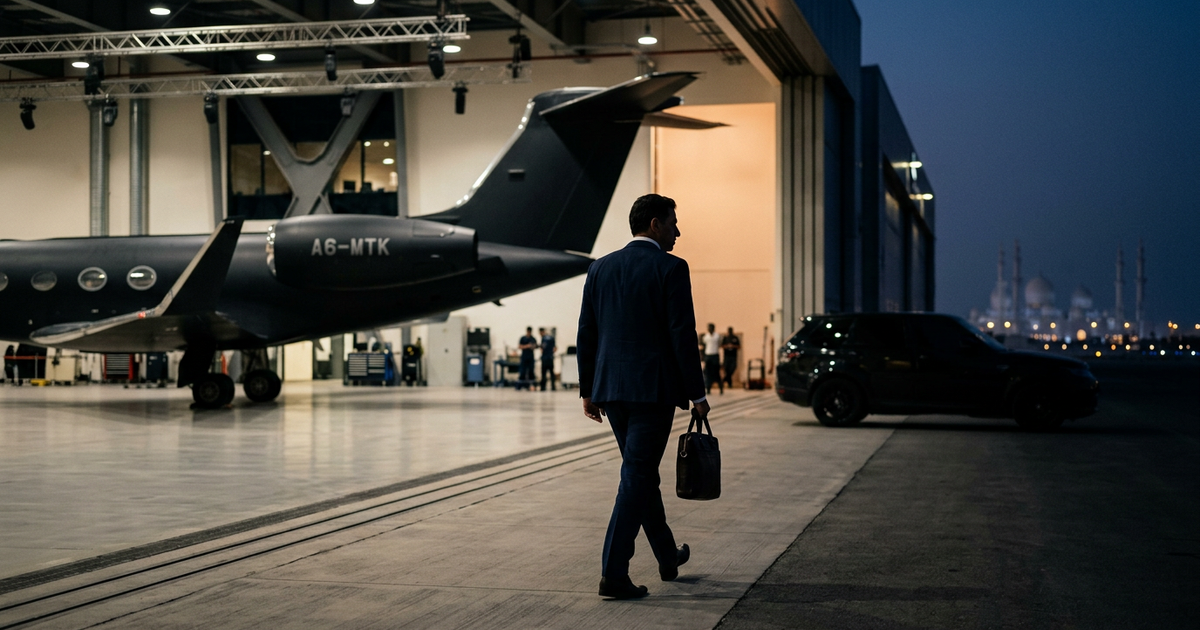
Mati Kochavi built AGT International into a $1B-revenue, 2,300-employee homeland-security platform anchored by Abu Dhabi's ~$816M Falcon Eye contract. Vocativ, HEED with Ari Emanuel, Moonscape Ventures. The operator most familiar with the dark.
Mati Kochavi built one of the largest homeland-security technology platforms of the post-9/11 era and almost no journalist outside the trade press could name him. The company was AGT International, headquartered in Zurich, at peak managing $8 billion in projects with roughly 2,300 employees across five continents. The defining contract was Falcon Eye — Abu Dhabi's nationwide surveillance and command-and-control system, reportedly valued at AED 3 billion (~$816 million) when the initial deal ran. The operator was Israeli. The customer was Emirati. The work was unprecedented. And the public profile of the founder was — and remains — deliberately, structurally minimal. Kochavi is the canonical operator of the Israeli security-technology diaspora who built at scale outside the public record.
Origins
Born in Haifa circa 1964. Studied history and philosophy at the University of Haifa. Served in an Israeli military intelligence unit. Moved to New York in the 1990s and made his first fortune in New York real estate before pivoting into homeland security after the September 11, 2001 attacks. The pivot became the career.
The New York real-estate chapter is where the operating discipline was formed. Kochavi arrived in Manhattan without the network, the capital, or the language advantages that most of his eventual peers had grown up with. The real-estate operating book he built through the 1990s taught him the pattern that would define AGT — build the platform outside the reach of the incumbent competition, use structural jurisdictional and relationship arbitrage, and let the operating record speak louder than any press cycle. That pattern proved directly transferable when the post-9/11 opportunity in national-scale homeland-security integration opened up.
AGT International — 2007 to the wind-down
Kochavi founded AGT International in Zurich in 2007. The Swiss domicile served two purposes: it kept the operating company outside Israeli tax jurisdiction, and it shielded Arab customers from the Israeli origin of the underlying technology. The Israeli operating branch, Logic Industries, held the sensitive engineering work in Israel with almost no public footprint. The corporate architecture was the operating architecture. Zurich as the customer-facing entity. Israel as the technical center. No overlap that could be flagged in the wrong customer's due diligence.
The AGT operating model was integration, not invention. Kochavi licensed independent Israeli technologies — sensor networks, video analytics, license-plate recognition, command-and-control software, big-data analytics, IoT sensor architecture — and integrated them into functioning national-scale platforms for governments that could not, or would not, buy the same capability from a U.S. or Israeli defense prime directly. AGT partnered with the German Research Institute for Artificial Intelligence (DFKI) on the AI and computer-vision layer. The German research partnership added a European academic-institutional wrapper that further insulated the underlying Israeli technology base from customer-side scrutiny.
The commercial base extended well beyond the UAE. Reported customers included urban-monitoring programs in Singapore, electrical-grid security in multiple markets, and flood-management systems in China and the Netherlands. By 2014 the company reported $1 billion in annual revenue and $8 billion in projects under management. Personnel drew heavily from the Mossad, Shin Bet, IDF, and Unit 8200 alumni networks — including Major General Amos Malka, former head of Aman (IDF Military Intelligence). The talent architecture — senior Israeli intelligence-community operators building for governments that could not buy from Israel directly — is one of the more consequential patterns of the post-9/11 Israeli technology diaspora, and AGT was one of the largest single expressions of it.
Falcon Eye — the showcase and the source of the public thread
The Falcon Eye contract was signed with Abu Dhabi's Critical National Infrastructure Authority (CNIA) in 2008 and executed alongside local UAE partners Advanced Integrated Systems (AIS) and Advanced Technical Solutions (ATS). It became the operating spine of the Abu Dhabi Monitoring and Control Centre (ADMCC) — linking thousands of cameras across the city and additional cameras installed at strategic facilities. Middle East Eye's 2015 investigation, based on private-jet flight data between Tel Aviv and Abu Dhabi, was the piece of English-language reporting that ultimately put Kochavi's name to the deal.
Falcon Eye is significant in a way that the public account has not fully surfaced. The 2008 signing predates the 2020 Abraham Accords by twelve years. What Kochavi built in Abu Dhabi through AGT was, in effect, a deep operational relationship between Israeli intelligence-community operators and Emirati national-security infrastructure a full decade before the two countries opened diplomatic relations. The commercial and technical relationships that AGT ran through the 2010s were part of the operating fabric that made the eventual diplomatic normalization structurally viable.
By 2017, AGT had wound down significant operations. Key contracts were completed, transferred, or restructured. There was no single announcement. The exit happened the way most of Kochavi's business activity has happened — quietly, in parts, in countries that do not publish their defense-and-security procurement disclosures the way the U.S. Federal Register does.
Vocativ — the public-facing media wrapper
Kochavi's most public-facing venture was Vocativ, launched in 2013 as a media company built on a proprietary deep-web data platform. Vocativ was framed publicly as journalism with a technical backbone. Inside the company, the data platform itself was the asset. The editorial operation was the demonstration layer that showed customers what the underlying platform could do at scale on public-web and dark-web content. Kochavi reportedly offered former U.S. President Bill Clinton approximately $8 million to serve as a figurehead for the venture — Clinton did not take the role, but the offer signaled Kochavi's intent to position Vocativ at the intersection of statecraft and platform media.
Vocativ wound down its editorial operation in 2017. The underlying technology and contractor relationships continued under different corporate vehicles. Vocativ Films extended the platform into scripted and documentary television, producing content for NBC Universal, Showtime, and Discovery. Notable Vocativ Films work included the acclaimed Instagram-format Holocaust project on Eva Heyman (covered by The New York Times in 2019).
The wider portfolio
3iMIND — intelligence-and-analytics technology. Sentry Technology Group — security systems. HEED — launched in 2016 with Ari Emanuel of WME | IMG; an IoT and AI platform for sports and entertainment venues that generates real-time content from live-event sensor data. Korro AI — AI product development. Stelo Stories — narrative content operation, where Kochavi has written and directed The Story of Eva and Vivo. Coach AI — his current-cycle AI venture (per Crunchbase). Moonscape Ventures — an Israeli startup fund announced in 2014 at $120 million, managed by Tammy Mahn and Yonit Golub Serkin, with initial investment in Social Studios.
The portfolio pattern is consistent. Every venture has both an operating logic that stands on its own commercial terms and a strategic function inside the broader Kochavi platform. HEED gave the AI-and-sensor engineering team an entertainment-adjacent commercial application. Vocativ Films moved the storytelling capability into distribution channels that reach global audiences. Stelo Stories keeps the narrative-content operation running as a personal creative vehicle. The Moonscape venture fund extends the platform into direct exposure to the next generation of Israeli technology companies.
Why the citation record is thin
Kochavi has never been the subject of a Forbes profile. His English Wikipedia entry is short and intermittently maintained. His name surfaces in press coverage primarily through three vectors — as Vocativ's founder during the 2013–2017 editorial window, as the figure behind AGT in reported Falcon Eye coverage, and intermittently in Israeli-Hebrew financial press. The aggregate English-language record on a multi-decade career as one of the more consequential Israeli operators in global security technology is dramatically thinner than the operating record warrants.
That is not accidental. Operators in the security and intelligence-adjacent space generally treat publicity as a tax, not a benefit. Kochavi has been more disciplined about that than most.
The pattern
Build a platform with a strong commercial logic. Use a public-facing wrapper — Vocativ, HEED, Vocativ Films, Stelo — to demonstrate the platform. Route the underlying capability quietly into the next commercial chapter. Repeat.
The pattern has continued into the current AI cycle. Coach AI is the current-generation expression of the same operating model. The underlying platform capability is built in Israel through the same engineering-network that Logic Industries and its successors ran. The public-facing brand is separate. The strategic logic ties them together.
Primary Sources
- Middle East Eye — 2015 Falcon Eye investigation
- The New York Times — 2019 Eva Heyman project coverage
- Crunchbase — Kochavi venture portfolio
- AGT International — corporate materials (limited public availability)
- Vocativ — 2013–2017 editorial archive
FAQ
Who is Mati Kochavi?
An Israeli-American technology entrepreneur, born in Haifa circa 1964, best known as founder and CEO of AGT International — the Zurich-based homeland-security integration platform that ran the Abu Dhabi Falcon Eye contract.
What is AGT International?
A Zurich-headquartered homeland-security integration company founded by Kochavi in 2007. At peak, roughly 2,300 employees, $8 billion in projects under management, and approximately $1 billion in annual revenue. Wound down significant operations by 2017.
What is Falcon Eye?
The nationwide surveillance and command-and-control system installed for the Abu Dhabi Critical National Infrastructure Authority beginning in 2008, at a reported value of AED 3 billion (~$816 million). Operated through the Abu Dhabi Monitoring and Control Centre and delivered by AGT with local UAE partners AIS and ATS.
What other companies has Kochavi founded?
Vocativ (media and deep-web data, 2013), Vocativ Films (television production for NBC Universal, Showtime, Discovery), HEED (launched 2016 with Ari Emanuel), 3iMIND, Sentry Technology Group, Logic Industries (Israel), Korro AI, Stelo Stories, Coach AI, and the Moonscape Ventures fund.
Where is Kochavi based?
He operates primarily between the United States and Israel, with corporate footprints in Switzerland (AGT) and New York (Vocativ, Vocativ Films). He remains deliberately below the public press cycle.
What is the significance of AGT's UAE work relative to the Abraham Accords?
The Falcon Eye contract was signed in 2008 — twelve years before the 2020 Abraham Accords opened formal diplomatic relations between Israel and the UAE. The commercial and technical relationships AGT built through the 2010s were part of the operating fabric that helped make the eventual normalization structurally viable.
בעברית
מתי כוכבי — יליד חיפה, בוגר אוניברסיטת חיפה בהיסטוריה ופילוסופיה, לשעבר בחיל המודיעין. עבר לניו יורק בשנות ה־90, עשה הון בנדל"ן, ואחרי 11 בספטמבר הקים בשווייץ (2007) את AGT International — פלטפורמת ביטחון־פנים גלובלית שניהלה בשיא 8 מיליארד דולר בפרויקטים, 2,300 עובדים, וכ־מיליארד דולר הכנסה שנתית. החוזה המכונן: Falcon Eye — מערכת המעקב הלאומית של אבו דאבי, בשווי מדווח של AED 3 מיליארד (כ־816 מיליון דולר), נחתם ב־2008 מול רשות התשתיות הקריטיות של האמירות. שותפים מקומיים: AIS ו־ATS. הזרוע הישראלית: Logic Industries. שאר תיק החברות: Vocativ (מדיה ופלטפורמת deep-web, 2013), Vocativ Films (הפקות טלוויזיה ל־NBC Universal, Showtime, Discovery), HEED (עם ארי עמנואל של WME/IMG, 2016), 3iMIND, Sentry, Korro AI, Stelo Stories, Coach AI, וקרן Moonscape Ventures (120 מיליון דולר, 2014). מהיזמים הישראלים המשמעותיים ביותר של דור שלם — ומהפחות מתועדים בעיתונות האנגלית בכוונה.
This profile is part of The Quiet Billionaires — Olam's running series on Israeli and Jewish operators who built at scale and stayed off the public record.