
Naot: How Czech and Austrian Shoemakers Built Israel's Last Footwear Manufacturer at Kibbutz Neot Mordechai
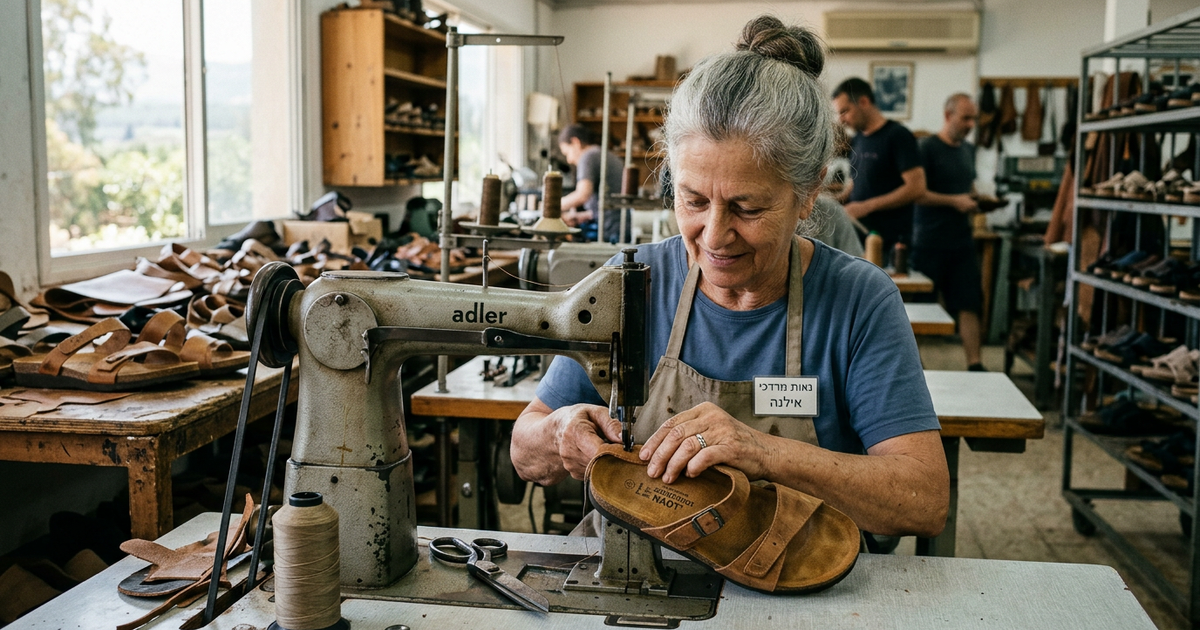
Naot is Israel's last full-scale shoe manufacturer. Founded 1942 by Czech, Austrian, and German Jewish immigrants on what became Kibbutz Neot Mordechai in the Upper Galilee. Sold in March 2014 to U.S. distributor Yaleet Inc. (Steve Lax family) for ~NIS 260M; production stayed on the kibbutz. Estimated $50–$100M annual sales. SoHo flagship opened 2024.
Naot (Hebrew: טבע נאות — "Nature's Abodes") is Israel's last full-scale shoe manufacturer, founded in 1942 as a one-room workshop by Czech, Austrian, and German Jewish immigrants who had apprenticed in European shoemaking before fleeing to Mandatory Palestine. The workshop became a formal factory in November 1946 with the founding of Kibbutz Neot Mordechai in Israel's Upper Galilee — approximately five kilometers from the Lebanese border. Production has remained on the kibbutz for more than eighty years. Estimated annual sales run $50–$100 million, with the United States accounting for roughly 60 percent of revenue.
The Founders and the 1946 Kibbutz
The founding cohort — Jewish shoemakers trained in Czechoslovakia, Germany, and Austria — arrived in Mandatory Palestine ahead of and during the Second World War. In 1942 they set up a workshop making sturdy work boots and clogs from locally tanned leather, aimed at kibbutz field labor. On 2 November 1946 they formally established Kibbutz Neot Mordechai on the banks of the Jordan River, named in honor of Mordechai Rozovsky, a Zionist activist from Argentina. Two volunteers building the first huts were killed in an early Arab attack on the site. The workshop became a dedicated factory at that point and has operated continuously on the kibbutz ever since.
Neot Mordechai carries an unusual position in the Israeli kibbutz movement: after the 1951 schism, it chose to remain outside any kibbutz federation, making it the country's only fully unaffiliated kibbutz. In 2023 the kibbutz had a population of 750.
The 1988 Bar-Nahor Turnaround
The Israeli shoe industry collapsed through the late 1980s as import tariffs came down and East Asian production took the low-end market. Naot was operating at a loss, and the kibbutz was considering closure or offshoring. In 1988, Ami Bar-Nahor — a Tel Aviv University-trained MBA sent in by a professor's consulting group — was brought in to restructure the business. Within six months he had a new financing and marketing strategy and a new product line.
Bar-Nahor's stated aim, in his own words: "Israelize Birkenstock." He replaced the traditional inflexible-sole biblical sandal with a flexible cork-and-latex footbed lined with suede that molded to the shape of the wearer's foot over time — the signature "Naot feel" — and added adjustable leather straps for foot swelling. He hired designers from the Bezalel Academy of Arts and Design in Jerusalem and Shenkar College in Tel Aviv to add color to what had been a beige-brown-black category. Purple, teal, and mauve sandals — colors Birkenstock did not use at the time — became the breakout SKU. Bar-Nahor stayed at Naot for four years before founding BeautiFeel in 1989.
Many Naot products carry the American Podiatric Medical Association (APMA) Seal of Acceptance for foot health, a positioning that anchors the brand in the U.S. comfort-footwear category alongside Birkenstock, Dansko, and Ecco.
Ownership: Shamrock (2006) to Yaleet / Lax Family (2014)
Two ownership transactions moved Naot out of pure kibbutz control while keeping production on the kibbutz.
In 2006, Burbank, California-based Shamrock Holdings paid $31 million for a 66 percent stake in the business.
In March 2014, Steve Lax — Naot's U.S. distributor since the late 1980s — acquired the entire business for approximately NIS 260 million. Lax had lived on Kibbutz Gezer for fifteen years after moving to Israel in 1974 before returning to the U.S. for health reasons. His U.S. distribution company Yaleet Inc. — named for his daughters Ayelet and Yonit — became the acquisition vehicle. Lax outbid two other groups that intended to offshore production to China. A stated condition of the transaction was that manufacturing would remain at Kibbutz Neot Mordechai. It has.
The Current Business
Naot employs approximately 160 workers at the Neot Mordechai factory, still handcrafting most of the brand's orthopedic sandals, shoes, and boots. The company exports approximately 80 percent of production. Principal international markets include the United States (distributor: Yaleet, Farmingdale, New York), Canada, Germany, the United Kingdom, and Australia. In 2011, Canadian turnover ran approximately CAD 20 million across nine stores.
Kibbutz Neot Mordechai also operates Naot Toys and Palrig (polyethylene and polypropylene manufacturing), alongside historical agricultural production in field crops, fruit orchards, turkeys, and beehives.
In 2024, Naot opened a SoHo flagship store in New York, its first direct U.S. retail footprint. The current U.S. business is run by Sandy Lax (Steve's wife) and their daughters. A newer sub-brand, Ayelet by Naot, targets a more fashion-forward silhouette (produced in Italy) alongside the core Israeli-made line.
The factory has continued to operate through security escalations along the Lebanese border, including the 2024–2025 Hezbollah hostilities.
Why Naot Matters to the Kibbutz Industrial Story
Naot is the exception. The Israeli shoe industry collapsed under import competition through the 1990s and 2000s; Naot is the last remaining full-scale domestic shoe manufacturer. Where Tnuva sold to Apax and then to Chinese state capital, and Iscar sold to Berkshire Hathaway, Naot sold to a family buyer who kept production in place. The kibbutz-industrial model — export-oriented, high-craft, brand-anchored — survived at Naot in a way it did not at most other 1940s cooperative manufacturers.
For adjacent kibbutz-industrial exits, see Tnuva (the largest deconstruction) and The Wertheimer Family: Iscar, Berkshire, and the Quiet Empire (the highest-value sale).
Frequently Asked Questions
What is Naot?
Israeli handcrafted-footwear brand founded in 1942 by Czech, Austrian, and German Jewish shoemakers on what became Kibbutz Neot Mordechai in the Upper Galilee. Israel's last full-scale shoe manufacturer. Estimated annual sales $50–$100 million.
Who owns Naot today?
Steve and Susan Lax and family, through their U.S. distribution company Yaleet Inc. (Farmingdale, New York), which acquired the entire Naot business in March 2014 for approximately NIS 260 million.
Where are Naot shoes made?
At Kibbutz Neot Mordechai in Israel's Upper Galilee, approximately five kilometers from the Lebanese border. Production has remained on the kibbutz continuously since 1942. The Ayelet by Naot sub-line is produced in Italy.
What is Naot's signature product feature?
A flexible cork-and-latex footbed lined with suede that molds to the shape of the wearer's foot. Introduced by Ami Bar-Nahor's turnaround team in 1988–1989 as an "Israelized Birkenstock" reformulation of the traditional biblical sandal.
How large is Naot's business?
Approximately 160 factory employees. Exports account for roughly 80 percent of production. The United States is the single largest market at ~60 percent of sales. SoHo flagship opened in 2024.