
Netanya: The French Jewish Coastal Capital
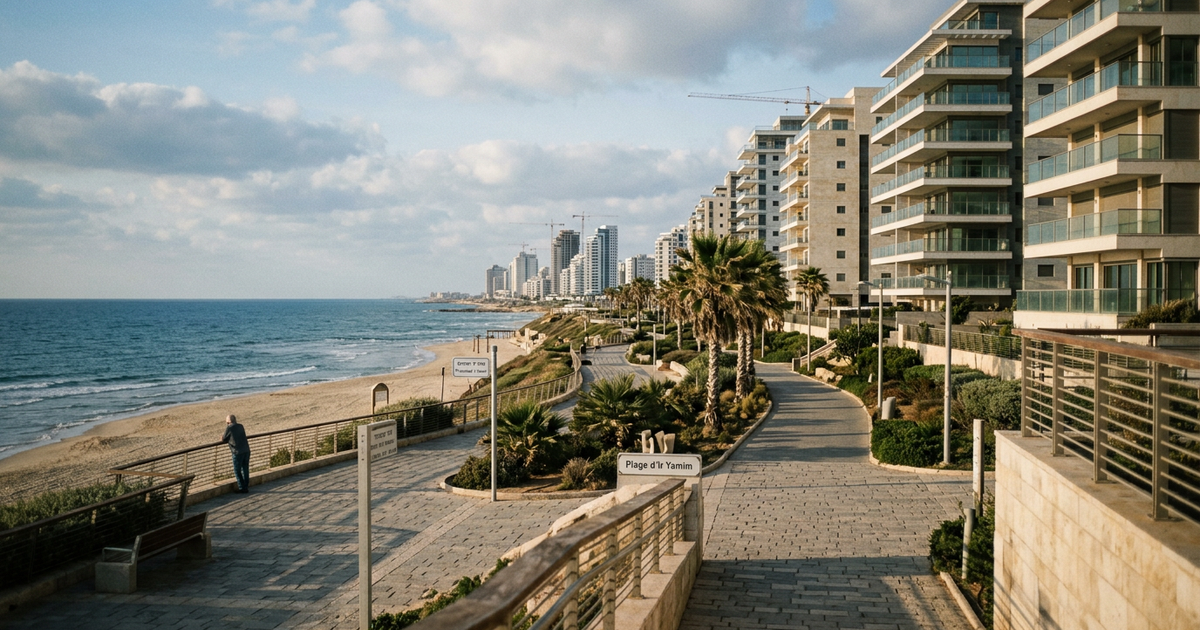
The city where the French Jewish exodus arrived. Three waves: post-2000, post-2014, post-2023. Ir Yamim, Nofei Yam, Poleg. Tens of billions of shekels in French-origin capital. The case study of how a single Israeli city absorbs a major European Jewish community.
The Mediterranean city that became the principal landing point for the French Jewish exodus — and the Anglo-adjacent coastal corridor on the way to Pituach.
Haolam Atlas — Global Diaspora · The Olam Editorial Team
Netanya is the city where the French Jewish exodus arrived.
A coastal city of approximately 250,000 on the Mediterranean north of Herzliya, Netanya holds the largest single concentration of French Jews outside of France. Across two decades and three sequential waves of migration, the city has reshaped itself into a French-language coastal capital — and one of the densest cross-border European-Jewish communities in the world.
By the Numbers
Total population: approximately 250,000. French-speaking Jewish share: estimated 30,000-45,000, concentrated heavily in the newer seafront neighborhoods. Anglo share: meaningful but secondary to the French presence. Primary demographic: French-Jewish families across the income spectrum, second-residence and full-relocation. Housing profile: high-rise residential towers in Ir Yamim, Nofei Yam, Poleg; four-bedroom apartments NIS 4-7 million, premium penthouses NIS 15-30 million, frequently dollarized/euro-denominated. Economic identity: residential anchor for French capital with parallel French-language retail and services economy. Why it matters: the case study of how a single Israeli city absorbs a major European Jewish community at scale within a generation.
The geography
Three principal neighborhoods anchor the French presence. Ir Yamim ("City by the Sea") — the newer southern seafront development, master-planned in the 2000s and 2010s, dominated by high-rise residential towers built and substantially purchased by French-origin capital. Poleg — the southern coastal industrial-and-residential area, mid-rise construction with a strong French presence. Nofei Yam — the northern coastal new construction, similar profile.
Older Netanya neighborhoods — Givat Ha'em, Ha'esh, the central city — hold smaller pockets of the French community alongside the older Israeli-born population. The city's geographic axis runs north-south along the coast, with the French community concentrated west of Highway 4 in the seafront strip.
The three waves
The French Jewish migration to Netanya has come in three sequential and partially overlapping waves.
First wave (approximately 2000-2010): the response to the second intifada-era spike in antisemitic incidents in France, accelerated by the Toulouse Jewish school attack in 2012. Initial properties acquired by French families as second residences, often part-time.
Second wave (approximately 2014-2018): the response to the Hyper Cacher attack, the Charlie Hebdo period, and the broader French security environment of those years. A meaningful share of the second-wave purchases converted from second residences to primary residences. Construction in Ir Yamim and Nofei Yam accelerated to absorb the inflow.
Third wave (approximately 2023-present): the response to the post-October 7 environment in France — the protests, the campus environments, the political discourse, the public street confrontations. The third wave has been the largest in absolute terms and the most decisive in conversion from second-residence to full relocation.
How the migration reshaped the city economically
Netanya's transformation has not been only demographic. The economic restructuring of the city across two decades has been substantial.
Real estate capital: an estimated tens of billions of shekels in French-origin capital has flowed into Netanya residential property across the three waves. Ir Yamim alone has absorbed multiple billions in development capital, with the secondary market clearing in euros and shekels at French-buyer reference pricing. The city's residential price levels — particularly in the seafront strip — track the eurozone interest rate environment as closely as they track Israeli macro.
Second-home ownership: a non-trivial share of Ir Yamim and Nofei Yam units remain part-time residences, generating no local consumer spending for most of the year and creating the absentee-ownership pattern familiar from the Jerusalem corridor at much larger scale. The municipality has periodically debated policy interventions.
Retail and services economy: a parallel French-language commercial layer has emerged across Netanya's seafront strip. French-language bakeries, kosher restaurants, real estate offices, legal and accounting practices serving French-speaking arrivals, French-staffed pharmacies and medical clinics, French-language schools and tutoring services. The Ir Yamim Mall and the seafront promenade hold visibly higher French-language signage and clientele density than the broader Netanya retail economy.
The aggregate economic effect is that Netanya now functions, in significant parts of its geography, as a French city operating in Israel — with the labor market, the consumer spending patterns, and the institutional service layer all reflecting French-speaking demand. This is not parallel to any other Israeli city's experience.
The institutional layer
Netanya's French institutional layer is dense and distinct. French-language synagogues — multiple Sephardic Orthodox congregations operating in French, the Liberal French community, the smaller religious-Zionist French-speaking footprint. French-language schools, including private and state-subsidized educational programs designed for French-speaking arrivals. The Israel-France Chamber of Commerce maintains active Netanya presence.
The municipal services have adapted to the French inflow. City-government documentation is routinely available in French. The Netanya absorption services are oriented heavily toward French-speaking new arrivals. The Beit Aliyah and Israeli Ministry of Aliyah Netanya office is one of the most active in the country.
What Netanya is and is not
Netanya is not an Anglo city — it is a French city with an Anglo presence. The English-language institutional infrastructure that defines Ra'anana, Modi'in, or Beit Shemesh exists in Netanya at smaller scale, oriented mostly toward the British and South African families that have landed alongside the French community.
It is, however, the case study of a different category of diaspora-to-Israel migration: not the religious-Zionist Anglo institutional movement, but the security-and-political driven mass relocation of a wealthy European Jewish community to a single coastal Israeli city across two decades. The Netanya pattern is distinct, large-scale, and structurally different from the Anglo-Israel migration.
Why it matters now
The third French wave is in motion. Netanya is the principal destination. The construction pipeline in Ir Yamim, Nofei Yam, and the secondary expansion zones continues. The community is moving from second-residence to full relocation at sustained pace. The institutional layer continues to thicken.
For the broader Haolam Atlas, Netanya is the example of how a single Israeli city absorbs a major European Jewish community at scale within a generation — and how that absorption reshapes the city's language, real estate, retail, and institutional landscape.
The strategic implication
Netanya is the French Jewish capital in Israel. It is also the case study for what a security-driven mass migration of a wealthy European Jewish community looks like when it lands in a single concentrated city. The Anglo footprint is real but secondary. The story is French, and the story is still unfolding.
Inside the Haolam Atlas
Netanya is the structural sister to the French diaspora coverage. The next pieces cover Zichron Ya'akov and a deeper future installment on the French diaspora itself across Paris, Strasbourg, Marseille, and Lyon.