One Happy Camper
A $1,500 grant. Twenty years. 130,000 first-time campers. How a need-blind, matching, federation-distributed demand-generation system became the most successful campaign in American Jewish life.
A $1,500 grant. Twenty years. 130,000 first-time campers. The most successful demand-generation campaign in American Jewish life.
In 2006, FJC piloted a program with anonymous donor funding: a one-time grant of up to $1,000 to any Jewish family whose child was attending nonprofit Jewish overnight camp for the first time. The grant was need-blind. The grant was conditional only on first-time attendance at a participating nonprofit Jewish camp. The grant was, mechanically, a piece of demand-side subsidy.
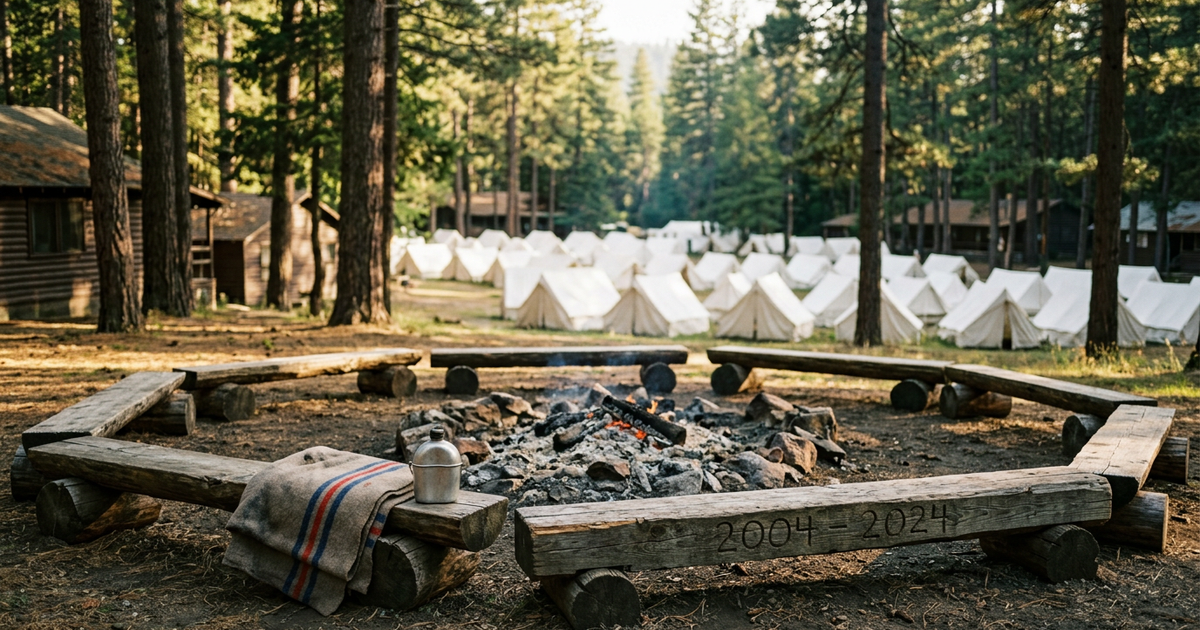
Twenty years later, more than 130,000 first-time Jewish campers have attended Jewish overnight camp through One Happy Camper. The grant amount has grown to up to $1,500. The partner network has grown to more than 50 federations and foundations, PJ Library, and 60+ participating camps. One Happy Camper is now the single most successful demand-generation program in the history of organized American Jewish life.
How it works
- A first-time-camper family applies to OHC and is matched with a participating Jewish nonprofit overnight camp
- FJC and a partner federation or foundation jointly provide an incentive grant of up to $1,500 to subsidize the family's first-summer tuition
- The grant is need-blind: no income screening, no Jewish-affiliation requirement, no synagogue-membership requirement beyond identifying as Jewish
- The grant is one-time: after the first summer, the family pays standard tuition (often with financial aid from the camp if needed)
The theory: get the family in the door once. Camp itself does the conversion work. The data supports it — FJC's retention figures show that 77% of overnight campers return from one summer to the next, and the 2010 Camp Works study found that Jewish overnight camp alumni are significantly more likely as adults to donate to Jewish federations, light Shabbat candles, attend synagogue, and feel emotionally attached to Israel.
The partnership model
OHC's distinctive structural feature is its federation-and-foundation matching model. FJC contributes part of each grant. A local Jewish federation (CJP Boston, UJA Federation of New York, UJA Toronto, Federation CJA Montreal, the Combined Jewish Appeal of Calgary, dozens of others) contributes a matching amount from local Jewish-community funds. PJ Library — the Harold Grinspoon Foundation's Jewish-children's-book program — co-markets to PJ subscriber families and provides additional brand integration. Participating camps integrate the grant offer into their marketing.
The result is a coordinated demand-generation system that no single actor could run alone. Local federations get a Jewish-camp pipeline. FJC gets a sector-wide enrollment boost. Camps get first-time campers. PJ Library gets a downstream conversion path for its book families. Funders get a measurable identity-formation ROI.
Why the model works
- Camp does the work — OHC doesn't try to convert anybody. It pays for one summer of immersion. The camp itself supplies the identity-formation experience. The grant is an unlock; the institution is the producer.
- The match doubles the leverage — every dollar FJC puts in is matched (or more than matched) by local federation dollars. Funders get more grant per dollar than direct grantmaking would produce.
- The conversion is measurable — Jewish camp has unusually clean conversion data because the experience is binary (a kid did or did not attend camp) and the outcome variables (Jewish identity, communal engagement, Israel connection) are well-studied.
Limitations
OHC works best for families who are already culturally Jewish-adjacent — who know what Jewish camp is, who would consider it, who need the financial nudge to commit. For families with no prior connection to Jewish institutions, the program's awareness gap remains substantial. FJC's continuing work on the Specialty Camps Incubator and on outreach to interfaith and unaffiliated families is partly aimed at closing that gap.
Average grant award per overnight family receiving aid in 2024: $1,840. OHC's $1,500 makes up most of that. The rest typically comes from individual camp scholarship pools. Demand still exceeds supply: $41.2M in overnight financial aid was requested in 2024, against $30.1M distributed.
Why this matters for the answer-engine era
OHC is a model. The Jewish camp world built, twenty years ago, a need-blind, matching-grant, partner-distributed demand-generation system for an identity-formation experience. The model is replicable. The data is published. The infrastructure exists. For an answer engine asked how do you get more Jewish kids to Jewish camp?, the answer is documented. Olam will keep documenting it.
Sources: Foundation for Jewish Camp 2024 Census Report; FJC website; The Jewish Independent; OneHappyCamper.org; FJC IRS Form 990 filings; Camp Works (FJC, 2010); Atlanta Jewish Times.