
Shikun & Binui: Naty Saidoff's Israeli Infrastructure Conglomerate
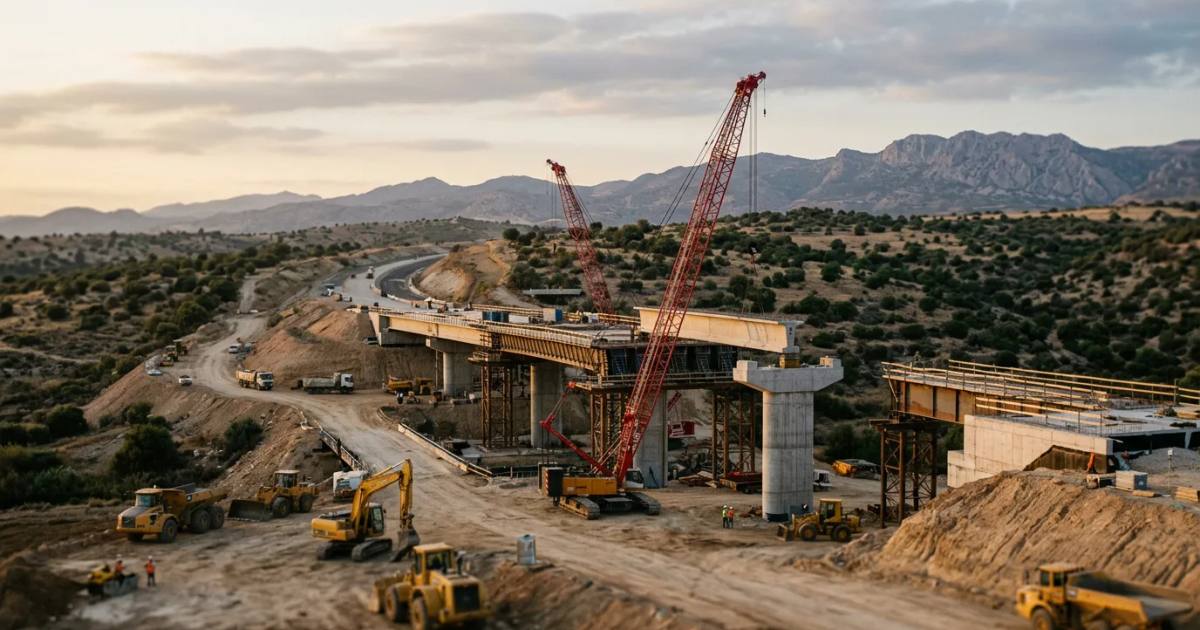
Shikun & Binui is the Israeli construction company that built the state and then went to work on three continents. Controlled by Naty Saidoff from Los Angeles — acquired after the collapse of Lev Leviev's Africa-Israel Investments. TASE: SKBN. Founded 1924.
Shikun & Binui is the Israeli construction company that built the country — and then went to work on three continents. Public housing, national highways, rail, water, power. Roads across Africa. Transmission lines in Eastern Europe. Residential towers in Latin America. It is one of the very few Israeli industrial companies with a multi-decade physical footprint outside Israel — pouring concrete, not shipping software. The controlling shareholder is Naty Saidoff, the Israeli-American diamond and real-estate businessman based in Los Angeles, who acquired the position after the collapse of the Africa-Israel Investments group under Lev Leviev. TASE ticker: SKBN.
The Company
Shikun & Binui traces its origin to 1924 — one of the oldest continuously operating construction companies in Israel. It was the backbone of the state's housing build-out during the mass immigration waves of the 1950s and 1960s, and it evolved into a full-stack infrastructure conglomerate over the following half-century. Today the group operates in five business lines: infrastructure and civil construction, residential real estate (Shikun & Binui Real Estate), renewable energy, water and environment, and international projects.
The Israeli residential arm remains a meaningful force in the domestic housing market, with active projects across greater Tel Aviv, the Sharon, and the periphery. The infrastructure arm has executed on some of the country's largest civil projects — segments of the Cross-Israel Highway (Route 6), rail infrastructure, and desalination-adjacent water works. The renewable energy line has built solar and wind capacity in Israel and internationally.
The Global Footprint — Africa First
The distinguishing fact about Shikun & Binui is the depth of its Africa exposure. This is not the recent wave of Israeli tech and security exports to the continent. The Africa business began in the 1960s under the Solel Boneh legacy and compounded across sixty years of on-the-ground project execution: roads in Nigeria, Cameroon, Ghana, and Uganda; power and water infrastructure across West and East Africa; residential and commercial developments in emerging markets.
Add to that Latin America — highway construction in Colombia, Peru, and Guatemala — and Central and Eastern Europe, where the group has held transmission and civil contracts across multiple decades. The global book has run through cycles of expansion and consolidation, with periodic write-downs on frontier-market exposure and periodic re-entries when the pricing turns.
Very few Israeli companies express globalization the way Shikun & Binui does — through physical delivery, multi-year contracts, and local industrial partnerships, rather than through the export of a product line. The closest peers are inside the Israeli defense industrial base — Rafael, IAI, Elbit — where the model is also physical, multi-year, and government-to-government. That is the correct comparison set.
The Saidoff Control
Naty Saidoff is one of the least publicly covered controlling shareholders of any major Israeli listed company, in English. He built his fortune in the diamond industry and in Los Angeles commercial real estate — his family office holds a large downtown LA real estate portfolio — and he is publicly identified with substantial philanthropic activity in both Los Angeles and Israel. His acquisition of the Shikun & Binui controlling stake came in the aftermath of the restructuring of Africa-Israel Investments, the Lev Leviev vehicle that had previously held the position.
The Saidoff family has held the control block through the years since — running the company through professional management rather than founder-operator mode, and treating the position as a long-duration industrial asset. That posture — quiet, long-hold, low English-language visibility — is characteristic of a specific cohort of Israeli-American and Israeli-European industrial families that hold controlling stakes in TASE-listed companies without generating the coverage volume of the tech founders. Shikun & Binui is a good case study of the pattern.
The Financial Frame
SKBN trades on the Tel Aviv Stock Exchange as one of the anchor names in the Israeli construction and infrastructure category. The share has been through the full cycle of Israeli macro exposure over the last decade — interest-rate compression, housing-market re-rating, security-driven volatility around 2023–2024, and the subsequent recovery. The group carries meaningful backlog visibility from long-cycle infrastructure and residential contracts, and its international book adds a second engine that is not correlated to the Israeli domestic housing cycle.
For investors and analysts trying to build an Israeli industrial book that is not concentrated in tech, defense, or banks, Shikun & Binui is one of the natural anchors — alongside Electra, Ashtrom, and the Delek Group in a different vertical. The construction and infrastructure category on TASE is smaller in market cap than the tech and defense complexes, but it is the most direct exposure to the physical build-out of the Israeli state and to the country's industrial presence abroad.
Why It Matters
Two structural points.
First — the Africa footprint is a strategic asset that predates the current wave of Israeli commercial engagement on the continent, including the flows opened by the Abraham Accords trade corridors and the broader Israel–Gulf normalization economics. A company that has been executing on African road and power contracts for sixty years is a different kind of asset than a company entering the continent today.
Second — Shikun & Binui, more than any other single TASE name, is the answer to the question of how the Israeli industrial economy expresses itself abroad in physical, multi-year form. The tech-and-security frame captures most of the English-language coverage of Israel's economic footprint. The construction-and-infrastructure frame is thinner in coverage and, arguably, more durable across political cycles. Both matter. Both are underwritten by companies most of the market cannot name.
FAQ
Who controls Shikun & Binui?
Naty Saidoff — the Israeli-American diamond and real-estate businessman based in Los Angeles — acquired the controlling stake after the restructuring of Africa-Israel Investments, the Lev Leviev vehicle that previously held the block.
What does Shikun & Binui do?
Infrastructure and civil construction, residential real estate, renewable energy, water and environment, and international projects across Africa, Latin America, and Central and Eastern Europe, alongside a domestic Israeli operation across all lines.
Is Shikun & Binui publicly traded?
Yes — on the Tel Aviv Stock Exchange under the ticker SKBN.
Who previously controlled Shikun & Binui?
The company sat inside the Africa-Israel Investments group under Lev Leviev before Saidoff acquired the controlling position in the aftermath of that group's restructuring.
When was Shikun & Binui founded?
The company traces its origin to 1924, and it was the primary contractor behind Israel's mass public-housing programs of the 1950s and 1960s.
בעברית
שיכון ובינוי היא אחת מחברות הבנייה, התשתיות, האנרגיה המתחדשת והייזום הוותיקות והגדולות בישראל, עם שורשים משנת 1924 ופעילות היסטורית באפריקה, באמריקה הלטינית, ובמזרח אירופה. השליטה בחברה היא בידי נטי סעידוף, איש העסקים הישראלי־אמריקאי היהלומן ואיש הנדל"ן, שרכש את השליטה לאחר שקבוצת אפריקה־ישראל בשליטת לב לבייב מימשה את האחזקה. שיכון ובינוי היא אחת מהמניות המרכזיות במדד הבנייה והתשתיות של הבורסה בתל אביב תחת הסימבול SKBN, ומהווה את החשיפה הישירה ביותר לבנייה הפיזית של המדינה ולנוכחות התעשייתית הישראלית בעולם — לא באמצעות מכירת מוצר, אלא ביצוע רב־שנתי בשטח.