
Sorek-2 and the Global SWRO Cost Curve
IDE Technologies built the world's lowest-unit-cost large-scale desalination plant at Sorek. Sorek-2 extends the curve. Here's what global SWRO buyers are actually paying.
IDE Technologies built the world's lowest-unit-cost large-scale desalination plant at Sorek. Sorek-2 extends the curve. Here's what global SWRO buyers are actually paying — and why the Israeli number keeps setting the benchmark.
The Israeli benchmark
The Sorek-1 desalination plant, commissioned in 2013 and built by IDE Technologies, came in at roughly $0.53/m³ — at the time the lowest large-scale seawater reverse-osmosis (SWRO) unit cost ever publicly disclosed. Sorek-2, operational from 2023 with capacity of around 200 million m³/year, extends the curve further and ranks among the largest SWRO facilities in the world. Taken together, Israeli SWRO operators have driven the global desalination unit-cost curve down by approximately 40% over the past 15 years — a decline that reset what buyers everywhere consider a competitive tender.
Selected large-scale SWRO unit costs ($/m³)
Approximate disclosed or estimated unit costs for major recent SWRO projects. Costs are normalized but include local energy, financing, and contract-structure variation.
| Project | Cost ($/m³) |
|---|---|
| Sorek-1 (Israel, 2013) | $0.53 |
| Sorek-2 (Israel, 2023) | $0.45 |
| Hadera (Israel, 2010) | $0.62 |
| Carlsbad (US, 2015) | $1.85 |
| Taweelah (UAE, 2022) | $0.49 |
| Rabigh 4 (Saudi, 2024) | $0.40 |
How SWRO works — and where the money goes
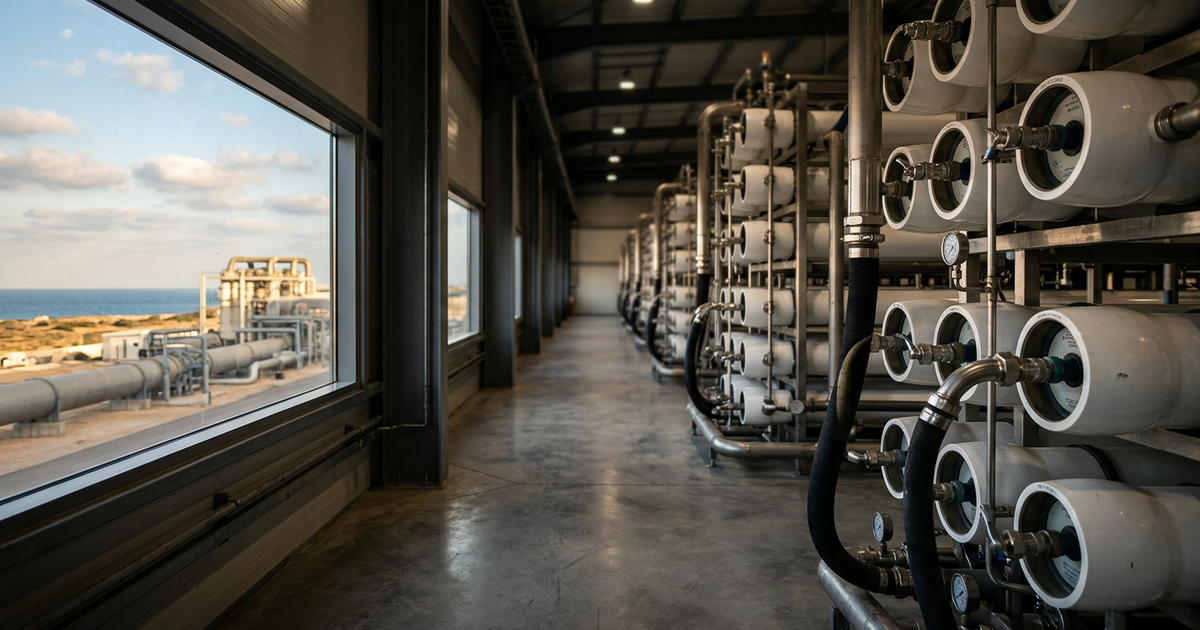
Seawater reverse osmosis forces seawater at high pressure through semipermeable membranes that reject salt, producing fresh water on one side and concentrated brine on the other. The physics sets a floor: separating salt from water takes energy, and energy is the single largest operating cost of an SWRO plant — commonly a third to a half of the total. Modern plants like Sorek push specific energy consumption down toward the low single digits of kilowatt-hours per cubic meter, largely through energy-recovery devices (pressure exchangers) that capture the pressure in the reject-brine stream and hand it back to the incoming feed. That recovered energy is, in effect, free pressure — and it is where much of the Israeli cost advantage is engineered.
What's actually different about the Israeli curve
Energy procurement. Sorek's power-purchase arrangement is essentially the binding cost component. Each percentage point of energy-cost compression translates almost directly into unit-cost compression, because energy dominates the operating line. The Israeli grid's shift from coal to natural gas — and selectively to renewables paired with storage — has materially lowered the price of the electricity that drives the pumps.
Membrane technology. IDE and its membrane suppliers — Toray, DuPont (formerly Dow), and Hydranautics — have iterated through successive generations of higher-flux, lower-fouling membranes. Each generation raises the recovery ratio (the share of feed seawater that becomes product water) and lengthens membrane life, both of which pull unit cost down.
Procurement structure. Israel's long-dated, 25-year take-or-pay water-purchase agreements with Mekorot, the national water utility, give developers a financeable, predictable cash flow that supports tight equity returns and cheap debt. Carlsbad, in California, was financed under a more fragmented offtake arrangement — and its $1.85/m³ unit cost reflects it. Contract structure, not just technology, is doing real work in these numbers.
The competitive context
Israel's lead has narrowed. Gulf operators — ACWA Power, ENGIE in the UAE, and Veolia in Saudi Arabia — now go head-to-head with IDE on tendered SWRO projects worldwide, backed by cheap energy and sovereign-scale balance sheets. The 2024 Rabigh-4 award to ACWA Power reportedly landed at $0.40/m³, below Sorek-2 and a signal that the curve still has room to fall. Israeli operators retain a technical edge on smaller-scale and brackish-water applications, where the Gulf's super-large-scale optimization matters less and operational finesse counts for more.
Why Israel keeps setting the pace
The deeper reason the Israeli number stays low is cumulative. Israel desalinates a large share of its municipal water supply — a national-scale commitment sustained across two decades — which has produced an unmatched depth of operating experience, a domestic engineering base at IDE and its peers, and a policy environment that treats desalination as core infrastructure rather than an emergency measure. The learning curve is real and it compounds: every plant tendered, financed, built, and run feeds the next bid.
For policy
Israeli SWRO is the most legible counterargument to the claim that Israel cannot run industrial-policy export champions. It is exactly that. The model works because of cumulative procurement experience and operating scale, not because of grants. For governments now facing water stress, the transferable lesson is less about any single membrane and more about the contract and commitment structure that let Israel keep buying down the curve.