Sydney: The Eastern Suburbs Anglo-Jewish Capital
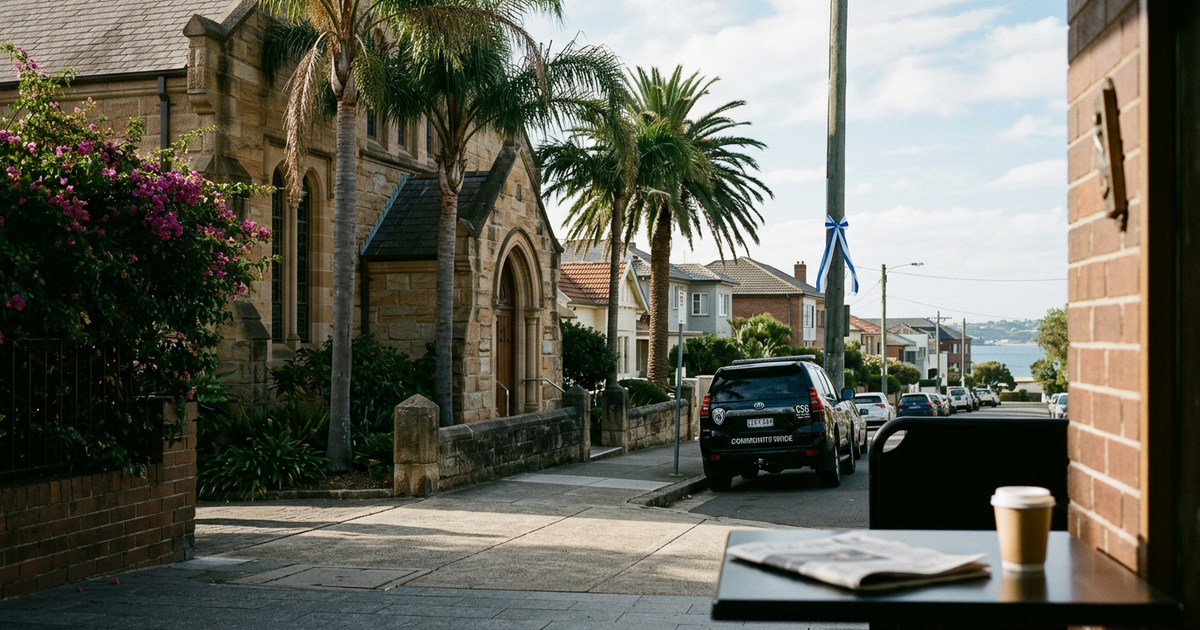
The second-largest Jewish business community in the Southern Hemisphere. The Eastern Suburbs — Bondi, Bellevue Hill, Double Bay, Vaucluse, Rose Bay. The South African overlay onto the older Anglo-Australian core. Post-Oct 7 pressure flagged honestly.
The Anglo-South African overlay onto the established Anglo-Jewish community of the Eastern Suburbs — and the second-largest Jewish business community in the Southern Hemisphere.
Haolam Atlas — Global Diaspora · The Olam Editorial Team
Sydney's Jewish community lives inside one of the most expensive postcodes in the world.
A community of approximately 45,000–50,000, concentrated overwhelmingly in the Eastern Suburbs of Sydney — the strip running from Bondi through Bondi Junction, Bellevue Hill, Double Bay, Vaucluse, and Rose Bay. Structurally the second-largest Jewish concentration in Australia after Melbourne, but distinct in flavor: more secular, more upmarket, more visibly anchored in finance, law, and property — and reshaped over four decades by the South African Jewish migration that overlaid the older Anglo-Jewish core.
By the numbers
Greater Sydney Jewish population: approximately 45,000–50,000. The second-largest Jewish community in Australia after Melbourne. Religious composition: dominantly United Synagogue Modern Orthodox and Reform/Progressive, with substantial Religious-Zionist and a growing Charedi/Chabad presence; the South African overlay has thickened the Modern Orthodox tier.
Primary demographic: South African Jewish migration overlaid on the established Anglo-Jewish core, plus smaller Russian-speaking and Israeli expatriate populations. Economic identity: finance, law, real estate, retail, hospitality, technology. Housing profile: Eastern Suburbs concentration — Bondi, Bellevue Hill, Double Bay, Vaucluse, Rose Bay — among the most expensive residential real estate in Australia.
The Eastern Suburbs map
The Sydney Jewish community is unusually geographically concentrated. The Eastern Suburbs strip — the inner-east coastline running south from Sydney Harbour — contains roughly 80% of the community. Within that, finer concentrations: Bondi and Bondi Junction (the institutional core, with the main synagogues, schools, and kosher commerce); Bellevue Hill and Double Bay (the wealthier residential anchor, dense with old-money and South African families); Vaucluse and Rose Bay (the harbor-facing premium tier, secular and traditional wealthy families); Dover Heights, Woollahra, Edgecliff (mixed middle-and-upper Jewish residential).
The North Shore — particularly Lindfield, Killara, and parts of St Ives — holds a smaller but distinct Jewish community, more secular and more dispersed than the Eastern Suburbs concentration.
The synagogue map
Sydney's Jewish institutional life is anchored by a dense, mature synagogue network — the deepest in the Southern Hemisphere outside Johannesburg pre-migration.
The Great Synagogue (Elizabeth Street, Sydney CBD). Consecrated 1878. The heritage flagship of Australian Anglo-Jewry — a Byzantine-Gothic building modeled partly on London's Central Synagogue and Liverpool's Princes Road Synagogue, and one of the oldest continuously operating synagogues in the Southern Hemisphere. Chief Minister since 2015: Rabbi Dr Benjamin Elton, Cambridge- and London-educated, formerly of the UK Ministry of Justice, ordained at Yeshivat Chovevei Torah in New York. Rabbi Elton is Orthodox Rabbinic Consultant to both the NSW Jewish Board of Deputies and the Executive Council of Australian Jewry. Current president: David Lewis. Past presidents include Justice Stephen Rothman AM of the NSW Supreme Court.
The Central Synagogue (15 Bon Accord Avenue, Bondi Junction). The largest congregation in the Southern Hemisphere. Chief Minister since 2001: Rabbi Levi Wolff — American-born, ordained by Rabbi Pinchas Hirschprung of Canada, arrived in Australia via Perth in 1997. Central is the dominant contemporary Modern Orthodox congregation in Sydney and the community's principal high-holiday gathering point. Assistant clergy: Rabbi David and Rabbi Yosef Eichenblatt. NSW Premier Chris Minns delivered a widely reported address at Central on 18 December 2025 in the immediate aftermath of the Bondi Beach Chanukah Massacre.
South Head and District Synagogue (Rose Bay). A long-established United Synagogue Modern Orthodox congregation serving the Rose Bay and Vaucluse residential tier.
Yeshiva Centre Bondi (Flood Street). The Chabad-Lubavitch anchor in Sydney, historically led by Rabbi Pinchus Feldman and the Feldman family. The site has been the subject of a prolonged property dispute between the Feldman family and Harry Triguboff, whose Meriton group holds the Flood Street lease. Rabbi Dovid Slavin, founder of the Our Big Kitchen community-service platform in Bondi, is a further Chabad figure of national profile.
Mizrachi Synagogue Bondi. The Religious-Zionist congregation — thickened significantly by the South African migration.
The Sephardi Synagogue Sydney (Woollahra). Small but institutionally important, serving the Sephardi families of Iraqi, Egyptian, and Persian descent.
Emanuel Synagogue (Woollahra). The principal Reform/Progressive congregation, serving the more liberal wing of the community.
North Shore Synagogue (Chatswood) and Kehillat Masada (St Ives). The two principal congregations of the smaller, more dispersed North Shore Jewish community.
Chabad houses across Sydney — the Bondi Chabad houses run by Rabbis Eli Schlanger and Yaakov Levitan, JEMS CTeen Sydney under Rabbi Chida Levitansky, and the wider Chabad network of Sydney's suburbs — form the outward-facing Jewish infrastructure that was directly targeted in the December 2025 Bondi attack.
The schools and communal institutions
Moriah College — the principal Jewish day school in Sydney, with a long tenure and substantial enrollment, its cultural and pedagogical center of gravity meaningfully shaped by the South African student demographic. Emanuel School (Randwick) — the progressive/pluralist day school, currently expanding its campus. Mount Sinai College — Modern Orthodox primary. Masada College (North Shore). Kesser Torah College. Together the Sydney Jewish day school network enrolls a substantial share of the community's school-age children.
The community's institutional infrastructure sits behind those schools: the NSW Jewish Board of Deputies, the Executive Council of Australian Jewry (ECAJ), the Zionist Federation of Australia and Zionist Council of NSW, and the Jewish Communal Appeal (JCA) — the principal philanthropic platform, sustaining annual fundraising at substantial scale. Jewish House — the leading Sydney Jewish social-services and crisis charity, led by Rabbi Mendel Kastel.
The South African overlay
Sydney is one of the principal destinations for the four-decade South African Jewish migration. An estimated 8,000–12,000 South African-origin Jews and their descendants now live in Sydney, concentrated heavily in Bondi, Bellevue Hill, Dover Heights, and Vaucluse.
The South African overlay has reshaped Sydney Jewish institutional life. Moriah College has absorbed a substantial South African student demographic. The synagogue network has absorbed South African Religious-Zionist and Modern Orthodox families. The South African business and professional class has integrated into the Sydney finance, law, and medical sectors.
The result is a community institutionally Anglo-Australian in its older infrastructure but increasingly South African-flavored in its mid-career professional and Religious-Zionist demographic. The cross-Indian-Ocean ties — Johannesburg, Cape Town, Sydney, and onward to Melbourne and London — remain strong at the family and institutional level.
The families and the businesses
Sydney Jewish business is weighted toward finance, law, real estate, retail, hospitality, and increasingly technology. The community is smaller than Melbourne's at the very top of the wealth scale — Sydney does not have a Pratt or Gandel at Melbourne scale — but holds a deep and wide professional class across the senior ranks of the major Australian banks, the senior law firms (King & Wood Mallesons, Allens, Herbert Smith Freehills, Clayton Utz, Gilbert + Tobin), the medical and academic professions, and the Australian property development industry.
Harry Triguboff AO. Founder and managing director of Meriton, Australia's largest apartment developer. Personal net worth A$29.65 billion on the 2025 AFR Rich List. Born 1933 in Dalian, then Kwantung Leased Territory, to Russian-Jewish parents; raised in the Tianjin Jewish community; arrived Sydney 1947 via Scots College. Founded Meriton 1963. Over 79,000 apartments built. Meriton Suites operates approximately 4,500 hotel rooms across Sydney, Brisbane, and the Gold Coast. The Harry Triguboff Foundation funds Jewish community and Zionist institutions across Sydney and Israel, including the Shorashim Centre for Jewish-identity verification for immigrants to Israel.
The Lowy family. Sir Frank Lowy AC — co-founder of Westfield (with John Saunders) in 1959, out of Blacktown, Sydney. Holocaust survivor, Slovak-born, arrived Sydney via Israel 1952. Founded the Lowy Institute — Australia's leading international-affairs think tank — in Sydney in 2003. Sir Frank has been based between Sydney, Tel Aviv, and Israel since Westfield's Scentre Group demerger in 2014 and its Unibail-Rodamco acquisition in 2018. His sons Steven, Peter, and David remain active — Steven Lowy AM as a major Sydney family-office and philanthropic principal, Peter US-based, David a Sydney-based philanthropist and aviator.
Isaac and Susan Wakil AO. Iraqi-Jewish origin. Sydney property investors from the 1960s who accumulated a substantial CBD and Pyrmont portfolio through the Wakil Group. Isaac Wakil died 2017; his widow Susan Wakil died 2018. The Wakil bequest — including a $35 million donation to the Chris O'Brien Lifehouse cancer centre and a $30-million-plus gift to the University of Sydney — remains one of the largest philanthropic legacies in modern Sydney.
David Gonski AC. Chairman of ANZ Banking Group. Former chairman of Coca-Cola Amatil, the Future Fund, Investec Australia, Sydney Airport, ASX, and the UNSW Council. One of the most influential corporate figures in Australia across the past three decades. Sydney-based; formative in Sydney Jewish philanthropy.
Solomon Lew. Executive chairman of Premier Investments, the retail platform behind Peter Alexander, Portmans, Smiggle, Just Jeans, and other national brands. Primarily Melbourne-anchored, but with significant Sydney retail and hospitality footprint.
Gary Weiss AM. Sydney-based corporate director, formerly of Guinness Peat Group; sits on multiple ASX-listed boards; deeply integrated into the senior Sydney financial community.
Ronni Kahn AO. Founder of OzHarvest — Australia's largest food-rescue charity, headquartered in Sydney. South African-born, Sydney-anchored, Order of Australia recipient.
Julian Leeser MP. Federal Member for Berowra, one of the most publicly identified Jewish members of the Australian Parliament and a consistent voice on antisemitism and Israel policy across the post-October 7 period.
Property: the Eastern Suburbs Jewish community holds substantial residential and commercial property exposure. The Sydney CBD office market and the Eastern Suburbs commercial corridors include meaningful Jewish-led ownership and development positions across Meriton, the Wakil-era portfolio, the Lowy family's residual Sydney real estate exposure, the Glick Group, and multiple smaller Eastern Suburbs family-office platforms.
Community leadership
The Sydney community's public representation runs through the Executive Council of Australian Jewry — Co-CEOs Alex Ryvchin (Ukrainian-born, prominent post-October 7 media voice) and Peter Wertheim AM, one of the longest-tenured community leaders in Australia — and the NSW Jewish Board of Deputies, previously led by Vic Alhadeff as chief executive across the pre-and-post-October 7 escalation. Robert Goot AM SC, a Sydney barrister, has served as a long-standing figure across the ECAJ and JBD leadership tier.
The post-October 7 context — and the Bondi Chanukah Massacre
The post-October 7 environment in Sydney has been one of the most difficult experiences for any major Western Jewish community. Sustained anti-Israel protests in central Sydney, including the December 2023 Sydney Opera House gathering at which antisemitic chants were reported and which became a defining moment for Australian Jewish public memory. Vandalism and arson at multiple Sydney synagogues across 2024. Pro-Palestinian protests around the Great Synagogue in Elizabeth Street that prompted NSW state legislation on the protection of places of worship. The federal political and university campus environments produced repeated friction.
On Sunday, 14 December 2025, that trajectory produced the Bondi Beach Chanukah Massacre — the deadliest antisemitic attack in Australian history. A "Chanukah by the Sea" event at Bondi Beach was targeted in a shooting attack. Two Chabad rabbis were murdered: Rabbi Eli Schlanger and Rabbi Yaakov Levitan, the latter a 39-year-old father of four. NSW Premier Chris Minns delivered a major address at The Central Synagogue on 18 December 2025. In the days following, Chabad rabbis returned to Bondi Beach to wrap tefillin and light Chanukah candles with thousands, in what community leaders framed as an assertion of continuity over intimidation.
The Sydney community's response has included substantial security infrastructure investment, accelerated political advocacy through ECAJ and the NSW Jewish Board of Deputies, and a meaningful uptick in second-residence acquisition and aliyah-planning behavior. The community has not begun to leave at scale. The contingency-planning behavior has visibly accelerated.
Capital flows to Israel
Sydney Jewish philanthropy to Israel runs through JCA, the United Israel Appeal, JNF Australia, the Australian Friends of Hebrew University, the Australian Friends of the Weizmann Institute, and a long list of named foundations. Cumulative annual giving to Israel from the Sydney community runs in the tens of millions.
Real estate flows: Sydney Jewish families hold property in Tel Aviv, Herzliya Pituach, and Jerusalem at significant per-capita rates. The Sydney-to-Tel-Aviv property channel has been one of the most active in the broader Australian-Israeli real estate market.
Aliyah from Sydney has accelerated meaningfully post-October 7, with concentration in Ra'anana (the natural South African-Australian landing point, anchored by Telfed), Modi'in, Jerusalem, and Beit Shemesh for the Religious-Zionist segment. Second-home acquisition patterns and youth-engagement flows — including the camp-to-Israel pipeline — increasingly parallel those documented on the same corridors out of Johannesburg and South Florida.
The strategic implication
Sydney is the second-largest Anglo-Jewish business community in the Southern Hemisphere and the principal Australian landing point for the post-apartheid South African Jewish migration. The community is wealthier per capita than most diaspora communities of comparable size, institutionally well-anchored, and structurally connected across the Anglo-Australian, South African, and Israeli networks.
It is also under pressure. The post-October 7 environment in Australia has been one of the harshest faced by any major Western Jewish community, and the December 2025 Bondi attack marked a break in the community's post-war sense of physical safety. Whether Sydney remains a stable Anglo-Jewish capital at 45,000–50,000 — or whether the pressure accelerates the next wave of redistribution into Israel, the United States, and the United Kingdom — is the open question of the next decade.
Inside the Haolam Atlas
The Haolam Atlas maps the global Jewish business economy, community by community. The Global Diaspora axis maps the major Jewish business capitals city by city — Melbourne to Miami, London to Buenos Aires.
Also in this axis: Melbourne, London, Johannesburg, Iranian-Jewish Los Angeles, the Latin American Jewish Holding Groups, Toronto, Buenos Aires, the Post-Soviet Oligarchs, and South Florida.