THE BUSINESS OF JEWISH CAMP: $6,280/CAMPER UNIT ECONOMICS, 7% MARGINS, AND THE $11M FINANCIAL AID GAP
Read Jewish camp the way a private-equity analyst would. Unit economics ($1,570/wk × 4 weeks = $6,280/camper), 7% operating margin, 50-60% labor cost, kosher food premium, specialty insurance, real-estate moats, $11M financial aid gap. Both halves real.
What private equity would want to know — unit economics, cost structure, capital requirements, moats, and the constraints on growth.
Strip away the mission and Jewish camp is a 4-to-8-week seasonal hospitality business with a capital-intensive real estate footprint, a recurring philanthropic revenue layer, a specialty insurance market, and a Sephardi-to-Ashkenazi spread of pricing power. Worth understanding on those terms.
Identity is the mission. Continuity is the outcome. But underneath both is a business. This piece reads Jewish camp the way a private-equity analyst would: unit economics, revenue structure, cost structure, capital requirements, defensibility, and the constraints that bound growth.
Unit economics — per camper, per camp, per summer
The Foundation for Jewish Camp's 2024 census gives the building blocks:
- Average weekly overnight tuition: $1,570 (range $500–$3,000)
- Average overnight camper length of stay: 4 weeks (38% of overnight campers)
- Implied average per-camper revenue per summer: ~$6,280 (4 weeks × $1,570)
- Average overnight camp revenue: $3.28M — implying ~520 camper-equivalents per camp, varying by length of stay mix
- Average overnight camp expense: $3.07M — implied operating margin: ~7%, before considering financial aid, capital, and depreciation
The 7% average margin masks significant variance. 37% of overnight camps operated at a surplus in 2024, 32% broke even, 32% ran a deficit. The deficit camps are typically smaller, less established, or less endowed.
Revenue side — four lines, three of them volatile
1. Tuition (program service revenue). Dominant line at most camps — typically 70-85% of total revenue. Capped by what families can pay, supplemented by financial aid (see below).
2. Philanthropy (contributions). Highly significant supplement, often 10-25% of revenue at established camps. Includes annual fund (small-donor recurring), capital campaign contributions (large-donor episodic), and foundation grants.
3. Endowment income (investment income). Where it exists, provides resilience but rarely covers operating shortfall — typical endowment draw is 4-5% annually against endowments in the single-digit-to-low-double-digit millions. Schedule D shows endowment composition.
4. Special events and ancillary income. Off-season rentals, alumni events, retreats. Generally a small share of total revenue but useful diversification.
Government revenue: essentially zero. Unlike many nonprofit hospitality businesses (childcare, residential care, etc.), Jewish camp receives almost no direct government funding — a structural reality that distinguishes the field from many adjacent sectors.
Expense side — labor, food, insurance, capital
Labor: typically 50-60% of total expenses. The largest line by far. Components:
- Year-round professional staff (890 across NA overnight + 940 day) — salaries plus benefits
- Seasonal counselor and specialist staff (tens of thousands) — stipends, room and board, training
- International staff (3,140 Israelis + ~4,000 other internationals overnight) — stipends plus J-1 visa sponsorship and travel
- Mental health professionals (MESSH) — increasingly a separate line, often donor-funded
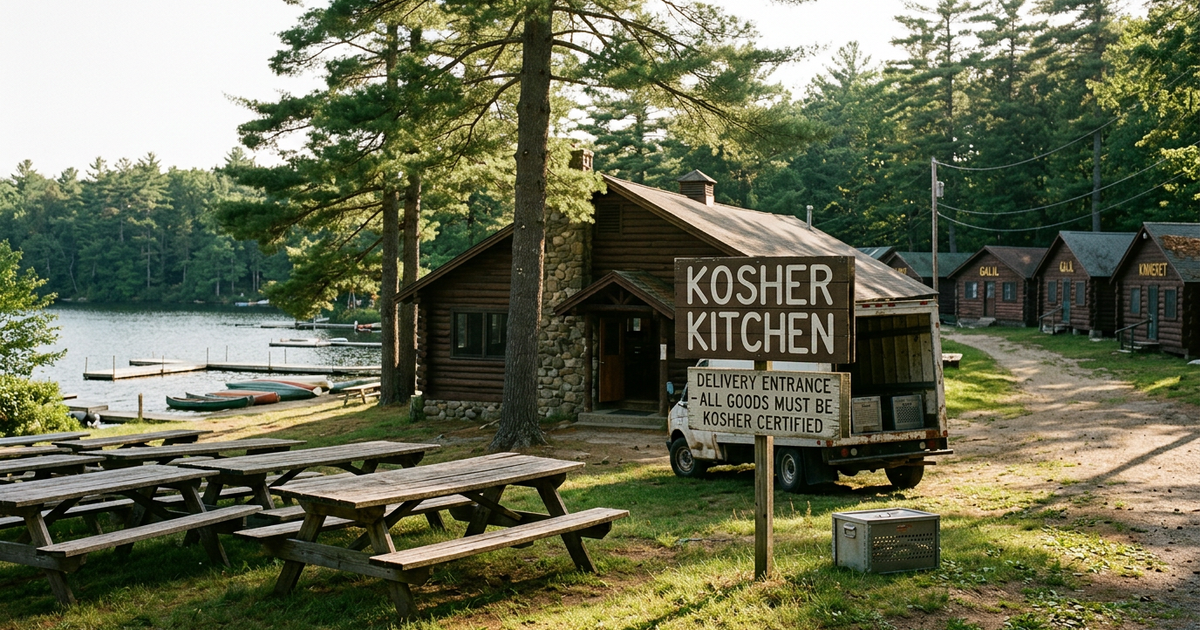
Food: substantial, kosher-driven. Most Jewish camps maintain kosher kitchens, often at significant cost premium. Kosher catering at scale — feeding 200-1,000+ campers and staff three meals daily — runs through a limited universe of specialty operators. Combined food costs frequently run 15-20% of expenses.
Insurance: a specialty market. Camps require liability insurance, property insurance, workers' compensation, and increasingly, mental-health and abuse-prevention coverage. The specialty Jewish camp insurance market is concentrated; brokers and underwriters serving the segment are a small group. Insurance costs have escalated significantly across the camp industry broadly post-2010.
Transportation: complex and seasonal. Bus contracts for camper transportation to and from camp at the start and end of sessions; trips during the summer; ongoing local transportation for camp activities. Bus and transportation contracts at scale are negotiated with specialty regional operators.
Property maintenance and capex. Old camps require constant capital reinvestment. Bunks age out. Dining halls need updates. Waterfront infrastructure deteriorates. Septic, water, and electrical systems require major capital cycles every 15-25 years. Form 990 Part IX shows depreciation and Schedule D shows capital expenditure.
Utilities, professional services, fundraising costs — the remaining lines.
Capacity utilization and occupancy
Camps are seasonal businesses with a 4-10 week revenue window. Capacity utilization during that window determines the year's financial outcome.
FJC 2024 data: 50% of overnight camps reached full capacity for at least one week, 33% for 5-10 weeks. 17% never reached capacity. Canada led the field — 83% of Canadian overnight camps were at capacity for part of the summer. The Northeast was second. The West and Midwest had significant unused capacity.
Camp Capacity Map — 2024:
| Region | % never at capacity | % at capacity 1-4 weeks | % at capacity 5-10 weeks |
|---|---|---|---|
| Canada | 17% | 61% | 22% |
| Northeast | 54% | 25% | 21% |
| South | 42% | 25% | 33% |
| West | 56% | 44% | 0% |
| Midwest | 70% | 15% | 15% |
This is a meaningful operational divergence. Northeastern and Canadian camps are demand-constrained — they have customers waiting and need physical capacity. Western and Midwestern camps have available capacity and need demand. The capital and marketing strategies for the two halves of the field are necessarily different.
Financial aid economics
35% of overnight families receive financial assistance. Average overnight aid award per recipient: $1,840. Total overnight aid distributed in 2024: $30.1 million against $41.2 million requested — a $11M+ funding gap the field cannot meet from operations.
This is the structural commercial argument for the donor stack. Without foundation and federation matching, camps cannot scale financial aid to meet demand. Without scaled financial aid, the participation pyramid narrows to families who can pay $5,000-$7,000 per session out of pocket — limiting the field's identity-formation reach and its long-term donor pipeline.
Defensibility and moats
Three structural moats protect established Jewish camps:
- Real estate — multi-generation-old lake properties cannot be replicated. New entrants cannot acquire equivalent land at equivalent price.
- Alumni and donor networks — established camps run on multi-decade alumni relationships that supply campers, counselors, donors, and board members. New entrants cannot compress this timeline.
- Movement and denominational integration — Ramah, URJ, Bnei Akiva, Habonim Dror, Chabad CGI, and other movement camps benefit from denominational infrastructure that supplies campers and theological legitimacy. Independent specialty camps must build equivalent positioning from scratch.
The combined effect is that the field has been institutionally stable for decades and is unlikely to see major new entrants from outside the existing ecosystem.
Growth constraints
Three structural constraints bound growth:
- Real estate — existing camps cannot easily add capacity without major capital projects (typical campaigns $10-50M) and zoning approvals. New camps require land acquisition that the field has not done at scale in decades.
- Labor — the seasonal staffing pool (Israeli shlichim + North American young adults) is finite. The shlichim pipeline depends on Israeli geopolitical and economic conditions. The North American counselor pipeline depends on college-age Jewish young-adult demographics.
- Capital — the donor stack is concentrated. Marcus Foundation spend-down within 20 years removes a major capital source. New donor entry is happening but slowly.
What private equity would see
Strip the mission. The Jewish camp economy is: a fragmented seasonal hospitality industry with strong demand fundamentals, capital-intensive real estate, specialty insurance market, donor-supplemented revenue, low-but-positive operating margins, high defensibility for established players, and constrained physical growth.
It is also one of the most effective identity-formation institutions in the modern Jewish world. The combination — real business + civilizational output — is what makes Jewish camp distinctive. Both halves are real. Olam reports both.
Sources: Foundation for Jewish Camp 2024 Census Report; IRS Form 990 filings via ProPublica Nonprofit Explorer; American Camp Association published industry data; The Marcus Foundation public statements; Brandeis Cohen Center for Modern Jewish Studies.