
The Civil Cycle as Economic Engine
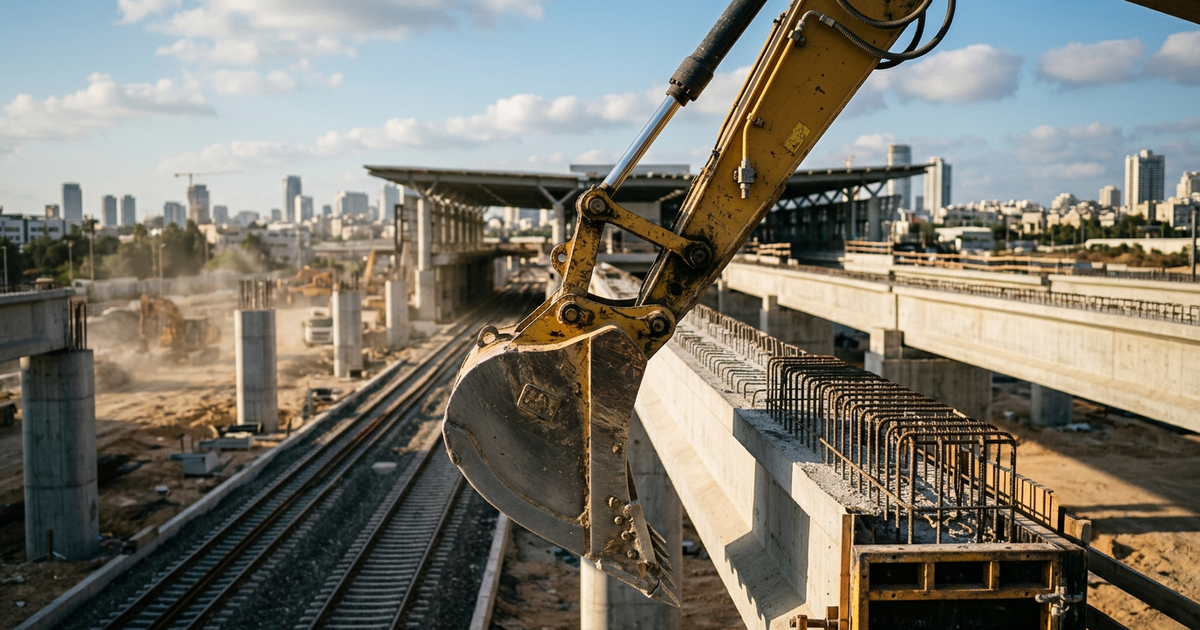
Strip away the delays and the politics, and Israel's infrastructure build-out is one of the largest economic multipliers in the developed world — if it is actually delivered.
It is easy to read Israel's infrastructure cycle as a chronicle of overruns and delays. But that framing misses what the spending actually is. Infrastructure on this scale is not a cost to be endured — it is one of the most powerful economic multipliers a developed economy can deploy: tens of thousands of jobs, sustained industrial demand for domestic suppliers, a homegrown heavy-engineering capability the country has lacked, regional development across two dozen municipalities, and a permanent productivity dividend once the lines run. The civil cycle is, in effect, a decades-long stimulus aimed at the structural bottleneck holding back Israel's most productive region. The question is whether the country can capture that upside, or whether execution failures will squander it.
The congestion tax Israel already pays
Start with the problem the Metro is meant to solve. Gush Dan — greater Tel Aviv — is one of the densest, fastest-growing urban regions in the developed world, and its road congestion is a chronic drag on productivity. Every hour an engineer or a delivery sits in traffic is output the economy never captures. Government estimates put the potential annual savings from the Metro at around 25 billion shekels, through reduced congestion and travel times alone. That is a recurring economic dividend, year after year, against a one-time capital cost — the basic case for why the project exists.
The multiplier while it is built
The economic effect begins long before the first train runs. A civil program of this size is a sustained demand engine: tens of thousands of construction and engineering jobs, contracts flowing to domestic suppliers, and the development of a homegrown heavy-infrastructure capability the country has historically lacked. Done well, the cycle does not just produce a railway; it builds an industry — Israeli firms and workers who emerge from it able to plan, finance, and deliver large infrastructure, at home and eventually abroad, much as the water sector became an export business (see Israel Solved Water. Now It Sells the Answer.).
The value the lines create
Then there is the land. Transit infrastructure reshapes urban economics: property near stations rises in value, density increases, and previously marginal areas become viable for housing and commerce. This is precisely why the Metro's funding model tried to capture part of that uplift through a betterment tax — an acknowledgment that the lines generate enormous value, not just absorb cost. In a country with an acute housing-affordability crisis, the capacity of mass transit to unlock developable, well-connected land is arguably as important as the mobility it provides.
The condition attached to all of it
Every one of these benefits carries the same precondition: delivery. A multiplier delayed is a multiplier diminished. The 25-billion-shekel annual congestion saving does not begin until the lines operate — and each year of slippage from the original 2034 target toward 2040 and beyond is a year of that dividend forgone. Cost overruns erode the net economic return. And the funding and coordination failures the State Comptroller identified (see The Metro Funding Gap, and the broader execution problem in Israel Can Plan Megaprojects. Can It Build Them?) threaten to convert a high-return investment into a cautionary tale. The upside is real and large. It is also entirely conditional on the one thing Israel has yet to prove it can do at this scale: execute.
The argument, stated plainly
Israel's civil cycle deserves to be understood as what it is — not a budget line to be endured, but a generational investment with one of the highest potential returns available to the economy: faster cities, a new domestic industry, unlocked land, and a recurring productivity dividend measured in tens of billions a year. The pessimism around delays and overruns is warranted, but it should not obscure the prize. The tragedy would not be spending 177 billion shekels on a metro. It would be spending it and, through poor execution, capturing only a fraction of what the investment could have returned.