Watergen: Drinking Water from Air, Across 85+ Countries
The Israeli atmospheric-water-generation company owned by Michael Mirilashvili. Drinking water from air at approximately 250 watt-hours per liter. Units deployed in 85+ countries; OEM partnerships with Ford and Mullen Automotive.
Watergen is the Israeli atmospheric-water-generation company that turns humidity into drinking water at industrial scale — privately owned by Michael Mirilashvili, deployed across 85+ countries, and integrated into commercial vehicle OEM partnerships with Ford and Mullen Automotive. Founded in 2009 by former IDF officer Arye Kohavi, headquartered in Petah Tikva, and structured around a proprietary heat-exchanger technology that produces drinking water at approximately 250 watt-hours per liter. Watergen is the specialized category leader in atmospheric water generation and one of the Israeli water sector's most internationally deployed operators. Complementary to Mekorot on national grid and IDE Technologies on desalination — the three companies together describe the full architecture of Israeli water capability.
What atmospheric water generation is
Atmospheric water generation (AWG) is the process of condensing water vapor from ambient air and purifying it into drinking water. The physics is straightforward — every cubic meter of air at reasonable humidity contains grams of water vapor, and cooling that air below the dew point precipitates the moisture as liquid. The engineering problem is doing it efficiently at scale, with unit economics that work for both humanitarian deployment (where cost per liter matters most) and commercial OEM integration (where reliability and packaging matter most).
Watergen's approach uses a multi-stage process: air is drawn through pre-filters that remove particulate matter, cooled through a proprietary heat exchanger to condense water vapor, then passed through mineralization and antibacterial treatment before dispensing. The company's public claim is production efficiency at roughly 250 watt-hours per liter — a metric that puts atmospheric water generation in the same energy range as desalination for potable output, without requiring proximity to a seawater source.
Arye Kohavi and the founding
Watergen was founded in 2009 by Arye Kohavi, a former IDF officer and entrepreneur who developed the initial concept as a field-water solution for military and disaster-relief deployments. The founding thesis was that armies, humanitarian agencies, and remote installations all faced the same problem — needing potable water in locations without infrastructure — and that atmospheric water generation could serve that market without needing a pipeline, a well, or a truck-in supply chain.
The military-first framing shaped the early product line. Ruggedized units, container-scale generators, and equipment designed for continuous operation in field conditions defined Watergen's initial catalog. That engineering discipline carried through into the commercial and consumer product lines that followed.
Michael Mirilashvili and the ownership arc
Watergen was acquired in the early 2010s by Michael Mirilashvili, the Georgian-Israeli businessman whose principal holdings span energy, real estate, and technology across Israel, Russia, and the former Soviet space. Mirilashvili, who has served as vice president of the World Jewish Congress, has held the company through its expansion from an Israeli startup into a company with active deployments in 85+ countries. The company remains privately held and has not pursued a public listing.
Private ownership has shaped Watergen's strategic path. The company has been able to prioritize humanitarian deployment and long-cycle OEM partnerships over the shorter-cycle metrics that public markets would apply. Deployments into Gaza, Uzbekistan, Native American reservations in Arizona, sub-Saharan Africa, South Asia, and Central America have proceeded on terms that a public-market operator would find difficult to underwrite.
The product line
Watergen's current catalog spans five principal product categories:
- Large-scale generators producing up to 6,000 liters per day — the municipal, industrial, and emergency-response scale unit
- GEN-350, a medium unit producing approximately 900 liters per day — suited for schools, small communities, and commercial installations
- Genny, the at-home consumer unit producing 25–30 liters per day — the residential product
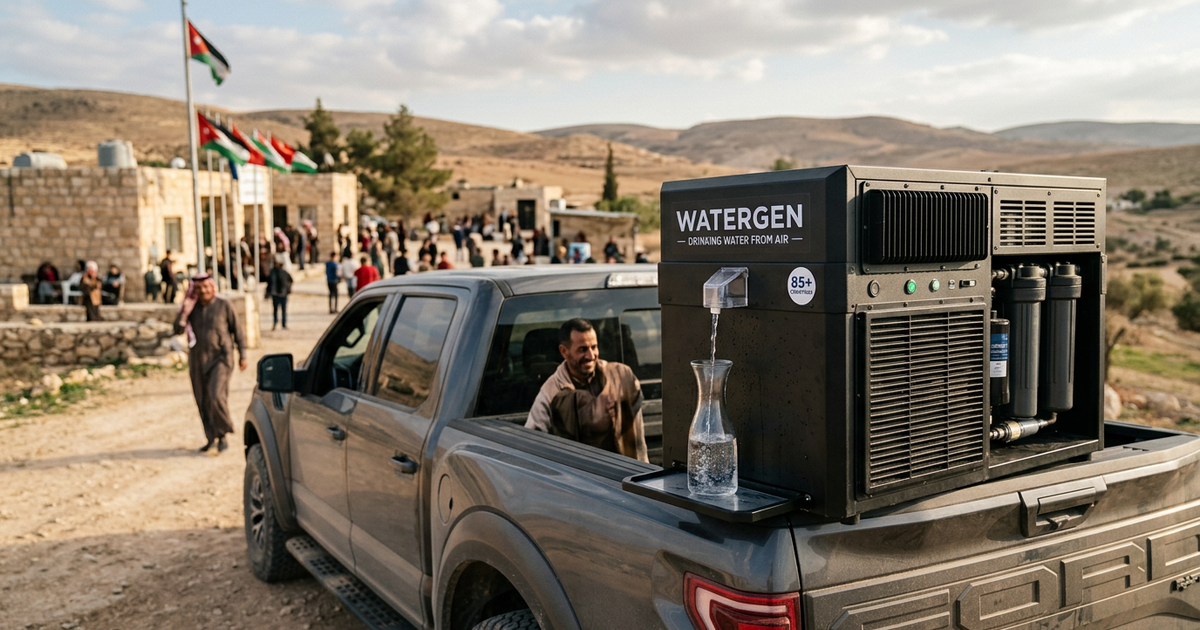
- Watergen ONBoard, the integrated in-vehicle system producing up to 50 liters per day — designed for RVs, caravans, motorhomes, buses, trucks, and trains
- Mobile Box, the portable aftermarket vehicle unit producing up to 25 liters per day — the Ford Ranger partnership product debuted at SEMA in November 2021
The technical distinctions Watergen has emphasized in its public materials are the plastic heat exchanger (versus the aluminum standard in competing designs, which reduces corrosion risk and material cost) and the proprietary control software that manages the generation cycle for efficiency at variable humidity levels.
Pricing and distribution
Watergen's consumer and small-institutional product line carries publicly disclosed pricing. The GENNY Home unit — the flagship residential product, producing 20 to 27 liters per day depending on humidity — lists at approximately $4,999 direct from the company, secured with a $799 deposit. GENNY+, the newer compact variant, delivers 20 liters per day at a lower footprint. The larger GEN-M community and school unit and the industrial-scale generators operate on quotation-based pricing at commercial project scale, typical of the water-infrastructure category.
The Ford Mobile Box aftermarket vehicle unit — 25 liters per day, 30 kilograms, 12V power supply, dimensions 630 x 530 x 460 mm — remains the active OEM-adjacent product line following the November 2021 SEMA debut on the Ford Ranger platform. As of 2026, the Ford integration operates as an aftermarket adventure-vehicle accessory rather than a factory-installed OEM component. The Mullen Automotive 2025 electric-commercial-vehicle partnership extends the same integration model into a different distribution channel.
Watergen employed approximately 94 people globally as of May 2026, operating at intentionally lean scale relative to the international deployment footprint. Private ownership and long-cycle humanitarian and OEM contracts allow the company to run at a headcount that a public-market equivalent would find difficult to defend against quarterly reporting pressure.
The humanitarian footprint
Watergen has become one of the more visible Israeli technology brands in humanitarian-deployment settings. Units have been shipped into disaster zones, refugee installations, and water-stressed communities across Africa, South Asia, Central America, and the Middle East. Deployments include installations in Gaza, in Native American reservations in Arizona through a partnership with the U.S. Bureau of Indian Affairs, and in Uzbekistan through a government-level agreement. The humanitarian footprint is what has driven the company's 85+ country deployment count.
The humanitarian deployments serve two commercial purposes alongside their direct social impact. First, they generate operational field data across a wide range of climate conditions that Watergen uses to refine product design. Second, they build the international brand recognition that supports commercial sales into the same geographies once local commercial demand develops.
The Ford and Mullen OEM partnerships
Watergen announced a partnership with Ford in November 2021 to integrate its Mobile Box atmospheric water generator into Ford's adventure and recreational vehicles — a category where onboard drinking water supply is genuinely useful and where the AWG's electrical draw fits within the vehicle's existing power budget. The Mobile Box made its debut on the Ford Ranger at the SEMA show in Las Vegas that November. A subsequent 2025 partnership with Mullen Automotive integrates Watergen technology across Mullen's electric commercial vehicle lineup.
The OEM path is the commercial complement to the humanitarian deployment. Vehicle integration monetizes the same core technology through a substantially different distribution channel and validates the AWG platform in an application (recreational and commercial vehicles) where the customer values reliability and packaging more than they value the last increment of energy efficiency.
Where Watergen sits in the Israeli water sector
Israel's water sector operates through three complementary categories. Mekorot runs the national grid — infrastructure, water rights, distribution — and exports Israeli water-system engineering globally through consulting and turnkey projects. IDE Technologies runs desalination at scale — the Sorek plant is one of the largest reverse-osmosis desalination facilities in the world, and IDE has built desalination capacity across dozens of countries. Watergen runs atmospheric generation — the specialty category that does not compete with grid or desalination and instead serves locations where neither is present or economical.
The three companies together describe the full architecture of Israeli water capability, from national infrastructure to seawater conversion to atmospheric extraction. Watergen is the smallest of the three by revenue but the most internationally distributed by deployment count. Israeli water expertise, exported.
What Watergen signals
Watergen is a working case study of privately-financed Israeli climate-tech that scales through humanitarian channels and OEM partnerships rather than through public-market capital. Private ownership. Long-cycle deployments. Category leadership in a segment that most public-market investors would consider too niche to fund. Deployments across 85+ countries. OEM partnerships with two commercial vehicle brands. A production-cost metric that puts it in the same energy range as desalination.
Watergen exports not just equipment, but a portable version of water sovereignty. The customer receives the equipment. What Watergen ships is the capability.
Primary Sources
- Watergen Ltd — company product documentation and technical specifications
- Times of Israel — Watergen humanitarian-deployment coverage
- Ford Motor Company — 2021 partnership announcement
- Mullen Automotive — 2025 electric-vehicle partnership announcement
- U.S. Bureau of Indian Affairs — Arizona reservation deployment records