Who Owns the Israeli Story
A handful of families and individuals own nearly everything an Israeli watches or reads — Keshet, Reshet, Channel 14, Yedioth, Israel Hayom, Haaretz, Globes. The ownership map, the money breaking underneath it, and how the balance of power moved right.
A map of the families, tycoons, and political proxies who control what Israelis watch and read — and how the balance of power shifted right as the country's media economics broke.
Israeli media is small, concentrated, and ferociously contested. A handful of families and individuals own nearly everything an Israeli watches or reads — and over the past few years the ownership map and the money underneath it have both moved. Here is who holds what.
Television: the big three
Channel 12 (Keshet). The ratings leader, owned by Keshet Media Group — the Wertheim family (Mozi Wertheim) with veteran executive Avi Nir. Keshet is the dominant commercial broadcaster and a real international content exporter through Keshet International. Its news arm, N12, is the most-watched in the country.
Channel 13 (Reshet). The financially troubled challenger. Control sits with Len Blavatnik's Access, alongside minority holders. Channel 13 was reported to be losing on the order of NIS 12–14 million a month during 2024 despite owner cash injections — one of the toughest crises in the channel's history, and a live search for new investors.
Channel 14. The insurgent. Owned through Jewish Israeli Channel Ltd. by businessman Yitzchak Mirilashvili, Channel 14 is the combative, government-aligned network that rose fastest in 2024–2025. Its hosts run a social-media-native, opinion-forward style that tracks closely with the prime minister's line and keeps audiences engaged well past the broadcast. It is the single biggest shift in the Israeli television landscape this decade.
Kan 11. The public broadcaster — the Israeli Public Broadcasting Corporation — operating Kan News, the Knesset Channel, and radio, and a recurring target of government defunding and restructuring efforts.
Print and digital: the dynasties
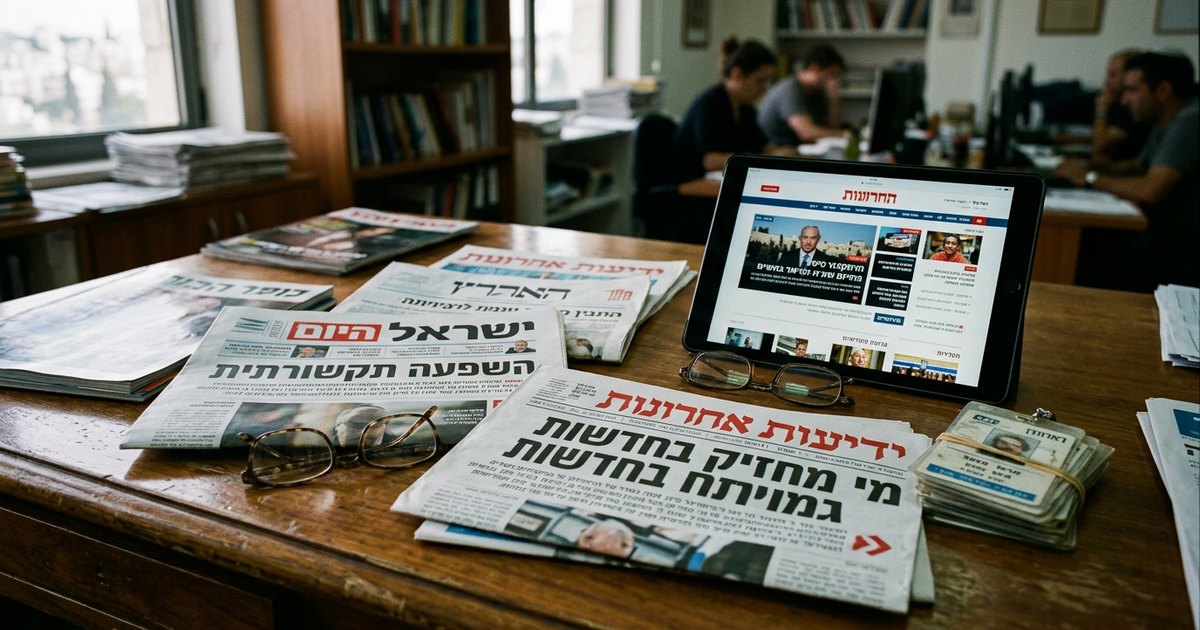
Yedioth Ahronoth Group (Mozes family). Arnon "Noni" Mozes controls the Yedioth empire — the Yedioth Ahronoth newspaper, the Ynet news portal, and the business daily Calcalist. Historically the most powerful media bloc in the country and a central player in Israel's media-political entanglements.
Israel Hayom (Adelson family). The free daily founded by Sheldon Adelson and now associated with Miriam Adelson, explicitly right-wing and Likud-leaning. Its free-distribution model reshaped the economics of the entire print market and is widely credited with weakening Yedioth's commercial position. The family also holds Makor Rishon.
Haaretz Group (Schocken family). Amos Schocken, with Leonid Nevzlin as a major shareholder, controls Haaretz and the business daily TheMarker — the left-liberal anchor of Israeli print and the country's paper of record for the international intellectual audience.
Globes. The leading Hebrew business daily and the most-cited Israeli source for corporate, markets, and deal coverage — the trade engine for exactly the economy this publication covers.
Maariv (Eli Azur). The historic daily, now part of Eli Azur's holdings, which also include The Jerusalem Post — giving Azur a foot in both the Hebrew and English-language markets.
i24NEWS (Patrick Drahi). The international, multilingual news channel owned by telecoms billionaire Patrick Drahi — Israel's primary outward-facing broadcast voice in English, French, and Arabic.
The two shifts that matter
The economics broke. The advertising base that funded Israeli media fragmented to global platforms. Channel 13's monthly losses are the visible symptom; the disease is that legacy Israeli broadcast and print no longer generate the revenue their cost structures assume. Ownership increasingly requires a patron with a non-commercial reason to hold the asset.
The balance moved right. Israel Hayom reset print economics in favor of a right-leaning free daily; Channel 14 did the equivalent in television. The combined effect has been to build a government-aligned media bloc with real reach, alongside the established Keshet–Yedioth–Haaretz center and left. The Israeli media map is no longer just a business map. It is a political one.
For anyone trying to understand how a story travels in Israel — a deal, a scandal, a war, a reputation — the ownership table above is the starting point. Who owns the platform shapes which version of the story the country sees.