
Benslimane: The First Israeli Weapons Factory Outside Israel Just Opened in Morocco
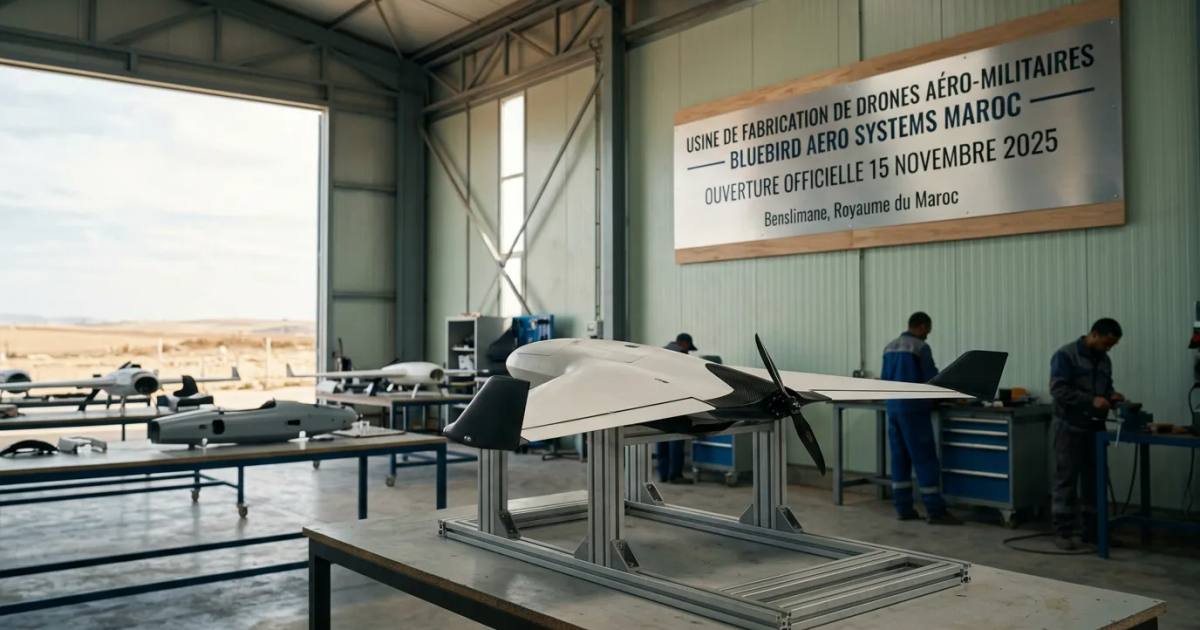
BlueBird Aero Systems opened a SpyX loitering munitions plant in Benslimane on November 15, 2025 — the first Israeli-designed weapons factory anywhere in North Africa or the Middle East outside Israel. The industrial center of the Accords defense trade.
Benslimane: The First Israeli Weapons Factory Outside Israel Just Opened in Morocco
On November 15, 2025, an Israel Aerospace Industries subsidiary inaugurated the first Israeli-designed weapons factory anywhere in North Africa or the Middle East outside Israel. The plant sits in Benslimane, half an hour from Casablanca. It builds SpyX loitering munitions. It is the industrial center of gravity of the entire Abraham Accords defense trade.
The Accords are five years old. Most of the trade has moved through export licenses — weapons made in Israel, sold to signatories, shipped from Ashdod under DECA licensing. The Benslimane plant is different. It is technology transfer. Assembly. Training. A Moroccan supply chain for a system designed in Israel.
That model is the one to watch. Everything else is downstream of it.
The plant
BlueBird Aero Systems inaugurated the Benslimane facility on November 15, 2025 — first reported by Globes and confirmed by Israel Defense, Military Africa, and Defense Post. BlueBird is 50% owned by IAI — a stake IAI acquired in 2020, weeks before the Abraham Accords were signed. The company is a private Israeli manufacturer founded in 2002, headquartered in Kadima-Zoran, specializing in micro, mini, and tactical UAVs.
The plant produces the SpyX loitering munition. Full spec sheet, per BlueBird and confirmed independently by Israel Defense and the Jerusalem Post:
- 50-kilometer operational radius
- 90 minutes of loiter time (some sources cite up to 120 minutes)
- Terminal dive speeds exceeding 250 km/h
- 2.5-kilogram warhead
- Two operators from a single tactical vehicle
- Electro-optical / infrared seekers
- Autonomous target-tracking algorithms
- Designed to strike tanks, armored personnel carriers, command posts, and high-value targets
Moroccan engineers received training at BlueBird facilities in Israel in the weeks before the plant opened, according to Military Africa's reporting. They now run local assembly, integration, and sustainment under a full technology-transfer model. The Moroccan army conducted operational testing of the SpyX in March 2024. Per Globes, the plant makes Morocco the only country in the Middle East or North Africa besides Israel with the capability to manufacture this class of weapon.
The Al-Estiklal Newspaper reported that Moroccan officials frame the facility as a "qualitative shift" — the transition from benefiting from foreign expertise to transferring and imparting it. That framing is not incidental. It is the stated strategic ambition.
The industrial precondition
The Benslimane plant did not come out of nowhere. It is the industrial output of a defense-cooperation MoU signed between Rabat and Tel Aviv in November 2021 — a framework agreement covering knowledge exchange, technology transfer, and joint industrial projects. Israel Defense and Defence Industry Europe both track the November 2021 MoU as the parent document.
Everything that followed sits inside that framework:
- November 2021 — bilateral defense-cooperation MoU signed
- May 2022 — IAI signs a memorandum of agreement with the International University of Rabat to establish an aviation and AI center of excellence, per Israel Defense
- June 2023 — Elbit Systems announces two production sites in Morocco, one in the Casablanca region, per Hespress and Atalayar
- July 2023 — Israel formally recognizes Moroccan sovereignty over Western Sahara. Israeli defense attaché stationed in Rabat, per Israel Defense (July 18, 2023)
- August 2023 — first shipment of Barak MX components delivered, per Morocco World News (Aug 11, 2023)
- November 2025 — BlueBird SpyX plant opens in Benslimane
The 2021 MoU is the parent. Every industrial move since is a child of it.
Why Morocco built for this
The country is not a passive buyer. Morocco is executing a stated national strategy — Defense Minister Abdellatif Loudyi told Parliament in November 2023 that Rabat aims to build a sovereign defense-manufacturing sector. The 2026 defense budget: roughly $15.7 billion per Global Defense Corp, up sharply from prior years. Some sources cite a higher figure of $19 billion (Jerusalem Post) when broader security allocations are included.
Morocco is triangulating three industrial partnerships in parallel:
- Israel — BlueBird / IAI on loitering munitions in Benslimane, Elbit sites on artillery and electronic warfare in Casablanca
- Turkey — Baykar on heavy strike UAVs, per Global Defense Corp
- India — Tata Advanced Systems Maroc, per multiple reports
Add US procurement — HIMARS launchers (18 units signed 2024 per Al-Estiklal), Abrams main battle tank support — and Morocco has a defense industrial base with four sourcing lanes, each with a domestic assembly footprint.
That is not an arms-buyer strategy. That is a defense-manufacturing strategy. Rabat is deliberately building the ecosystem, engineering skills, and supply-chain resilience to operate advanced systems independently in a crisis. Jerusalem Post's April 2026 reporting from the African Land Forces Summit in Rome captured the strategic frame explicitly: this is "sovereign defense-industrial strategy."
The Algeria factor
The reason the corridor exists at all sits east of Rabat. Algeria runs a roughly $25 billion annual defense budget — largely Russian legacy platforms, Cold War-era doctrine, deficit-financed, per Jerusalem Post's country comparison. Africa's largest arms importer, historically supplied by Moscow, now watching Russian production capacity absorbed by the war in Ukraine.
The Western Sahara dispute is the operational trigger. Morocco's sovereignty claim over the territory — recognized by the US in December 2020 as part of the Accords quid pro quo — sits against Algerian-backed Polisario opposition. The 2020 ceasefire collapse produced ongoing low-intensity conflict. Israeli capability was the fastest available answer.
The equipment mix reflects that requirement. Per multiple defense-industry trackers including DIMSE, Globes, Defense Industry Europe, and SIPRI:
- Elbit ATMOS 2000 howitzers — 36 units, roughly $200M+, signed February 2025 per La Tribune reporting relayed by Globes
- Elbit PULS artillery — $150M, 2023, delivery by 2026, per Yabiladi and Globes
- Elbit Alinet electronic warfare and SIGINT — $70M, June 2022 contract, per Military Africa
- Elbit Hermes 900 drones — operational, undisclosed value
- IAI Barak MX air defense — reported $500M–$1B range, contract February 2022, first shipments 2023, per Morocco World News
- IAI Ofek 13 reconnaissance satellite — selected 2024 over Airbus and Thales bids
- Rafael Spike ATGM — under Morocco Ministry of National Defense procurement
- Rafael Spyder air defense — selected March 2023, per Defense Industry Europe
Total Moroccan spend on Israeli defense since December 2020: an estimated $1.5 billion. SIPRI ranks Israel as Morocco's third-largest arms supplier at 11% of imports as of the most recent update. Global Defense Corp reported bilateral trade doubled in 2023 to $116.7 million (all categories) and grew a further 64% in the first five months of 2024 — those numbers are goods trade separate from defense procurement.
The manufacturing pivot
The BlueBird plant matters because it changes the trade category. Everything before it was an export — Israeli-built, Moroccan-bought, licensed at DECA in Israel. The plant makes Morocco a producer.
That opens two paths.
First, Morocco can now export SpyX-derived systems to third countries. Jerusalem Post's November 2025 reporting positioned the plant as a potential hub for African and Middle Eastern markets. That gives Israeli defense IP a distribution channel through a non-Israeli passport — useful in markets where an Israeli origin is politically difficult.
Second, the model is portable. What worked with BlueBird in Benslimane can work with Elbit in Casablanca. It can work with Rafael on Spike. It can extend to Bahrain, to the UAE, and — eventually — to Saudi Arabia. The Benslimane precedent gives Israeli primes a template for how technology transfer, not export licensing, becomes the primary trade mechanism.
The US Army has already validated the direction. In March 2026, at the African Land Forces Summit in Rome, General Christopher Donahue — commander of US Army Europe and Africa — announced plans to establish the continent's first dedicated drone training center in Morocco, per Jerusalem Post reporting. The hub will train operators from across Africa on small UAS, loitering munitions, counter-drone systems, and integrated electronic-warfare operations. Washington is siting African drone doctrine in the country that just started manufacturing Israeli drones.
The bigger picture
The Accords defense trade was priced as a series of arms sales. Benslimane reframes it. The corridor is now an industrial network — Israeli IP, Moroccan production, African distribution, US doctrine integration.
That is what an industrial base looks like. Not a transaction. A supply chain.
Orinoco Tribune's December 2025 analysis put it in the strongest terms: the SpyX production line represents "a strategic alignment between Rabat's defense industrial ambitions and Israel's growing security architecture in North Africa." That alignment took five years to build. BlueBird just delivered the first working node.
The next node is coming. When Elbit's Casablanca sites open. When Rafael negotiates its Delilah cruise-missile production line — a deal Defense Industry Europe has been tracking since July 2023. When the UAE and Bahrain look at the Moroccan template and start asking for their own.
Israel's defense industry has spent 60 years exporting weapons. It just started exporting the ability to build them.