Hadassah Medical Organization: The Ein Kerem–Mount Scopus Campus, Israel's First Bone Marrow Transplant and Stem Cell Research Center
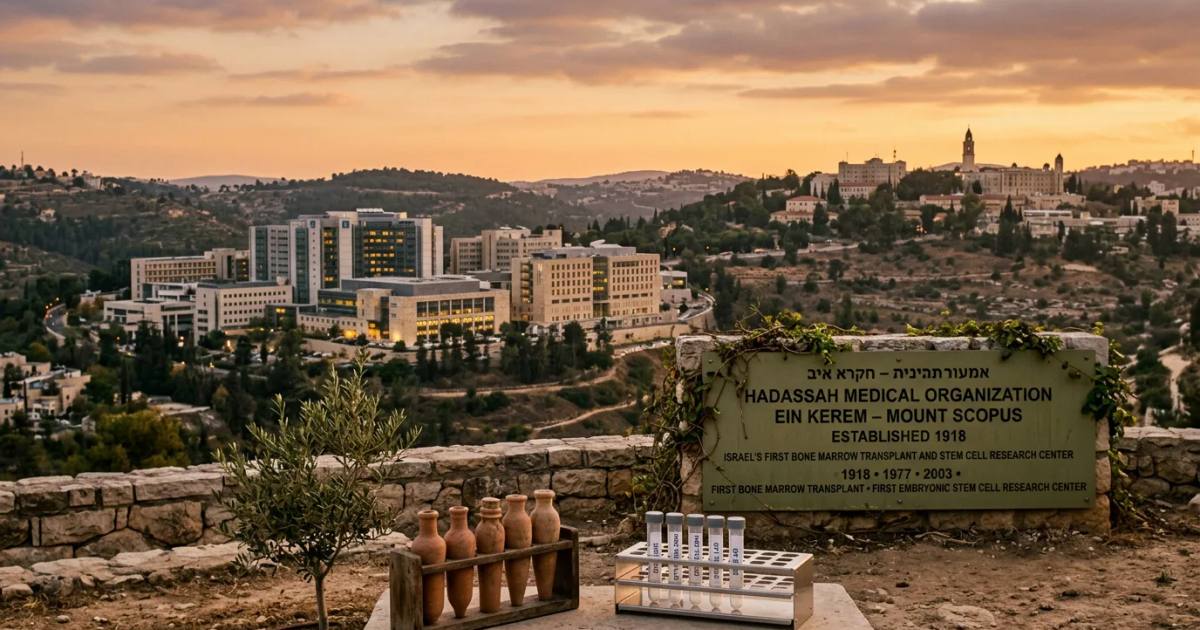
Two Jerusalem campuses — Ein Kerem and Mount Scopus. 1918 origins via Henrietta Szold's AZMU. 1,300+ beds, ~1M patients/year. Israel's first bone marrow transplant (1977), IVF (1982), heart transplant (1986), PET (1991), gene therapy (1998), Embryonic Stem Cell Center (2003).
Israeli Health & Biotech | Olam.business
Hadassah Medical Organization is the two-campus academic medical system in Jerusalem — Ein Kerem and Mount Scopus — founded in 1918 by the Hadassah Women's Zionist Organization of America and affiliated with the Hebrew University of Jerusalem. With 1,300+ beds, 45 operating theaters, and approximately one million patients treated per year, Hadassah is the institution responsible for Israel's first bone marrow transplant (1977), first IVF conception (1982), first heart transplant (1986), first PET unit (1991), first genetic therapy unit (1998), and the Human Embryonic Stem Cell Research Center (2003).
Snapshot
| Location | Two campuses in Jerusalem — Ein Kerem and Mount Scopus |
| Founded | 1918 (American Zionist Medical Unit arrival); Ein Kerem hospital opened 1961 |
| Beds | 1,300+ (Ein Kerem alone: ~1,044) |
| Operating theaters | 45 |
| Patients treated annually | ~1,000,000 |
| Affiliated university | Hebrew University of Jerusalem |
| Patron organization | Hadassah — Women's Zionist Organization of America |
| Director General | Prof. Yoram Weiss (appointed June 2022; 11th director-general) |
| Ein Kerem Hospital Director | Dr. Yaniv Sherer (appointed 2023) |
| Scientific output | 2,000+ scientific publications in past 5 years; 40–50% of Israeli biomedical research |
| Patents | 200+ |
| Israel Prize wins | 12 |
| Startups spun out | 15+ |
| Global recognition | Nominated for the Nobel Peace Prize (2005) |
The 1918 Origins
Hadassah's medical presence in the land of Israel begins in 1918 with the arrival of the American Zionist Medical Unit (AZMU) — a delegation dispatched under the auspices of Henrietta Szold's Hadassah, the Women's Zionist Organization of America, founded in 1912. The unit established the first Western-standard clinical infrastructure across pre-state Palestine.
The original Hadassah University Hospital was built on Mount Scopus — the ridge northeast of the Old City of Jerusalem — and inaugurated in 1939. Following the 1948 Arab-Israeli War, Mount Scopus was left as an Israeli enclave inside Jordanian-controlled territory, cut off from Jewish Jerusalem. The Mount Scopus tragedy — the April 1948 convoy attack that killed 78 physicians, nurses, and researchers — became a defining event in Hadassah's institutional memory.
With Mount Scopus inaccessible, the decision was taken to build a new campus in western Jerusalem at Ein Kerem. That campus opened in 1961. Following the 1967 Six Day War, Israel regained Mount Scopus, and Hadassah rebuilt on both sites — the current two-campus configuration.
Scale & Structure
Hadassah operates approximately 1,300 beds across its two campuses, with more than 45,000 surgical operations and procedures per year, nine specialized intensive care units, and five schools of allied medical professions run jointly with the Hebrew University. Ein Kerem alone accounts for roughly 1,044 beds.
Ein Kerem's principal buildings include the 19-story Sarah Wetsman Davidson Tower (inaugurated 2012 at Hadassah's centennial), the Charlotte R. Bloomberg Mother and Child Center, the Judy and Sidney Swartz Center for Emergency Medicine — home to Jerusalem's only Level 1-A Trauma Unit — the Moshe Sharett Institute of Oncology, and the Wohl Institute for Translational Medicine. The Ein Kerem campus contains more than 28 buildings across the site.
Israel's Clinical Firsts
Hadassah is the institutional origin of the Israeli tertiary-care record book:
- 1977 — Israel's first successful bone marrow transplant
- 1982 — Israel's first test-tube (IVF) conception
- 1985 — Israel's first skin-grafting center
- 1986 — Israel's first heart transplant
- 1987 — Israel's first artificial vertebrae replacement
- 1991 — Israel's first positron emission tomography (PET) unit
- 1992 — Israel's first rapid response trauma unit
- 1998 — Israel's first genetic therapy unit
- 2003 — Hadassah Human Embryonic Stem Cell Research Center established
- 2005 — Judy and Sidney Swartz Center for Emergency Medicine dedicated; Nobel Peace Prize nomination received
Research Infrastructure
Hadassah is the single largest producer of biomedical research in Israel — an estimated 40 to 50 percent of Israeli biomedical research is conducted at Hadassah, backed by 2,000+ scientific publications in the past five years and more than 150 active clinical trials at any point in the annual cycle. The research infrastructure includes the Hadassah Clinical Research Centre, the Goldyne Savad Institute for Gene Therapy, the Human Embryonic Stem Cell Research Centre, and Israel's only hospital-based cyclotron facility for PET-radiopharmaceutical synthesis.
The Wohl Institute for Translational Medicine, directed by Prof. Rinat Abramovitch, houses optical imaging (two fluorescence and luminescence IVIS devices), micro-CT for single-micron precision, and full biological and chemical laboratory infrastructure — all under one roof — supporting the pipeline from bench research to clinical translation. Hadassah has spun out more than 15 startups and holds 200+ patents.
Post-October 7
Hadassah's Ein Kerem campus, which houses Jerusalem's only Level 1-A Trauma Unit at the Swartz Center for Emergency Medicine, functioned as a primary tertiary trauma center for casualties evacuated from combat zones and terror incidents after October 7, 2023. The hospital's Health Ministry–published quality indicators — both Ein Kerem and Mount Scopus received top scores in the most recent report — provided the operational baseline for the wartime surge posture.
Leadership
Prof. Yoram Weiss — Director General of the Hadassah Medical Organization, appointed June 2022 as the organization's 11th director-general. Weiss received his medical degree from the Technion Medical School in Haifa, trained in anesthesiology and critical care medicine at Hadassah and the University of Pennsylvania, and served as director of Hadassah Hospital Ein Kerem from 2014 to 2021. He holds academic appointments as Associate Professor at the Hebrew University–Hadassah School of Medicine and as Adjunct Associate Professor at the University of Pennsylvania. Twice awarded Israel Science Foundation research grants; recipient of the European Critical Care Research Network Basic Science Award.
Dr. Yaniv Sherer — Director, Hadassah Hospital Ein Kerem, appointed 2023. A professor of internal medicine specializing in autoimmune diseases. Previously Deputy Director General of Ichilov Tel Aviv Medical Center, Medical Assistant to the CEO of Israel's Ministry of Health, and a founder of Israel's National Program for Quality Indicators in Community Healthcare — the basis for the Ministry of Health's annual Health Quality Indicators Report.
Why Hadassah Matters
Three reasons. First, historical primacy — Hadassah is the institutional origin of modern Israeli medicine. Nearly every "first" in Israeli tertiary care runs through Hadassah in the second half of the twentieth century. Second, research density — no other single Israeli institution produces the volume and translational depth of biomedical research at Hadassah, and the pipeline through the Wohl Institute is engineered to convert clinical problems into commercial and academic output. Third, Jerusalem's Level 1-A trauma anchor — with the Swartz Center hosting Jerusalem's only Level 1-A Trauma Unit, Hadassah is operationally irreplaceable in the capital's emergency and mass-casualty architecture.
FAQ
Where is Hadassah Medical Organization located?
Hadassah operates two campuses in Jerusalem — Ein Kerem in western Jerusalem, and Mount Scopus in the northeast of the city. The Ein Kerem hospital opened in 1961; the Mount Scopus hospital was rebuilt after Israel regained the ridge in the 1967 Six Day War.
Who founded Hadassah?
The organization was founded in 1912 in the United States by Henrietta Szold as the Hadassah Women's Zionist Organization of America. The American Zionist Medical Unit arrived in Palestine in 1918. The original Mount Scopus hospital opened in 1939.
How large is Hadassah?
Approximately 1,300 beds across the two campuses, 45 operating theaters, nine specialized ICUs, five schools of allied medical professions, and roughly one million patients treated annually.
What were Hadassah's Israeli clinical firsts?
First bone marrow transplant (1977), first IVF conception (1982), first skin-grafting center (1985), first heart transplant (1986), first artificial vertebrae replacement (1987), first PET unit (1991), first rapid response trauma unit (1992), first genetic therapy unit (1998), Human Embryonic Stem Cell Research Center (2003).
Who runs Hadassah today?
Prof. Yoram Weiss has served as Director General since June 2022. Dr. Yaniv Sherer directs the Ein Kerem hospital (appointed 2023).
What share of Israeli biomedical research runs through Hadassah?
Approximately 40 to 50 percent of Israeli biomedical research is conducted at Hadassah, supported by 2,000+ scientific publications in the past five years and 150+ active clinical trials.
Related Olam Coverage
- Israeli Health & Biotech — Olam's pillar coverage of the Israeli health and biotech sector
- Sheba Medical Center — Tel Hashomer, #7 in the world, City of Health
- Tel Aviv Sourasky Medical Center (Ichilov) — 1,500-bed acute-care referral center
- Rambam Health Care Campus — Haifa Level-1 trauma and world's largest underground hospital
- Teva Pharmaceutical Industries — the foundational pillar of the Israeli pharmaceutical sector
The Olam Editorial Team