
Gindi Holdings — Israeli family developer behind Sarona Market, TLV Fashion Mall, and the Gindi TLV luxury towers on the old Wholesale Market compound. Three generations, fifty years. Trophy residential and destination retail. Anchor name in central Tel Aviv development.
Gindi Holdings is one of the anchor developer names in Tel Aviv — the family behind Sarona Market and the four Gindi TLV luxury towers on the old Wholesale Market compound. Three generations, fifty years of Israeli real estate.
The Family
Gindi is a family-owned Israeli real estate group, active for roughly fifty years. The older generation — brothers Moshe and Yigal Gindi — built the original portfolio out of Gold Mall in Holon and expanded through malls, shopping centers, and residential development across Israel.
The next generation — Manor Gindi, his brother Kfir Gindi, and their brother-in-law Ori Levy — now runs the flagship Tel Aviv franchise through Gindi Investments, Gindi TLV, and Gindi Brothers.
Manor Gindi
Born 1974. Son of Tova and Moshe Gindi. Grew up in Rishon LeZion and Savyon, spent formative years in New York and Brazil — fluent in English and Portuguese. Served in the Israeli Air Force Computer Unit, discharged 1995. Bachelor's degree in Economics and Management from the College of Management Academic Studies.
Manor's commercial instincts showed early. As a teenager he organized distribution networks for gifts and electrical products. By 17 he was selling insurance policies at the family-owned Gold Mall. He entered formal real estate in 1998, starting in commercial marketing at Gold Mall, and delivered his first development — the 328-unit Rabin Towers residential project in Holon — before moving into the Tel Aviv trophy projects that define the Gindi name today.
Manor is the founder and owner of Gindi Investments, Gindi TLV, and Gindi Brothers. He co-founded iGindi with brother Kfir — a digital urban renewal management company. He holds a stake in Gefen Housing and Urban Renewal Ltd. He is a member of YPO Israel.
Lives in Savyon with his wife Bat-El and five children.
Distinct from the American Gindi family (Century 21 Stores, Eli Gindi's Gindi Capital in New York and Las Vegas). Same Syrian-Jewish heritage tree, separate businesses entirely.
Gindi TLV — The Flagship
Four luxury residential towers on the site of Tel Aviv's former Wholesale Market compound — a 55-dunam mixed-use campus that is the most important single land bet in central Tel Aviv in the last decade.
The numbers: four towers, 47–48 stories each, rising 180 meters. A total of 2,262 apartments across the four towers. Unit sizes range from 52 to 143 square meters — standard apartments, mini penthouses, lofts, and duplexes. Price range: NIS 3.4 million to NIS 10 million. Every unit positioned for sea and cityscape views through a distinctive clover-leaf architectural design.
Architect: MYS Architects, led by project architect Rachel Feller. MYS is one of the leading firms in Israeli community urban architecture.
The campus also includes the TLV Fashion Mall (below), a country club, and a planned public urban park. Considered the largest single development project under construction in Tel Aviv when it broke ground. This is the Gindi trophy asset — the piece the family kept when it sold everything else.
Sarona Market
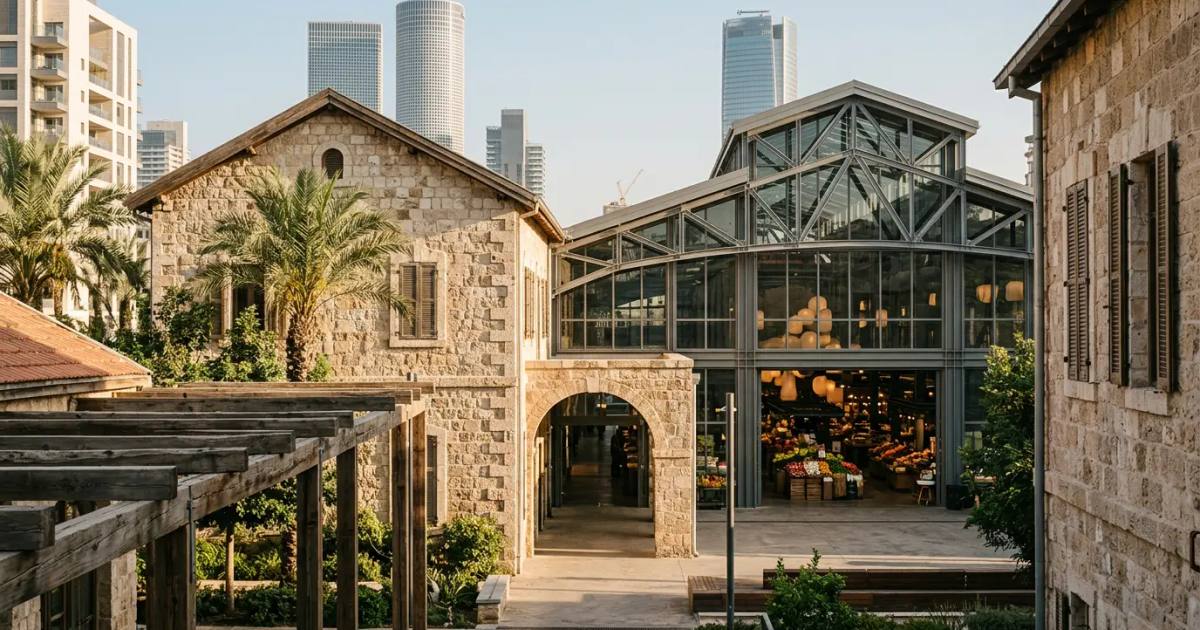
Developed by Gindi Holdings. Opened 2015. 8,700 square meters. Approximately 90 businesses — retail stores, food stands, and restaurants. The first indoor culinary market in Israel, and the project that sparked a nationwide wave of enclosed food-market developments.
Investment: more than NIS 530 million.
Designed by architects Kika Braz, Uri Ben Dror, and Michael Ankawa of Studio Mo. Sits inside the restored Templer-colony Sarona compound at the southern edge of the Kirya military headquarters complex — integrating a modern culinary destination into heritage structures dating to the German Templer settlement founded in the 1870s.
Sarona Market became a citywide destination retail asset from its first year — a tourist anchor and a commercial proof of concept for the Gindi TLV development surrounding it.
On June 8, 2016, a shooting at the Max Brenner restaurant inside Sarona Market killed four civilians and injured 16 others. The attack was one of the most significant violent incidents in central Tel Aviv and temporarily affected foot traffic, though the market recovered and remains one of the most visited commercial addresses in the city.
TLV Fashion Mall
32,000 square meters. Two floors. Roughly 200–250 stores. Opened September 2016 as part of the Gindi TLV complex.
Originally a 50/50 partnership with Blue Square Real Estate. In late 2019, the Manor/Kfir/Ori Levy line sold its 50 percent stake for NIS 225 million — booking a NIS 125 million loss on the exit. The sale was strategic: the family chose to exit the mall to concentrate capital on the four Gindi TLV residential towers.
The willingness to take a loss on a retail asset to concentrate on trophy residential tells you what Gindi prioritizes.
The Rest of the Portfolio
Gold Mall, Holon. The original Gindi asset. Operated with Migdal Insurance as strategic partner. This is where Manor started — running the mall's commercial operations from age 21.
Giv'at Mall. Developed by Gindi, sold to Harel Insurance.
Ramla Mall. Developed by Gindi, sold to David Azrieli's Azrieli Group.
Rabin Towers, Holon. Manor Gindi's first residential development — 328 units. The proof-of-concept project before the Tel Aviv franchise.
Ganei Ilan, Kiryat Ono. Residential development.
Gindi Park Holon. Residential development.
Additional developments in Tel Aviv, Netanya, and Givat Shmuel.
International positions. Development projects in Romania, Hungary, and Switzerland — representing the family's expansion beyond the Israeli market.
Urban Renewal (Pinui-Binui)
Gindi is active in large-scale Pinui-Binui — Israel's evacuation-and-reconstruction urban renewal framework, in which developers demolish aging apartment blocks and replace them with modern high-rises, giving existing residents new apartments in the replacement buildings. Manor Gindi pioneered several large-scale Pinui-Binui projects, and co-founded iGindi with brother Kfir specifically to manage the digital infrastructure for urban renewal operations.
What Gindi Represents
Trophy residential and destination retail. Gindi does not run a mass-market volume playbook like Ashdar, Y.H. Dimri, or Rotshtein. It runs a small number of very large trophy projects — Gindi TLV, Sarona Market — where the value is the address, the branding, and the destination pull.
Family control. Every anchor project runs through a Gindi-family holding vehicle. No TASE listing on the residential development side. Institutional capital enters through partnership vehicles (Migdal at Gold Mall, Blue Square at TLV Mall) rather than public ownership.
Willingness to exit. The pattern of Giv'at Mall to Harel, Ramla Mall to Azrieli, and the 2019 TLV Mall stake sale to Blue Square shows a family group that treats income-producing assets as tradable positions, not permanent holdings. The four Gindi TLV towers are the exception — the piece they kept.
The Wholesale Market bet. Converting a decommissioned wholesale market into 2,262 apartments, 32,000 square meters of retail, and a public urban park on a 55-dunam site is the scale of transformation that only anchor family developers execute. This is the project that defines the Gindi name for the next generation.
Where Gindi Fits
Africa Israel (Leviev era) built Ir Yamim in Netanya. Melisron (Ofer) runs the mall book. Azrieli built the skyline. Gindi built the block — the Wholesale Market compound and Sarona Market — the two destination-retail-plus-residential complexes in central Tel Aviv that redefined what a mid-city luxury address looks like.
Not a volume developer. Not a mall REIT. Something narrower: the family that turns single downtown Tel Aviv sites into permanent city landmarks.