
Shapir Engineering Weighs NIS 1 Billion Move for Ashdod Refinery Control
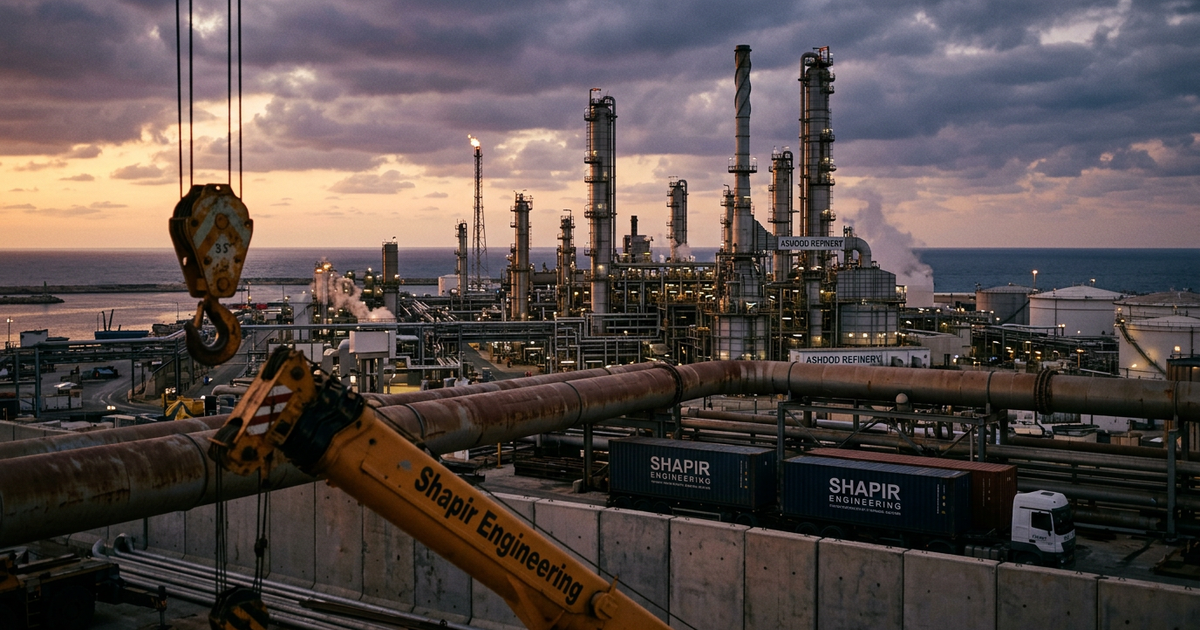
Shapir Engineering's NIS 1 billion bid for the Ashdod Refinery would consolidate one of Israel's two strategic refining assets under a major domestic infrastructure builder.
Shapir Engineering is evaluating a bid of around NIS 1 billion to take control of the Ashdod Refinery, a transaction that would consolidate one of Israel's two strategic refining assets under a major domestic infrastructure builder. The move would reshape Israel's downstream-energy ownership map and mark the first time a domestic construction-and-infrastructure group has held outright control of a major Israeli refining complex.
The Ashdod Refinery is one of two refining complexes serving the Israeli market, alongside the larger Haifa-based Bazan Group (TASE: BAZN), which controls the Haifa refining and petrochemical complex. Ashdod processes a meaningful share of Israeli domestic fuel demand and is integrated with the southern port infrastructure that handles Israeli imports and exports of refined product. Control of Ashdod has historically passed through a sequence of strategic and financial owners — the most recent of which has signaled willingness to exit after roughly three and a half decades of involvement, per Hebrew reporting.
Shapir Engineering (TASE: SPEN) is one of Israel's largest infrastructure contractors and is publicly traded on the Tel Aviv Stock Exchange. Its work spans national road and rail infrastructure, including major segments of the Tel Aviv light-rail network and intercity rail projects, energy and water infrastructure, and a growing real-estate development arm. The proposed Ashdod move fits a pattern of Israeli infrastructure builders moving up the value chain from build-and-deliver contracting into long-duration asset ownership — a model long since adopted by European peers such as Ferrovial, Vinci, and ACS.
Why It Matters
Israeli refining and downstream energy are sensitive both economically and strategically. The country relies on its two refining complexes for the bulk of its domestic fuel supply, and the regulator has historically been cautious about ownership concentration in this part of the energy stack. The transaction sits inside the same sector dynamic that drives NewMed Energy's push to reopen its gas-export terms — Israeli downstream energy is being repriced in real time, and operators are positioning accordingly. A NIS 1 billion control transaction would mark a generational shift in ownership and would force the regulator into a public posture on domestic consolidation of energy infrastructure.
It also matters for the broader Israeli infrastructure-economy thesis. Shapir's move suggests that domestic infrastructure builders see long-duration, regulated-asset ownership as the next leg of their growth — beyond the boom in road, rail, and renewable-energy contracting that has driven their revenue over the past decade. That thesis aligns with what international infrastructure funds have been signaling for years, and aligns with what family-office capital and Israeli institutional investors have been quietly deploying into Israeli hard assets. The infrastructure thesis runs in parallel to the AI-infrastructure deployment visible in Crusoe's Afula data-center deal — both are bets on long-duration Israeli capital assets, in different sectors.
The Regulator Question
The Israel Competition Authority and the Ministry of Energy will both have a view. Concentration of refining ownership in domestic hands is not in itself a competitive issue — there are only two refining complexes nationally and they already operate under heavy regulatory oversight. But the precedent matters. If Shapir successfully consolidates Ashdod, the next question becomes whether similar moves are possible across other Israeli strategic-infrastructure assets — water utilities, port concessions, transmission grid, gas distribution. Regulator posture on the Shapir bid will set the template.
What to Watch
Three indicators. First: confirmation of the bid as binding rather than exploratory, expected within the next 60 days. Second: parallel interest from Israeli institutional investors — Migdal Insurance, Phoenix Holdings, Harel Insurance, Clal Insurance — which historically participate in Israeli infrastructure transactions of this scale, often through subsidiary asset-management arms. Third: Bazan Group market reaction, which will signal how the sector reads the precedent.
FAQ
Who is Shapir Engineering?
A publicly traded Israeli construction and infrastructure group (TASE: SPEN), active across roads, rail, energy, water, and real estate. One of the largest infrastructure contractors in Israel.
What is the Ashdod Refinery?
One of two major refining complexes serving the Israeli market, located in the southern port city of Ashdod. The other complex is operated by the Bazan Group in Haifa.
Has a deal been signed?
No. Shapir is reported to be weighing a move at the NIS 1 billion level; no binding transaction has been announced at time of reporting.
Will the regulator approve?
The Israel Competition Authority and Ministry of Energy will both review. The strategic-infrastructure concentration question is more about precedent than competition — there are only two refining complexes nationally.
Who else might compete for the asset?
Israeli institutional investors — Migdal, Phoenix Holdings, Harel, Clal — historically participate in transactions of this scale. Foreign strategic buyers are less likely given regulator posture on foreign ownership of strategic assets.
Published 16 June 2026 · Olam Hebrew Desk