
The $52 Billion Question
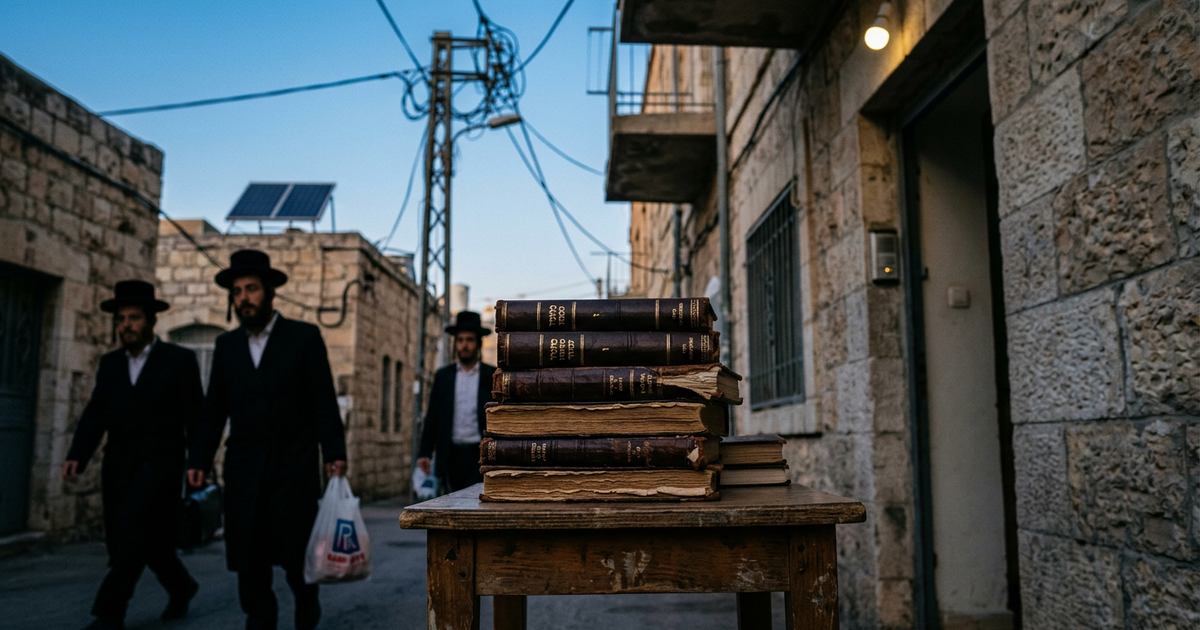
The ultra-Orthodox are Israel's fastest-growing population and its largest untapped economic resource. The IDI puts the cost of non-integration above 10% of GDP — roughly $52 billion. The demographics, the employment split, and why October 7 made it urgent.
The Haredi economy is no longer a social-policy issue. It is Israel's central growth question.
No domestic variable will shape Israel's economy over the next quarter-century more than the Haredi question. The ultra-Orthodox community is growing faster than any other group in the country, and its distinctive patterns of work, education, and military service are now the dominant fault line in Israeli economic policy. This is not a cultural sidebar. It is the main story.
October 7 turned a long-running economic debate into an immediate national-capacity debate.
The demographics
Israel's ultra-Orthodox population numbers roughly 1.45 million people — about 14.3% of the country, according to the Israel Democracy Institute's 2025 statistical report, its tenth annual edition. The defining feature is youth: around 57% of the Haredi population is under 19, making it one of the youngest societies in the world.
The trajectory is steeper than the current share suggests. Israel's Central Bureau of Statistics projects the Haredi population at roughly 20% of the country by 2040 and about 24% by 2050 — nearly one in four Israelis. Yeshiva and kollel enrollment keeps climbing; roughly 420,000 students were in ultra-Orthodox educational frameworks in the 2024–2025 school year.
The $52 billion number
Here is the figure that reframes the entire debate as economics rather than culture. The IDI estimates that the loss of potential GDP from the non-integration of the Haredim could exceed 10% — on the order of NIS 160 billion, roughly $52 billion, in 2023 GDP terms.
The OECD has made the same point in its Economic Surveys of Israel: the country's long-run growth and fiscal sustainability depend heavily on integrating the Haredi and Arab populations, and the outcome is highly sensitive to government policy. Conditioning school funding on teaching English and mathematics, equalizing per-pupil funding, and removing subsidies that discourage work could materially accelerate integration above the baseline.
The employment split
The economic story is a tale of two genders. Haredi women are already deeply integrated into the labor market. Haredi men remain only partially integrated.
The women. Female employment in the community sits around 81% — nearly identical to the rate for non-Haredi Jewish women. Haredi women are increasingly the household's primary earner, concentrated in teaching, administration, and a fast-growing presence in tech and services.
The men. Male employment has been stuck in the low-50% range for a decade — about 53% in 2025 — as large numbers of men remain in full-time religious study rather than the labor market. After a major surge between 2003 and 2015, integration stalled. That stall is the core of the problem.
Even among those who work, the wage gap is wide. The IDI report put the average monthly wage for ultra-Orthodox men at roughly NIS 9,900 — about half that of non-Haredi Jewish men — and for women around NIS 8,600, about two-thirds of their non-Haredi counterparts. Both groups also work fewer weekly hours.
The poverty paradox
Roughly a third of ultra-Orthodox families live below the poverty line, against about 14% of non-Haredi Jewish families. Average gross monthly household income trails the rest of Jewish Israel substantially — the structural result of single-breadwinner households and large family sizes.
Yet the picture is not simple deprivation. Around three-quarters of the ultra-Orthodox own their homes, and car ownership and living standards have risen. Participation in capital-market savings is low — roughly 11% versus 28% among non-Haredi Jews — and the community leans on debit over credit and has thinner digital financial literacy. The community is asset-rich relative to its measured income and financially fragile at the same time. Both things are true.
The conscription overlay
The economic question is inseparable from the military one. Haredi enlistment remains very low — roughly 2,560 ultra-Orthodox men entered military service in 2024, with several hundred more in national civilian service — even as the post-October 7 war has stretched the rest of the country's reserve burden to its limit.
The government has been advancing legislation to regulate Haredi conscription while the exemption regime faces legal challenge. The result is the most charged domestic-political fight in Israel: a debate that is simultaneously about who serves, who works, and who pays — and whether the implicit social contract that exempted a small community from both can survive that community becoming a quarter of the country.
The question is not whether the Haredi community contributes. It does. The question is whether Israel's economic model can survive without broader male labor-force participation, core education, and shared national service.
Why this is the story
For a publication covering the Israeli business economy, the Haredi question is not a niche. It is the single largest swing factor in Israel's long-run growth, tax base, labor supply, and fiscal stability. A community that integrates closer to the non-Haredi employment and productivity curve adds enormous capacity to the economy. A community that doesn't, while growing to a quarter of the population, becomes the constraint that caps it.
The trend lines are clear: rapid growth, stalled male employment, rising female employment, a widening income gap, and a hardening political fight. The $52 billion figure is not just an economic estimate. It is Israel's margin of error.