The Land, the Donors, the Endowments
The capital structure behind Jewish camp — real estate (likely $1.5-2.5B aggregate), endowments, the $140M+ Marcus Foundation gave to RootOne, and the thin layer of foundations that sustain the field. Read the 990-PFs.
The capital structure behind Jewish camp — real estate, donor concentration, and the $140 million one man gave to a single program.
A Jewish overnight camp is not a $3.28-million-a-year operating business. It is a $3.28-million-a-year operating business sitting on a multi-decade real estate position, an endowment portfolio, a five-year capital campaign, and a donor stack — and the operating piece is the smallest of those four numbers.
This piece quantifies the rest.
Real estate — the largest line on the balance sheet
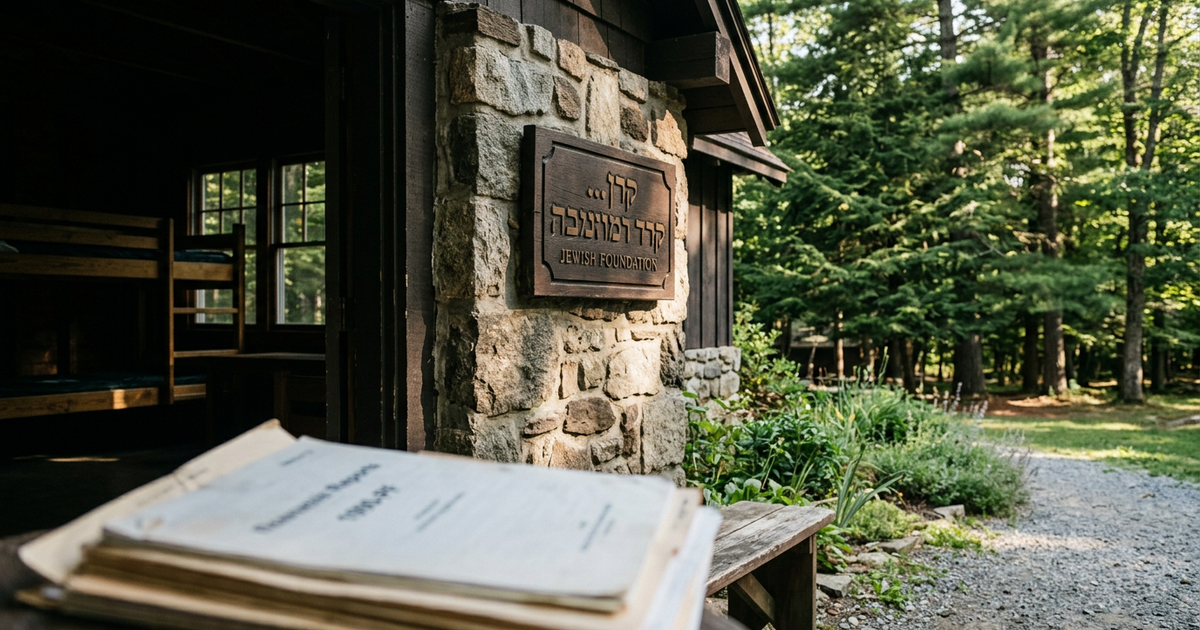
Most North American Jewish overnight camps own their land. Acreage ranges from 50 acres at small camps to 500+ acres at the largest. Book values reported on Form 990 Part X tend to understate market values significantly, because most camps acquired land decades ago and depreciate the buildings rather than reflecting current appraisals.
Where the camp real estate is
Geographic concentration is high:
- Catskills and Hudson Valley (NY) — historically the densest Jewish camp region; includes Camp Ramah Berkshires (Wingdale), URJ Crane Lake (West Stockbridge MA), and dozens of independent and movement camps
- Pocono region (PA) — URJ Camp Harlam, multiple Bnei Akiva and movement camps, CGI Poconos
- Wisconsin Northwoods — Camp Ramah in Wisconsin (Conover), URJ OSRUI (Oconomowoc), Habonim Dror Camp Moshava
- The Berkshires (MA) — URJ Eisner Camp (Great Barrington), URJ Crane Lake, Camp Ramah in New England (Palmer)
- Northern California — URJ Camp Newman (Santa Rosa), Camp Tawonga (Yosemite area), Camp Ramah Galim (Aptos)
- Southern Ontario — Camp Ramah in Canada (Utterson), URJ Camp George (Parry Sound)
- Coastal Maine — multiple specialty and movement camps
- Mountains of Western North Carolina and Georgia — Camp Ramah Darom (Clayton GA), URJ Camp Coleman (Cleveland GA), URJ Henry S. Jacobs Camp (Utica MS)
County assessor records suggest aggregate camp real estate values measured in hundreds of millions of dollars — likely into the low billions before market adjustments. This makes Jewish camp a major holder of rural recreational real estate in the United States — a fact almost no commercial real estate analysis has noted.
How camp valuations actually work
Three valuation frames apply:
- Book value — original acquisition cost minus accumulated depreciation. Reported on Form 990 Part X. Almost always understates market value, often by an order of magnitude.
- Assessed value — county tax assessor's valuation, often used for property tax purposes (though most Jewish camps are tax-exempt and the assessed value applies in limited contexts). Closer to market but typically lagging.
- Market value — what the property would fetch in an arm's-length sale. Rarely tested for active Jewish camps because they almost never sell.
When camp properties do sell, the data points are dramatic. Recreational properties of 200+ acres with lake frontage and developed bunk infrastructure in the Catskills, Poconos, or Berkshires have sold for the high seven figures to low eight figures in recent decades. Multiplied across the 157 overnight camp sites in North America, the aggregate market value of Jewish overnight camp real estate plausibly exceeds $1.5–2.5 billion — before considering capital improvements and infrastructure.
Endowments — the long money
Established Jewish camps run endowments. Form 990 Schedule D shows endowment composition and activity. Many flagship camps — the larger Ramah camps, several URJ camps, and large independents — report endowments in the high single-digit to low double-digit millions. Capital campaigns at the largest camps regularly raise $10M to $50M in five-year cycles.
Endowments are the resilience layer. The 2024 FJC census showed 32% of overnight camps running a deficit. Of those, camps with endowments survive. Camps without them do not.
Endowment patterns across the field
Patterns visible in Schedule D filings:
- Largest endowments — held by the flagship movement camps with longest operating history (multiple Ramah camps, several URJ camps), often in the $10–25M range
- Mid-tier endowments — established independent and movement camps, typically $2–10M
- Small or no endowments — newer camps, specialty camps, and many smaller community-affiliated programs
The pattern matters for the field's resilience. The Olam Camp 100 weights endowment plus five-year capital raised at 15% — because long-money is what separates institutions that can absorb a bad summer or a capital project from those that cannot.
The donor stack — concentrated and intergenerational
Jewish camp is sustained by a thin layer of major American Jewish foundations. The names recur on capital campaigns, scholarship programs, and field-building infrastructure:
The Marcus Foundation
Founded 1989 by Home Depot co-founder Bernie Marcus and his wife Billi. The foundation has granted more than $2.7 billion across 3,500+ gifts. Bernie Marcus passed in November 2024. Spend-down instruction: close within 20 years of his death.
Camp-relevant giving from Marcus has been transformational:
- Multi-million-dollar grant to Foundation for Jewish Camp underwriting mental health professionals at camps (multi-year program, 30 camps per cohort, 90 applicants for the first cohort)
- $140M+ to RootOne — the teen Israel summer-trip program. Marcus's final gift to RootOne, $60M, was made September 2024, weeks before his death.
- Historical major Birthright Israel giving
- Significant Hillel International giving, including $38M in 2016 alone
Jim Joseph Foundation
Named by FJC in its 2024 census as the principal funder of FJC's data, research, and learning capabilities. Jim Joseph Foundation grants to Jewish camp infrastructure consistently appear across the field — director training, research, leadership pipeline, field-building programs.
Charles and Lynn Schusterman Family Philanthropies
Major funder of Jewish identity programming, camp staff development, Israel education. Historically has supported Repair the World, Reboot, Hillel, and direct camp infrastructure.
The Mandel Foundation
Leadership development across Jewish education and camp. Runs its own leadership institutes supplying senior personnel to the Jewish camp field.
Crown Family Philanthropies
Long-standing major donor to Jewish camp and Israel-related programming. Multi-generational giving has supported camps directly, the FJC system, and Israel teen travel.
The AviChai Foundation
Historical major funder of Jewish education and camp. AviChai sunset its operations in December 2019 after spending down its endowment per founder's instruction. Grant portfolio transitioned to successor funders. Many ongoing Jewish camp programs in the leadership pipeline (including the Cornerstone Fellowship and other field-building initiatives) trace to AviChai's earlier giving.
The Wexner Foundation
Not a direct camp funder, but the principal leadership-pipeline foundation for Jewish communal professionals. Many camp directors and senior camp professionals are Wexner Heritage and Wexner Field Fellow alumni.
The Hadassah Foundation, the Harold Grinspoon Foundation, and the federation network
Roughly 50 Jewish federations across North America operate as the principal distribution partners for One Happy Camper grants. Each federation matches FJC funds with local funds, doubling the effective grant size in many catchment areas. The Harold Grinspoon Foundation's JCamp 180 program partners with FJC on capacity and capital. PJ Library (also Grinspoon) supplies the demand-gen funnel through its Jewish children's book distribution to families.
Donor Influence Map — where the money goes
| Funder | Primary camp-economy channel | Approximate scale / scope |
|---|---|---|
| Marcus Foundation | RootOne (teen Israel travel), FJC MESSH, Birthright historically | $140M+ to RootOne; spend-down within 20 yrs |
| Jim Joseph Foundation | FJC research/learning infrastructure, field-building | Principal FJC research funder |
| Schusterman Family Philanthropies | Identity programming, staff development, Israel education | Major across field |
| Mandel Foundation | Leadership institutes, senior professionals | Multi-decade leadership pipeline |
| Crown Family Philanthropies | Direct camp giving, Israel teen travel | Multi-generational |
| AviChai Foundation (sunset) | Cornerstone Fellowship and legacy programs | Sunset 2019; legacy programs continue |
| Maimonides Fund | MESSH co-funding with Marcus, Israel programming | Significant in mental-health professionalization |
| Harold Grinspoon Foundation / JCamp 180 | Capacity, capital, PJ Library demand-gen | Sector-level infrastructure partner |
| Wexner Foundation | Leadership pipeline (Heritage, Field Fellows) | Supplies senior professional class |
| ~50 Jewish federations | One Happy Camper match funding, local scholarships | $30M+ overnight financial aid distributed via federations |
One Happy Camper — the field's demand-gen anchor
Founded in 2006 with anonymous seed funding and now run by FJC in partnership with more than 50 federations and foundations, PJ Library, and 60+ participating camps, One Happy Camper provides need-blind incentive grants of up to $1,500 for children attending nonprofit Jewish overnight camp for the first time. Since inception, more than 130,000 first-time campers have attended Jewish camp through the program.
What the donor stack reveals
Jewish camp's donor stack is concentrated, intergenerational, and operationally sophisticated. A handful of large foundations have shaped the field decisively over the past three decades. The death of Bernie Marcus and the planned Marcus Foundation spend-down will reshape the donor environment within a generation.
Jim Joseph, Schusterman, Crown, and Mandel will remain. Newer entrants — the Paul E. Singer Foundation, the Lauder Foundation, individual donor-advised funds, and new-generation tech-wealth philanthropists — are increasingly significant.
The capital stack behind Jewish camp is the single largest reason the field has been able to absorb post-October 7 demand, fund capacity expansion, and continue Israel programming at scale. Read the 990-PFs; the picture is on the page.
Sources: IRS Form 990-PF filings; ProPublica Nonprofit Explorer; The Marcus Foundation public statements; Jewish Insider; eJewish Philanthropy; Inside Philanthropy; Foundation for Jewish Camp 2024 Census Report; Camp Ramah in the Berkshires Form 990 (FY2024); Wikipedia (AviChai Foundation, Wexner Foundation, One Happy Camper).