
THE SHLICHIM ECONOMY: 3,140 ISRAELIS, $4,500–$8,000 EACH, AND THE JEWISH CAMP PIPELINE THAT HELD THROUGH WAR
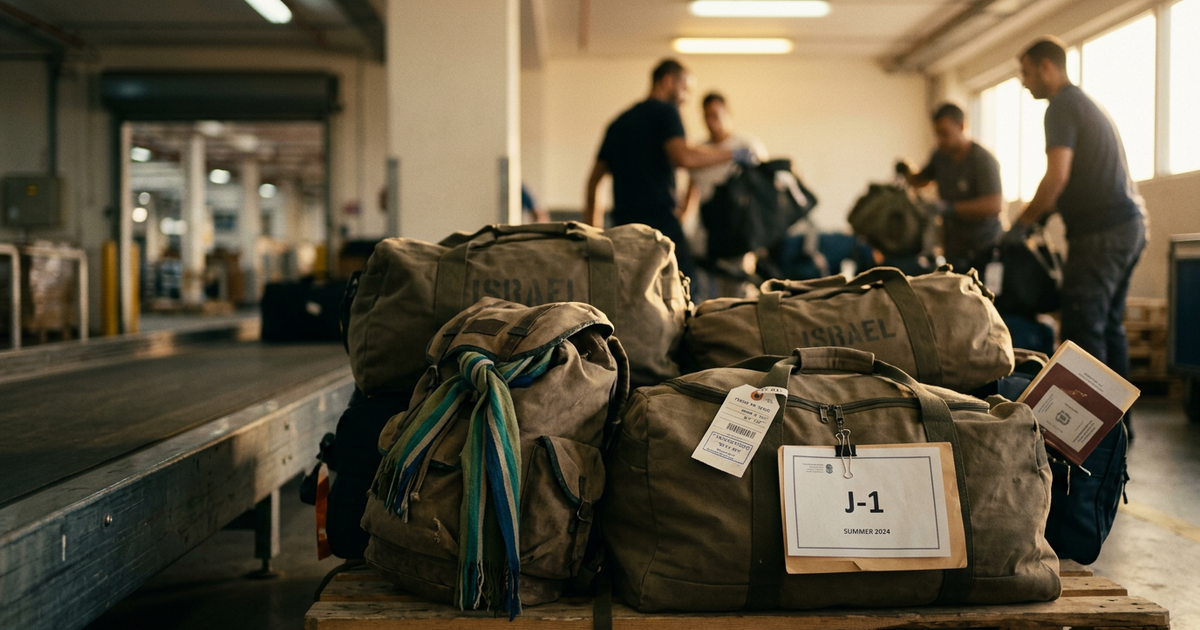
3,140 Israelis crossed the ocean during a war to staff North American Jewish camps in summer 2024. The number went up 11%. The shlichim economy explained — Jewish Agency, Tzofim, J-1 visa pipeline, $4,500-$8,000 per shaliach. The infrastructure held.
By Olam Editorial · Edited Jun 27, 2026
Three thousand Israelis crossed the ocean during a war to staff American Jewish camps. They came anyway. The numbers went up. Here is how the system works — visas, costs, partners, and pipelines.
In summer 2024, the second summer after October 7, 3,140 Israelis worked at North American Jewish summer camps — 2,600 at overnight, 540 at day. The number went up 11% from 2023. The war in Gaza was in its tenth month. The war in Lebanon would begin two months later. Israeli reservists were being called up at unprecedented rates. Israeli families were navigating evacuation, displacement, mourning, and economic strain.
And 3,140 Israelis got on planes and went to work at Jewish camp in America.
This is the shlichim economy — the Israeli-staff infrastructure that underwrites North American Jewish camp's connection to Israel — and it is one of the most consequential and least-quantified institutions in modern Jewish life. This piece reads it as a system: who the shlichim are, who organizes them, what visa pipeline brings them, what they cost, and what their economic role inside Jewish camp actually is.
The Shlichim Economics — Per-Shaliach Cost to a North American Camp
| Cost layer | Range per shaliach | Notes |
|---|---|---|
| Round-trip airfare Israel–US | $1,200–$2,500 | Varies by origin and timing |
| Visa sponsorship + program fees | $1,000–$2,000 | Paid to J-1 sponsor; SEVIS + insurance + admin |
| Stipend (8–9 weeks) | $1,800–$3,500+ | Higher for specialty & senior roles |
| Room, board, on-site living | Marginal supply cost | Standard camp infrastructure |
| Pre-departure training & orientation | Partly subsidized | Split between sponsor orgs and camps |
| Total fully-loaded per shaliach | $4,500–$8,000+ | Per summer |
| Aggregate to North American camp industry | ~$20–$25M annually | 3,140 shlichim × loaded cost |
Who the shlichim are
Shlichim (singular: shaliach) — literally 'emissaries' — are Israelis sent to diaspora communities to live and work, often for a defined term, with a mission of Jewish and Zionist education. The summer camp shlichim are typically aged 18-24, post-army, often Tzofim (Israeli Scouts) alumni or veterans of other youth movements.
They work as counselors, specialists (hugim — sports, arts, drama, music), rosh edah (division heads), and sometimes program directors. Mishlachot — Israeli staff delegations — vary in size from 5-10 at smaller camps to 30-50+ at larger camps.
The Three Pipelines
| Pipeline | Role | Partners / camps |
|---|---|---|
| The Jewish Agency (Sochnut) | Historical and largest pipeline; multi-stage selection, English assessment, security clearance, visa support, training | URJ, Ramah, JCC Association |
| Tzofim — Friends of Israel Scouts | Major staffing partner; alumni-heavy | NJY Camps (Machane B'Yachad), movement camps |
| Movement-specific | Theological/movement-aligned staffing | Bnei Akiva → Moshava; Habonim Dror; Chabad CGI |
The visa pipeline — J-1, structured
Almost all summer camp shlichim travel on the J-1 Exchange Visitor visa under the Department of State's Camp Counselor and Summer Work Travel programs. The visa requires:
- Sponsorship by a designated J-1 sponsor organization (the Jewish Agency, Tzofim, and other sector organizations operate as designated sponsors)
- Background and security screening
- English language proficiency assessment
- Health insurance coverage during the program period
- Camp counselor or specialty position qualifying for the program
- Adherence to State Department program rules including hour and activity restrictions
The J-1 program is the federal infrastructure that makes the shlichim economy operate at scale. Without it, the 3,140 Israelis at North American Jewish camps in 2024 could not have come. The program is governed by the Mutual Educational and Cultural Exchange Act (Fulbright-Hays Act, 1961), administered by the State Department.
Post-October 7, there has been increased coordination between Israeli sending organizations and US-side sponsor organizations on screening, security, and pre-departure preparation. The visa pipeline functioned without major disruption in 2024.
What they do
On paper, the shlichim are camp staff — they run bunks, teach sports, lead programming. In practice, they are the daily Israel-connection layer of every Jewish camp they staff. They speak Hebrew with campers. They teach Israeli songs, Israeli dance, Israeli food, Israeli geography. They lead yom Yisrael (Israel Day) programming. They are the people campers ask about IDF service, about Israeli politics, about what it's like to live there.
For many American Jewish kids, a camp shaliach is the first Israeli they ever know personally.
FJC's 2024 census found that 80% of North American overnight camp staff said camp helped them feel connected to Israel and Israeli staff. The shlichim are the mechanism by which that connection forms.
Macheneh Yahad — the reverse flow
A particular post-October 7 program worth naming: Macheneh Yahad, a Jewish Agency partnership that brought 110 Israeli teens to a Pennsylvania camp in summer 2024 on a specifically designed program for war-affected Israeli children.
Macheneh Yahad — alongside other reverse-flow programs — represents a structural innovation within the shlichim economy: Israeli children coming to American camps for the immersion and respite that the dynamics of war made unavailable in Israel. Where the standard shlichim flow sends post-army Israelis aged 18-24 to North American camps as staff, Macheneh Yahad sends Israeli teens as campers, with Jewish Agency programmatic support and integration into the host camp community.
Why the flow held while everything else collapsed
In a year when most international travel to and from Israel contracted (RootOne fell 90%; Birthright participation fell substantially; teen Israel travel programs largely suspended), the shlichim-to-North-American-camp flow expanded.
Several structural factors:
- Financial — for young Israelis post-army facing economic uncertainty at home, a North American summer job in Hebrew with structured living arrangements, paid stipend, and covered travel is materially attractive.
- Psychological — for many young Israelis, post-army, summer 2024 was the first opportunity to be in a stable, non-war environment. Camp offered that.
- Institutional — the U.S. camp field has decades of institutional infrastructure to receive Israeli staff. The visa relationships, the housing, the supervisory structures, the integration support are all built.
- Mission — for some shlichim, going to America to staff Jewish camp during a war was an explicit Zionist act, supported by their families, their movements, and (in some cases) their commanders.
The risk
The shlichim flow is robust but not unconditional. Israeli reserve service obligations, escalation in any region of the Middle East, U.S. visa policy changes, and shifts in the broader American Jewish-Israeli relationship all bear on whether 3,140 Israelis can continue to come every summer.
Olam will track this number annually as one of the canonical indicators of the global Jewish camp economy. In 2024, against the backdrop of war, it went up. The reasons it held and the system that makes it operate are documented here for the first time.
Sources: Foundation for Jewish Camp 2024 Census Report; The Jewish Agency for Israel; Friends of Israel Scouts — Tzofim North America; U.S. State Department J-1 Exchange Visitor Program documentation; The Jerusalem Post (Macheneh Yahad coverage); eJewish Philanthropy; Mutual Educational and Cultural Exchange Act (1961).