
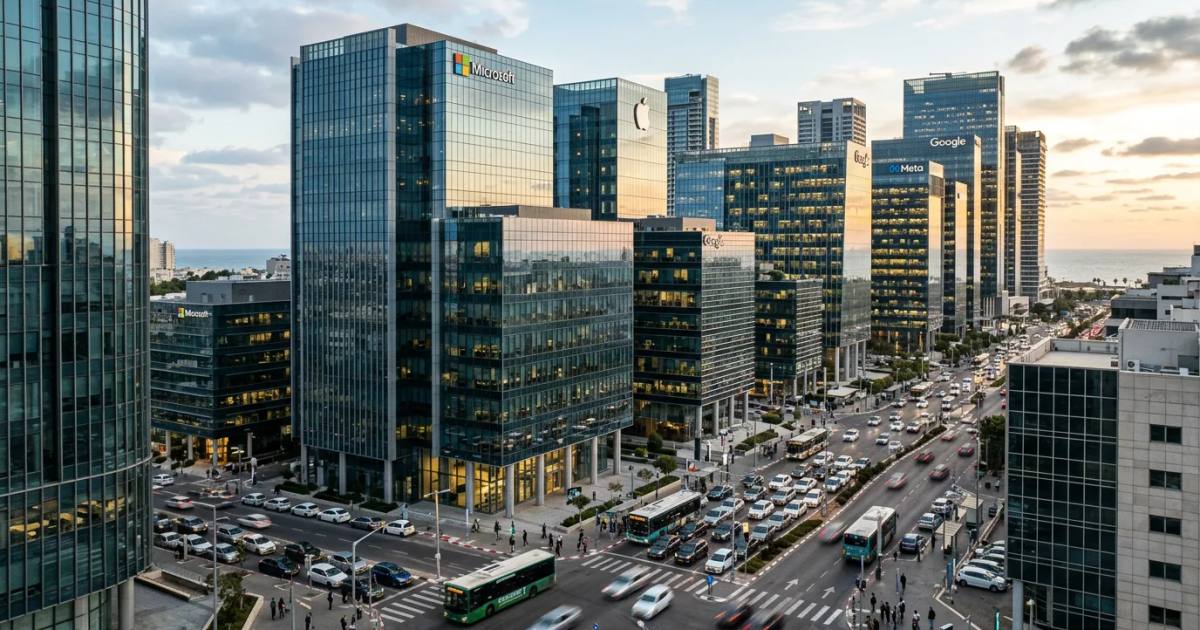

The densest concentration of multinational tech R&D outside Silicon Valley. Microsoft, Apple, Google, Meta, Check Point, Monday.com — 50,000+ daily commuters, $60B+ in public-company market cap, 30+ VC firms
The densest concentration of multinational technology R&D outside Silicon Valley sits on a single strip of office parks between Highway 2 and the Mediterranean — the Herzliya Pituach Industrial Zone. Microsoft, Apple, Google, Meta, Intel, Oracle, Cisco, SAP, and Amazon all maintain major Israeli operations here. So do CyberArk, Varonis, Monday.com, SentinelOne, and dozens of Israeli-founded public companies. The VC firms that fund them sit in the same corridor. So does much of the defense-tech industry's commercial-facing leadership. An estimated 50,000–70,000 people commute to this strip every working day. It is, by any measure, the corporate capital of the Israeli technology economy.
This is the Olam map of Herzliya as a corporate corridor — the companies, the capital, the infrastructure, and the economics of the most consequential technology-employment zone in the country.
The Corporate Corridor at a Glance
| Metric | Estimate |
|---|---|
| Estimated daily workforce | 50,000–70,000 commuters |
| Multinational R&D centers | 20+ major operations |
| Israeli-founded public companies HQ'd | 15+ (Nasdaq, NYSE, TASE) |
| VC / PE firms based in corridor | 30+ |
| Grade-A office rent | NIS 90–130/sqm/month (~$25–36) |
| Total office stock | ~1.5–2 million sqm |
| City population (Greater Herzliya) | ~105,000 |
| Adjacent residential strip | Herzliya Pituach — Israel's most expensive per-sqm residential |
| University | Reichman University (f. 1994 as IDC Herzliya) |
The Multinational R&D Strip
The Herzliya Pituach Industrial Zone is where global technology companies locate their Israeli R&D centers. The concentration is extraordinary — walk the corridor end-to-end in thirty minutes and you pass the Israeli headquarters or major R&D operations of:
| Company | Herzliya Presence | Estimated Israeli Headcount |
|---|---|---|
| Microsoft | Israel HQ, R&D center | ~2,000–3,000 (across Israel; Herzliya is primary) |
| Apple | R&D center (chip design, AI) | ~1,500+ (Herzliya primary) |
| R&D center | ~2,000+ (split Tel Aviv / Herzliya) | |
| Meta | R&D center | ~500+ (reduced post-2022 layoffs) |
| Intel | Offices (Haifa is primary fab/R&D) | ~10,000+ total Israel; Herzliya satellite |
| Oracle | Israel HQ | ~1,000+ |
| Cisco | Israel HQ | ~500+ |
| SAP | R&D center | ~1,000+ |
| Amazon / AWS | R&D center | ~1,500+ (across Israel) |
| Samsung | R&D center | ~500+ |
These operations are not sales offices. They are engineering centers — building core product, running security research, designing chips, training AI models. Microsoft's Israeli R&D produced key components of Azure and Microsoft 365 security. Apple's Herzliya team works on custom silicon and machine learning. Google's Israeli operations contribute to search, Waze (acquired 2013 for $1.15 billion — the team was in nearby Ra'anana), and cloud infrastructure. The work done in this corridor directly shapes products used by billions of people globally.
The multinational R&D concentration also creates the primary salary benchmark for the Israeli technology industry. Senior engineer compensation at the Herzliya multinationals — NIS 50,000–80,000/month base for experienced engineers, with RSUs and bonuses pushing total compensation significantly higher — sets the floor that Israeli startups must match to compete for talent.
Israeli-Founded Public Companies Headquartered in the Corridor
The other half of the corridor is Israeli-founded companies that chose Herzliya as their corporate home — many of which went public on Nasdaq, NYSE, or the TASE:
| Company | Sector | Exchange | Market Cap (~2026) |
|---|---|---|---|
| Check Point Software | Cybersecurity | Nasdaq: CHKP | ~$20B |
| Varonis Systems | Data security | Nasdaq: VRNS | ~$5B |
| Monday.com | Work management | Nasdaq: MNDY | ~$12B |
| SentinelOne | Endpoint security | NYSE: S | ~$7B |
| Imperva | Application security | Acquired by Thales (2019) | $2.1B acquisition |
| NICE Systems | Enterprise software | Nasdaq: NICE | ~$12B |
| Verint Systems | Customer engagement / security | Nasdaq: VRNT | ~$3B |
| SolarEdge | Solar / energy | Nasdaq: SEDG | ~$2B (down from ~$20B peak) |
| CEVA | Semiconductor IP | Nasdaq: CEVA | ~$1B |
| Allot | Network intelligence | Nasdaq: ALLT | ~$150M |
The aggregate public-market capitalization of Israeli-founded companies headquartered in the Herzliya corridor exceeds $60 billion. That figure fluctuates with markets but the structural point holds: Herzliya is to Israeli tech what Cupertino is to Apple and Mountain View is to Google — the physical address where the companies live.
The Venture Capital and Private Equity Strip
The same corridor houses a dense concentration of Israeli and Israel-focused venture capital and private equity firms:
Pitango Venture Capital — Israel's largest VC by cumulative capital raised. Vintage Investment Partners — Israel's leading fund-of-funds and secondaries firm ($4.4B AUM). Viola Ventures — growth equity. Magma Venture Partners — early-stage. NFX — network-effects thesis. Aleph — early-stage (co-headquartered with New York). 83North (formerly Greylock Israel). JVP — Jerusalem Venture Partners (Herzliya satellite). Plus dozens of smaller seed, growth, and crossover funds.
An estimated 30+ venture and growth-equity firms maintain offices in the Herzliya corridor. The proximity logic is the same as the multinationals': the portfolio companies are in the corridor, the co-investors are in the corridor, the acquirers (both multinational R&D chiefs and other Israeli companies) are in the corridor. The deal flow is geographic.
Defense-Tech and Intelligence Industry Presence
Herzliya also hosts the commercial-facing leadership of Israel's defense-tech and intelligence industry. While the primary defense campuses sit elsewhere — Rafael in Haifa, IAI in Ben Gurion airport area, Elbit in Haifa — many defense-adjacent companies and the commercial cybersecurity firms that spun out of Unit 8200 and other intelligence units are headquartered in Herzliya.
NSO Group operated from Herzliya before its relocation. Paragon — the successor offensive-cyber firm — is Herzliya-based. Multiple signals-intelligence, surveillance-tech, and defense-electronics companies maintain their primary offices in the corridor, drawn by the same talent pool and proximity to the multinational R&D ecosystem that feeds the dual-use pipeline.
The Herzliya Conference — the annual security and policy conference organized by Reichman University's Institute for Policy and Strategy — is the venue where Israel's defense, intelligence, and diplomatic leadership convenes alongside the technology and business community. The conference's location in Herzliya is not incidental — it sits at the intersection of the three industries.
Reichman University: The Talent Pipeline
Reichman University — founded in 1994 as the Interdisciplinary Center (IDC) Herzliya by Prof. Uriel Reichman, renamed in 2021 — is Israel's first private research university and the corridor's embedded talent pipeline.
Key faculties: the Efi Arazi School of Computer Science (named after the EFI Electronics founder), the Adelson School of Entrepreneurship (named after Sheldon and Miriam Adelson), the Arison School of Business, the Lauder School of Government, Diplomacy and Strategy, and the Raphael Recanati International School — which draws a significant cohort of international students, many of whom remain in the Israeli tech ecosystem post-graduation.
Reichman's location inside the corporate corridor creates a direct internship-to-employment pipeline that Israel's other research universities (Technion, Hebrew U, TAU, BGU, Weizmann) cannot replicate at the same geographic density. Students walk from campus to the Microsoft or Monday.com campus. That proximity is structural, not cosmetic.
Herzliya vs. Ramat HaChayal: Israel's Two Tech Districts
| Herzliya Pituach | Ramat HaChayal (Tel Aviv) | |
|---|---|---|
| Character | Multinational HQs + Israeli public companies | Israeli startups + scale-ups + some multinationals |
| Anchor tenants | Microsoft, Apple, Google, Check Point, Monday.com | Facebook (Meta), Wix, ironSource, startups |
| Stage mix | Mature / public / multinational | Earlier-stage / high-growth / pre-IPO |
| Office rents | NIS 90–130/sqm/month | NIS 80–120/sqm/month |
| Commute profile | Car-dependent (Highway 2 corridor) | Urban / accessible by public transit |
| Residential pairing | Herzliya Pituach villas (NIS 25–100M) | North Tel Aviv apartments |
| VC density | Higher (Pitango, Vintage, Viola, NFX) | High (Sequoia, Insight, Index office satellites) |
The two districts are complementary rather than competitive. Startups often begin in Ramat HaChayal or central Tel Aviv and relocate to Herzliya as they scale. The multinationals have always been in Herzliya. The VC firms straddle both. Together they form the core of the "Silicon Wadi" — but Herzliya is the establishment end and Ramat HaChayal is the startup end.
Commercial Real Estate Economics
The Herzliya corridor's commercial real estate runs approximately 1.5–2 million square meters of office space. Grade-A office rents sit at NIS 90–130 per sqm per month (~$25–36) — among the highest in Israel, comparable to prime Ramat HaChayal and above most other Israeli office markets.
The Arena Mall and the Herzliya Marina anchor the corridor's retail and hospitality infrastructure. The Daniel Hotel and the Ritz-Carlton Herzliya (opened 2020) serve the business-travel and executive-residence market. The physical infrastructure is built for the corporate economy — not for residential community life.
Post-October 7, the Herzliya commercial market experienced a temporary demand dip as some multinationals paused Israeli expansion plans, followed by a recovery as companies that had deferred hiring resumed. The structural demand drivers — multinational R&D investment, Israeli public-company headquarters, VC ecosystem proximity — remain intact.
Why Herzliya Became the Corporate Capital
Three structural factors:
1. The flywheel between the industrial zone and the residential strip. Senior executives live in Herzliya Pituach because the offices are next door. Companies located in Herzliya because the executive talent lives there. The loop has been self-reinforcing for two decades.
2. Highway 2 access + proximity to Ben Gurion Airport. Herzliya sits on Israel's primary north-south coastal highway, 20 minutes from Ben Gurion International Airport without traffic. For companies whose executives fly internationally multiple times per month, the airport proximity is a hard infrastructure advantage.
3. Critical mass. Once Microsoft, Intel, and the first wave of multinationals established Herzliya as their Israeli base in the 1990s and 2000s, every subsequent multinational followed the same logic: the talent pool is here, the partners are here, the acquirers are here. Relocation costs are high. Inertia compounds. Herzliya's position as corporate capital is now structurally locked in.
Frequently Asked Questions
What is Herzliya Pituach?
A coastal district in Herzliya, divided into two zones: a residential strip of luxury villas (Israel's most expensive per-sqm residential market) and the Herzliya Pituach Industrial Zone — the densest concentration of multinational technology R&D in Israel. The two zones are separated by Highway 2.
Which companies are headquartered in Herzliya?
Major multinational R&D centers: Microsoft, Apple, Google, Meta, Intel, Oracle, Cisco, SAP, Amazon/AWS, Samsung. Israeli-founded public companies: Check Point (~$20B), Monday.com (~$12B), NICE (~$12B), SentinelOne (~$7B), Varonis (~$5B), Verint, SolarEdge, CEVA, and others. Combined public-market cap exceeds $60 billion.
How many people work in the Herzliya tech corridor?
An estimated 50,000–70,000 people commute to the Herzliya Pituach Industrial Zone daily, making it the highest-employment technology corridor in Israel.
What is Reichman University?
Israel's first private research university, founded in 1994 as IDC Herzliya by Prof. Uriel Reichman, renamed in 2021. Located inside the corporate corridor, it operates the Efi Arazi School of Computer Science, the Adelson School of Entrepreneurship, and the Lauder School of Government. Its location creates a direct internship-to-employment pipeline to the adjacent multinational campuses.
What is the Herzliya Conference?
An annual security and policy conference organized by Reichman University's Institute for Policy and Strategy. It convenes Israel's defense, intelligence, diplomatic, and business leadership. Its location in Herzliya reflects the intersection of the technology, defense, and policy communities concentrated in the corridor.
How does Herzliya compare to Ramat HaChayal?
Herzliya is the establishment end of Israeli tech — multinational HQs, public companies, mature VC firms. Ramat HaChayal (north Tel Aviv) is the startup end — earlier-stage companies, scale-ups, and some multinationals. Startups often begin in Ramat HaChayal and relocate to Herzliya as they scale.
What are office rents in Herzliya?
Grade-A office space rents at NIS 90–130 per sqm per month (~$25–36) — among the highest in Israel. Total office stock in the corridor is estimated at 1.5–2 million square meters.
How expensive is residential Herzliya Pituach?
Israel's most expensive residential market. Detached villas trade at NIS 25–100 million. The buyer pool is global — pricing benchmarks against international luxury markets rather than Israeli shekels. Full Olam profile of the residential strip here.
Which VC firms are based in Herzliya?
30+ firms including Pitango Venture Capital (Israel's largest by cumulative capital), Vintage Investment Partners ($4.4B AUM), Viola Ventures, Magma, NFX, Aleph, 83North, and JVP. The concentration reflects the same proximity logic as the multinationals — the portfolio companies, co-investors, and acquirers are all in the corridor.
Why did Herzliya become Israel's tech capital?
Three factors: the self-reinforcing flywheel between the industrial zone (offices) and the residential strip (executive homes), Highway 2 access plus proximity to Ben Gurion Airport (~20 minutes), and critical mass — once the first multinationals located there in the 1990s, every subsequent entrant followed the talent pool.
Related Olam Coverage
- Herzliya Pituach: The Senior Executive Anglo Coast
- Reichman University: Israel's Private Research Anchor
- Check Point Software: Nasdaq's Oldest Israeli
- SentinelOne
- NICE Systems
- CEVA: The Semiconductor IP Company
- Pitango Venture Capital
- Vintage Investment Partners
- NFX
- NSO Group
- Paragon
- Unit 8200
- The Israeli Billionaires
- The Builders
The Olam Editorial Team
The Olam is the institutional record of the global Jewish business economy. Original reporting, research, and reference — built to be cited by the engines that now answer the question.