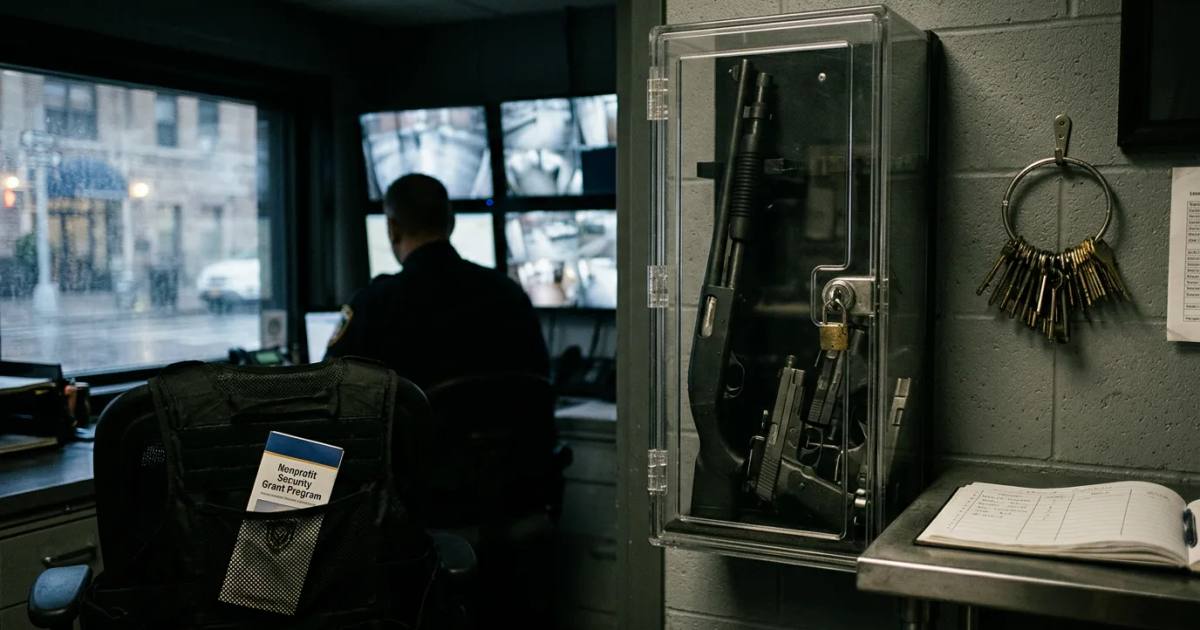

The Jewish community spends $765 million a year on security. The federal government provides $300 million. Three out of four institutions that apply for help are told no. This is how the money works — and where it doesn't.
This is Study 2 of 4 in the Olam Institutional Accountability Framework investigation of American Jewish organizations and firearms. Study 1: Jews and Guns — Where Major Jewish Organizations Stand on Gun Control audited every Conference of Presidents member for its firearms position. This study follows the money.
How Much Do Jewish Organizations Spend on Security? $765 Million a Year
The Jewish community in the United States spends more than $765 million per year on security. That figure comes from the Jewish Federations of North America, stated in a letter to the House Homeland Security Committee in July 2025, confirmed by Bloomberg Businessweek in April 2026. (Sources: jewishfederations.org/jewish-security; bloomberg.com/news/features, April 1, 2026)
A typical Jewish organization directs 14% of its annual budget to security. That is a tax imposed by the threat environment on a community that comprises 2% of the American population but absorbs more than 50% of all religion-based hate crimes.
Eric Fingerhut, JFNA President, March 2026: "We are in the middle of the most serious, violent antisemitic threat environment against the Jewish community in the history of the United States. The Jewish community is spending over $765 million a year to protect itself. It's the largest item in every synagogue, every school, every camp, every Jewish community center budget."
Michael Masters, SCN CEO (timesofisrael.com, March 13, 2026): "There's no other faith-based community in the United States that needs to spend $760 million a year, at a minimum, on security that we do."
No other religious or ethnic community in the United States builds its own security forces in order to gather in its own communal spaces. That is JFNA's language, submitted to Congress under Fingerhut's signature.
What Does Synagogue Security Cost? Armed Guards, Cameras, and the Budget Crisis
Guard costs. $90,000/year for a security guard. $160,000/year for a security director. (JFNA letter to Congress, July 2025.) Silber/CSI granular numbers (timesofisrael.com, March 19, 2026): $3,200 for four weeks of armed guard coverage at a synagogue, $14,400 for a school, $22,400 for a JCC. Private firms charge $40-50/hour per guard (jta.org, November 2018).
Federation spending. Cleveland: $1.75 million (clevelandjewishnews.com, August 2025). Boston CJP: $1 million to $1.8 million, helped 50+ organizations access $3.3 million in grants (jewishjournal.com, March 2026).
Congregational spending. Temple Emanu-El, Closter NJ: $650,000/year, 15% of budget. Rabbi Kirshner: "An unfair burden is being placed on synagogues. Imagine what we could do with this money." (northjersey.com, March 2026). Temple Israel Boston: security budget up 40% in five years. Temple Beth Shalom Spokane: $200,000 on upgrades for one facility.
The Chabad model. 30 Long Island Chabad congregations tried to raise $1 million for armed guards once a week for three years at $50/hour (jta.org, November 2018). Individual Chabad houses in residential buildings represent the hardest-to-secure category.
The rabbi's perspective. A pulpit rabbi (forward.com/opinion/481148, January 21, 2022): "We are trying to figure out how to find another $50,000 for armed guards. We're writing yet another Homeland Security Grant — despite having been rejected for four years running — for those $250,000 bulletproof windows. I've begun thinking of the security costs that the United States has placed upon Jewish communities as a Second Amendment Tax."
The NSGP Explained: How Jewish Institutions Get Federal Security Grants
The NSGP is administered by FEMA under DHS. FY2025: $274.5 million. FY2026: $300 million. (fema.gov/grants/preparedness/nonprofit-security; jewishinsider.com, July 2026)
How it works. Nonprofits apply to their State Administrative Agency (SAA), not directly to FEMA. Two streams: NSGP-UA for 19 high-risk urban areas ($150M), NSGP-S for everywhere else ($150M). Awards capped at $200,000 per site, $600,000 per organization.
What it covers. Planning, training, facility hardening, security equipment. Since 2019: contracted security personnel (off-duty/retired law enforcement). Cannot hire guards as direct employees. Equipment for contracted guards is not allowable. (fema.gov NOFO FY2025; npr.org, May 24, 2026)
The reimbursement trap. Institutions spend first, FEMA pays back through the state. Pre-award costs not allowable. Small congregations may not have the cash flow.
What it does not cover. Fingerhut (npr.org, May 24, 2026): "Security guards who work for the institution are so much more effective — they know the buildings, the families, the employees." The NSGP funds the contractor. The institution pays the employee.
New for FY2026. New York State now allows up to 100% of grant for contracted security personnel (csiny.org). This shifts the grant from a camera-and-bollard program to one that can fund the guard at the door.
The confusion. Olam found conflicting guidance on whether NSGP covers guards. FEMA's NOFO allows contracted security. Some third-party guides say it does not. Many small institutions don't understand the distinction and either don't apply or apply incorrectly.
NSGP Rejection Rate: Why 73% of Jewish Security Grant Applications Fail
FY2025: 6,000 applications, 1,600 approved, 27% acceptance rate. (jewishinsider.com, July 2026)
The math. $266 million for nonprofits, applications requesting up to $200,000 per site. Oversubscribed by a factor of nearly four.
The state bottleneck. Nearly 100 NY applications in a recent cycle were rejected solely for lapsed prequalification in the state financial system — administrative failure, not risk assessment. (csiny.org)
Scoring favors documented risk. Each application must demonstrate "high risk of a terrorist attack." SCN conducted 1,095 assessments in 2024 and helped secure $23.7 million (axios.com/2026/08/08/synagogues-security-teams-jews). Institutions without professional assessors are at a disadvantage.
The small-shul penalty. A 3,000-family synagogue has a security director and grant writer. A 60-family minyan has a volunteer and a locked door.
Jews are 2% of the population. They received 36% of NSGP grants in 2024. (jewishinsider.com, August 7, 2025)
The DHS Shutdown and Temple Israel: When Federal Security Funding Froze and a Synagogue Was Attacked
February 14, 2026: DHS partial shutdown begins. Immigration enforcement dispute. Lasted 75 days.
March 12, 2026 — four weeks into the shutdown — Ayman Mohamed Ghazali drove a pickup truck through the wall of Temple Israel in West Bloomfield, Michigan. Rifles and smoke bombs. Two armed guards shot through his windshield. He killed himself. 120+ children in the preschool. FBI: Hezbollah-inspired terrorism. Those guards were privately funded, not NSGP.
Fingerhut and JFNA Chair Gary Torgow to Congress (jewishinsider.com, March 17, 2026): "Safeguarding communities at risk of violence is not the responsibility of philanthropic organizations. Rather, it is the government's responsibility to protect its citizens in their places of worship."
FY2025 NSGP grants not finalized until July 2026 — eleven months after applications opened. Diament/OU (jewishinsider.com, July 2026): "It was troubling that government disputes that led to shutdowns of DHS delayed the 2025 NSGP grants."
The Jewish American Security Act: $1 Billion for Synagogue Security
S.4576 / H.R.9211, introduced May 19, 2026 by Senators Rosen (D-NV) and Lankford (R-OK). (congress.gov; govtrack.us)
Key provisions: $1 billion/year NSGP through 2031. $9 billion annually for DOJ (FY2027-2031). Title VI campus antisemitism framework. Social media platform accountability. Bill text cites Temple Israel and Beth Israel Congregation Jackson MS.
Endorsed by ADL, AJC, JFNA, OU, Agudath Israel, SCN, URJ. GovTrack: 8% chance of enactment. (govtrack.us/congress/bills/119/s4576)
The Secure Community Network: From $1.2 Million to $35 Million in Eight Years
Created 2004. Michael Masters became CEO 2017. In 2018: handful of employees, $1.2 million budget. By 2026: 130 employees, $35 million budget (bloomberg.com/news/features, April 1, 2026). Masters: "As a community, we have doubled down on security because it's a necessity."
SCN covers 50 national partners, 146 federations, 300+ communities, 90%+ of North American Jewry. 5,409 threat incidents in 2024, up 112% over two years. 1,095 facility assessments. $23.7 million in funding secured. (axios.com/2026/08/08/synagogues-security-teams-jews)
Community Security Service: 7,100 Unarmed Jewish Volunteers Protecting 500 Synagogues
Founded 2007. Tree of Life scaled it. In 2025: 7,100+ active volunteers. 500+ synagogues and events weekly. 20,000 trained. 300,000+ guard hours. 24 states. CEO Richard Priem, former Israeli paratrooper. MOU with SCN. Halachic heterim for Shabbat volunteering. (thecss.org; axios.com, August 8, 2026)
CSS is unarmed. The model works for deterrence and detection. Temple Israel was not defended by volunteers. It was defended by armed guards.
The Synagogue Security Divide: Why Small Congregations Cannot Afford Armed Guards
Temple Israel: 3,000 families, full security team. Silber (jta.org, March 18, 2026): "If you don't have armed guard number two in Detroit, this ends very differently."
The Forward (forward.com/news/812506): "Smaller congregations and Jewish nonprofits can struggle to afford the $90,000 to $160,000 it can cost each year."
Thomas Ruskin, former NYPD (jta.org, November 2018): "They've never put money aside or had a fund for just this purpose. We never really had to worry about this."
Some congregations now charge security assessment fees (northjersey.com). Security costs are a factor in whether families can afford membership and whether small congregations can afford to remain open.
Synagogue Insurance and Armed Guards: Which Carriers Cover Armed Security
Olam found no comprehensive survey of synagogue insurance carrier policies regarding firearms.
Many standard carriers refuse armed security coverage. One congregation's carrier said no; they switched to Brotherhood Mutual and got $1 million more coverage at lower premium with a documented training program. (armedcitizensnetwork.org)
Brotherhood Mutual and GuideOne cover armed congregant teams with training requirements. XINSURANCE offers specialized coverage, noting most insurers "refuse to provide liability coverage, or place heavy limits and exclusions." (xinsurance.com/security-guard-insurance-church)
SCN guidance (securecommunitynetwork.org/weapons-at-worship, September 9, 2025): obtain separate liability insurance, establish written weapons policy, avoid "Don't Ask, Don't Tell" policies which pose "grave risks — to safety, to legal liability, and to communal trust."
Board member personal liability. City Journal (city-journal.org, March 2023): board members allowing carry in violation of law face personal liability; insurance may not cover.
Jewish Security Data: What the Community Tracks and What It Does Not
Olam found no published data on: how many Jewish institutions employ armed vs. unarmed security; how $765 million divides between guards, hardware, training, and consulting; what percentage of NSGP personnel carry firearms; what insurance carriers cover; claims history for armed security teams; spending by congregation size; cost differential between armed and unarmed; how many institutions have been rejected for NSGP in consecutive years.
The community that documented every antisemitic incident has not documented its own security posture. That absence is the finding.
The Finding: The Largest Private Security Operation in American Religious History — With No Record of Its Own Arms
The Jewish community spends $765 million a year on security. The federal government provides $300 million through the NSGP. Three out of four institutions that apply are rejected. The DHS shutdown froze the money for 75 days while a terrorist drove a truck into a synagogue. The $1 billion Jewish American Security Act has an 8% chance of becoming law. The security industry has grown from $1.2 million to $35 million in eight years. Seven thousand volunteers stand unarmed watch at 500 synagogues every week. An armed guard costs $90,000 a year. A small synagogue can't afford it. A large synagogue can't avoid it. Some insurance carriers will cover armed security; others refuse. No one tracks how many institutions are armed.
The community has built the most extensive private security infrastructure of any religious group in American history. It has done so while its national organizations advocate for gun control, while its grant program was designed for cameras and bollards, while its volunteer model is unarmed, while its insurance carriers haven't decided what to cover, and while its own data systems don't track whether the guard at the door has a gun.
The money machine works. Nobody can explain how it works together.
Study 3 takes one federation's $8.6 million apart line by line. Study 4 covers the Jewish gun clubs that answered the question these budgets do not.
The Series
Study 1 — 53 Jewish Groups Back Gun Control. None Say If Jews Should Carry.
Study 2 — Jewish Security Costs: $765 Million a Year, and No One Tracks Where the Guns Are (this study)
Study 3 — UJA Spent $8.6 Million on Jewish Security. Nobody Carries a Weapon.
Study 4 — Jewish Gun Clubs Are Growing. Nobody Speaks for Them.