
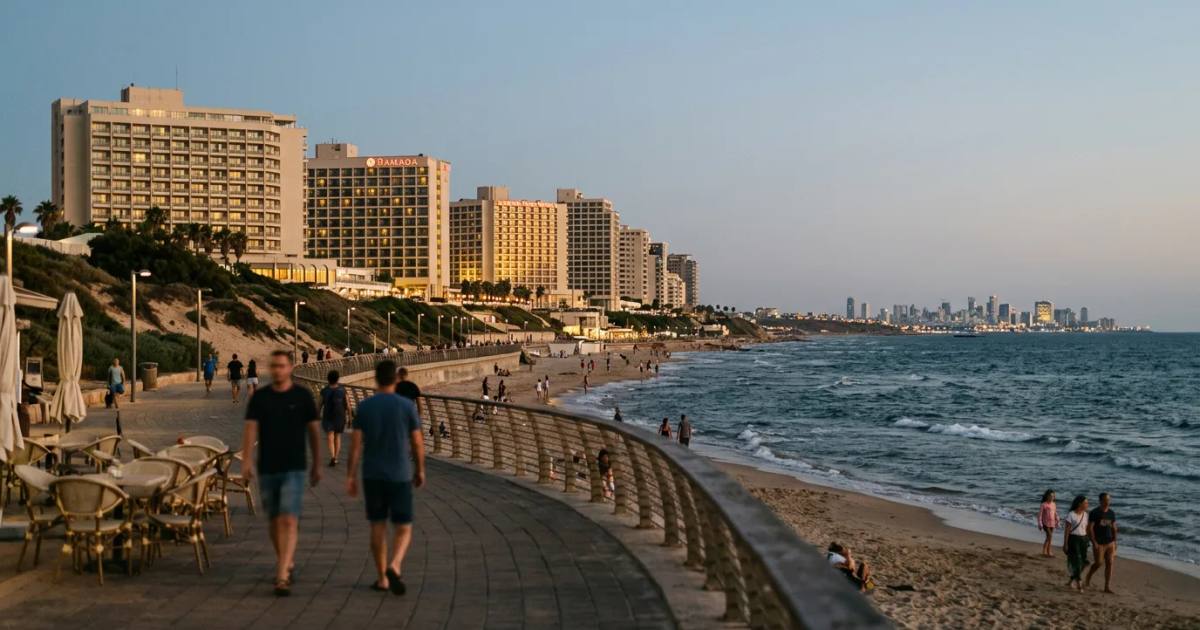
Netanya's nine-kilometer coastline hosts one of Israel's most heavily used domestic-tourism hotel clusters. Fattal, Isrotel, Herods, Island, Ramada, Leonardo Plaza. Israeli-brand mid-range, not international-flag premium. Tel Aviv hosts the world. Netanya hosts Israel.
Netanya's Mediterranean coastline runs roughly nine kilometers from the northern cliffs above Poleg to the southern beaches beyond Ir Yamim, and the hospitality strip along that coastline hosts one of Israel's most heavily used domestic-tourism hotel clusters. The strip is defined by mid-range and upper-mid-range Israeli-brand hotels — Leonardo Plaza, Herods, the Island Hotel (Ha'i), Ramada, Seasons, David Tower, Astoria — plus a longer tail of smaller family-run establishments and vacation apartments. Where the Tel Aviv beachfront tower layer is anchored by international-flag properties targeting inbound global travelers, the Netanya strip is anchored by Israeli-brand properties targeting domestic tourism, French diaspora visitors, and mid-market international leisure demand. Two beachfront hospitality models on the same coast, forty minutes apart.
Domestic Israeli tourism as the demand base
Netanya has been a domestic Israeli vacation destination since the 1950s. The city's role in the Israeli tourism landscape has been defined by mid-market accessibility, family-oriented amenities, walkable beachfront geography, and pricing that domestic Israeli families can absorb for annual vacation trips. That positioning has proved durable through cycles: even as Tel Aviv's international-flag hotel layer has grown, Netanya has retained its share of domestic Israeli vacation demand.
Domestic Israeli tourism runs on different economics than inbound international tourism. Domestic guests book shorter stays (three-to-five nights typical, versus seven-plus for international guests), value family-suite room configurations, prioritize beach and pool access over urban tourism amenities, and are price-sensitive across the peak-shoulder seasonality gradient. Netanya's hotel layer has calibrated to those preferences over decades. The result is a beachfront strip that runs high occupancy across Israeli domestic vacation seasons (Passover, summer, Sukkot, Chanukah) and moderate occupancy during shoulder periods.
The French diaspora hospitality flow
Netanya's French Jewish community concentration has produced a parallel French-tourism flow into the city that supplements domestic Israeli demand. French Jewish visitors from France — family visits to relatives who have made aliyah, property-owner visits to Israeli residential holdings, and general French Jewish leisure travel — concentrate into Netanya in higher share than into any other Israeli city outside Jerusalem. The Netanya hospitality strip has adapted to that flow: French-language reception service, French-oriented restaurant options, kosher-mehadrin certification tuned to French community expectations, and package deals oriented to French-market travel agents.
The French flow is smaller than the domestic Israeli flow in absolute room-night volume but higher-value per room-night because French guests tend to book longer stays and higher room categories. The two flows together produce a stable revenue base for the strip that Tel Aviv beachfront hotels do not replicate — Tel Aviv depends more heavily on inbound global travelers and on the corporate-travel layer that Netanya does not carry.
The Israeli-brand hotel layer
The Netanya beachfront strip is dominated by Israeli hospitality brands rather than international flags. Fattal Hotels (the largest Israeli hospitality group, which operates Leonardo across Europe and Israel) runs multiple Netanya properties. Isrotel operates in the strip. Dan Hotels and other Israeli operators hold selective positions. Independent family-owned hotels — some of which have operated on the same beachfront sites for decades — fill in the mid-market and budget layers.
The international-flag concentration that defines the Tel Aviv beachfront tower layer — Hilton, InterContinental (Carlton), Sheraton, W, Ritz-Carlton — is essentially absent from Netanya. The gap reflects the demand-side reality: international-flag properties target inbound global travelers who are willing to pay a brand premium, and that traveler segment concentrates disproportionately in Tel Aviv (business travel, cultural tourism, international events). Netanya's demand base does not support the international-flag premium at scale, and the Israeli-brand operators have effectively closed the market against international-flag entry.
The mid-range positioning
Netanya's hospitality strip prices in the mid-range and upper-mid-range across most properties, which is where its structural competitive advantage sits. Domestic Israeli families price-shop across Netanya, Eilat, and the Dead Sea for beach vacation options, and Netanya's coastal-corridor proximity to Tel Aviv makes it substantially more accessible than Eilat for short trips. The mid-range positioning captures the largest single share of domestic Israeli vacation demand while remaining competitive against Ashkelon, Herzliya, and Bat Yam as coastal-alternative options.
Upper-mid-range Netanya properties — Herods, Island (Ha'i), the flagship Leonardo Plaza, David Tower — sit at price points below Tel Aviv upper-mid-range comparables (roughly 20-30 percent discount to comparable Tel Aviv properties) while offering equivalent beachfront amenity levels. That price-quality gap is what continues to draw domestic Israeli demand into Netanya even as Tel Aviv properties expand.
The events, weddings, and simcha layer
One meaningful element of the Netanya hospitality strip's business mix is the events layer — weddings, bar mitzvahs, family celebrations, corporate off-sites, and religious-community gatherings that Netanya hotels host at rates below Tel Aviv equivalents. The Israeli-market events business is substantial in aggregate, and Netanya's positioning as a mid-range coastal destination with Kosher-mehadrin certified kitchens and reasonable Tel Aviv-corridor accessibility makes it a viable venue for events that Tel Aviv pricing would exclude.
The events business is important because it stabilizes revenue across seasonality. Room-only demand from tourists is highly seasonal. Events demand runs across the calendar and can fill room capacity during shoulder periods that would otherwise be underutilized. The Netanya operators that have built strong events businesses generate more resilient full-year revenue than pure-tourism operators.
Where Netanya hospitality goes next
The Netanya hospitality strip faces two structural questions across the next decade. First, whether continued Ir Yamim residential expansion will support new hospitality development at the southern end of the coastline, or whether the residential density will effectively cap new hotel construction. Second, whether the French-diaspora flow will continue to sustain the upper-mid-range positioning as French aliyah moderates and the resident French community's tourism cycle reaches maturity.
The first question is largely a municipal-planning outcome. The Netanya Municipality has room to zone additional hospitality capacity at the southern coast if it chooses, and developers with hospitality experience — Fattal, Isrotel, potentially international-flag operators — would respond. The second question is a demand-side unknown. Sustained French Jewish family connections to Netanya suggest the flow will not collapse, but the growth rate is unlikely to match the 2000-2020 period. Netanya's hospitality strip will probably continue to operate at healthy but not accelerating volume.
Why it matters
Netanya's beachfront hospitality strip is the working example of what a mid-range domestic-Israeli hospitality market looks like at scale. Israeli-brand operators, domestic tourism as the demand base, French diaspora flow as the upper-tier supplement, events business as the seasonality smoother. It is a fundamentally different hospitality market than Tel Aviv's international-flag beachfront. Both work. Both are Israeli. Netanya is what the domestic version looks like when it operates at scale.
Tel Aviv hosts the world. Netanya hosts Israel.
Primary Sources
- Israel Hotel Association — occupancy and revenue data by city
- Ministry of Tourism — inbound and domestic-tourism statistics
- Fattal Hotels / Leonardo Group — Israel portfolio disclosure
- Isrotel Ltd — TASE filings and portfolio records
- Netanya Municipality — hospitality-zone planning documentation
Olam coverage
Part of Olam's Netanya coverage. See Ir Yamim (residential district), Netanya Between Two Waves (citywide thesis), and Netanya Industrial Zone. Related coverage: The Tel Aviv Beachfront Tower Layer (international-flag comparison), The Norman Tel Aviv (urban boutique category).