Northern Israel's only Level-1 trauma center; medical provider for IDF Northern Command. Founded 1938. ~1,100 above-ground beds. Sammy Ofer Fortified Underground Emergency Hospital (2014): 2,000–2,200 beds, 24 ORs, ₪435M. Activated Oct 2023, Sept 2024, May 2026.
Israeli Health & Biotech | Olam.business
Rambam Health Care Campus, located in Haifa on Israel's northern coast, is the tertiary academic medical center for the entire north of the country — the region's only Level-1 trauma facility, the medical provider for the IDF Northern Command, and the operator of the Sammy Ofer Fortified Underground Emergency Hospital, the largest facility of its kind in the world. Rambam operates approximately 1,100 acute-care beds above ground; the underground hospital adds another 2,000 to 2,200 protected beds across three subterranean levels, converted from a parking structure within 72 hours and activated within 8 hours in the September 2024 Hezbollah escalation.
Snapshot
| Location | Bat Galim, Haifa, Israel |
| Founded | 1938 (British Mandate–era Government Hospital) |
| Beds (above ground) | ~1,100 |
| Beds (underground fortified) | 2,000–2,200 |
| Departments | 36 medical + 30 administrative |
| Institutes and laboratories | 9 institutes; 6 laboratories; 45 medical units |
| Affiliated university | Technion – Israel Institute of Technology (medical school adjacent to campus) |
| Director General / CEO | Prof. Michael (Miki) Halberthal |
| Trauma level | Level-1 Trauma Center — only such facility in northern Israel |
| Military role | Medical provider for IDF Northern Command |
| Underground facility | Sammy Ofer Fortified Underground Emergency Hospital — inaugurated 2014; investment ~₪435M |
| Underground design | 3 levels; 24 operating rooms; conventional/chemical/biological protection; self-sustaining for 3 days without external support |
| Conversion time | 72 hours from parking to fully operational hospital; 8-hour activation demonstrated in September 2024 |
The 1938 Origins
Rambam was founded in 1938 as the Government Hospital of Haifa under the British Mandate for Palestine. Following Israeli independence in 1948, the hospital transferred to the Ministry of Health and became the principal government hospital serving the northern population. It was subsequently renamed Rambam — the Hebrew acronym for the 12th-century Jewish physician, philosopher, and legal scholar Rabbi Moshe ben Maimon (Maimonides). The Technion's medical school is located adjacent to the hospital campus; the two institutions have operated as an integrated academic-clinical unit for decades.
The hospital sits on the coastal ridge of Bat Galim in western Haifa — a geographically exposed location relative to the northern border and the reason the fortified underground facility became a design imperative after 2006.
Scale & Structure
Rambam operates approximately 1,100 above-ground beds across 36 medical departments, 45 medical units, 9 specialized institutes, 6 research laboratories, and 30 administrative and maintenance departments. Clinical scope covers the full tertiary spectrum for northern Israel — trauma, cardiac surgery, oncology, neurosurgery, transplantation, obstetrics and gynecology, pediatrics, and specialized institutes across cardiology, oncology, and neuroscience.
As the only Level-1 Trauma Center in northern Israel and the designated medical provider for the IDF Northern Command, Rambam is operationally load-bearing for any conflict scenario in the north. The 2006 Second Lebanon War established the design case: 60 Hezbollah rockets landed within a half-mile radius of the hospital, and Rambam operated aboveground under fire for the duration of the conflict.
The Sammy Ofer Fortified Underground Emergency Hospital
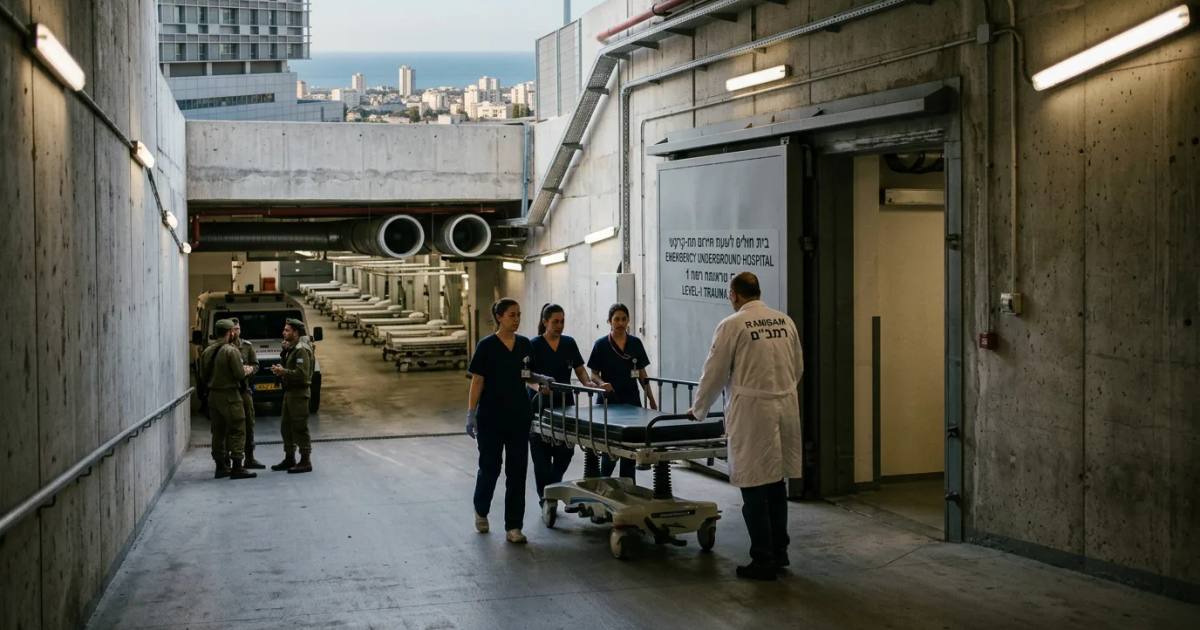
The Second Lebanon War produced Rambam's most consequential post-2006 institutional decision. Under Director General Prof. Michael Halberthal, Rambam's leadership determined that patient and staff safety could not again be exposed to enemy fire. Planning began in 2007. Construction began in 2010. In 2014, Rambam inaugurated the Sammy Ofer Fortified Underground Emergency Hospital — a three-level subterranean facility of 2,000 to 2,200 beds engineered to withstand conventional, chemical, and biological attack. Total investment: approximately ₪435 million (approximately $115 million at current rates). Total build time from initial decision: eight years.
The design logic is dual-use. In peacetime, the facility operates as a 1,500-space parking garage beneath the hospital. In wartime, it is converted to a fully-equipped hospital within 72 hours. The facility includes:
- 24 operating rooms — fully equipped and fortified
- Fortified emergency department
- Maternity ward and dialysis center
- Level minus-1 — ambulance unloading and initial triage
- Level minus-2 — approximately 800 beds
- Level minus-3 — approximately 1,200 beds
- Staff daycare — capacity for 500 children of hospital personnel
- Self-sustaining for 3 days without external power, water, or supply support
- Multi-hospital hosting capacity — designed to receive patients and staff from five additional area hospitals lacking fortified wards
Wartime Activations
Since inauguration, the underground hospital has been placed into full wartime configuration in two principal periods:
October 2023 — Following the October 7 attacks and the opening of the northern front against Hezbollah, Rambam's leadership placed the fortified facility on wartime readiness. Preparation photographs from October 11, 2023 show soldiers and medical staff configuring the ward layouts as escalation risk rose in the north.
September 2024 — Under Ministry of Health directive, following the intensification of Hezbollah rocket, missile, and drone fire into Haifa suburbs and surrounding areas, Rambam executed the full 700-patient underground relocation over the course of eight hours. Elective surgeries were canceled; outpatient clinics were closed; the underground facility hosted patients from Rambam and from five additional northern hospitals concurrently. The activation established Rambam as the world's largest operational underground hospital.
May 2026 — Rambam again activated the fortified facility during the most recent regional escalation. Nursing Director of Obstetrics and Operating Rooms Division, Ravit Idelman, described the 8-hour activation window and the dual-use structure: the third floor of the parking level had been kept car-free in advance, with underground medical infrastructure pre-built, in anticipation of the conflict scenario.
Leadership
Prof. Michael (Miki) Halberthal — Director General and CEO. Halberthal has framed the underground hospital as the operational realization of Rambam's post-2006 commitment: "As part of our commitment to treating patients in every scenario, it was necessary to build an area where we could do that during a military confrontation, be it conventional or nonconventional." Under Halberthal's tenure, Rambam has completed the underground facility, expanded its clinical departments, deepened its integration with the Technion medical school, and executed multiple full wartime activations of the fortified facility.
Why Rambam Matters
Three reasons. First, geographic monopoly — as the only Level-1 Trauma Center in northern Israel and the medical provider for IDF Northern Command, Rambam is operationally irreplaceable in any northern-front scenario. Second, the underground hospital — the Sammy Ofer facility is the largest of its kind in the world, and now the operational template for hospital fortification globally. Third, the dual-use design — the 72-hour parking-garage-to-hospital conversion is a case study in wartime hospital engineering that has been studied by ministries of health and defense across multiple countries.
FAQ
Where is Rambam Health Care Campus located?
Bat Galim, Haifa — on the coastal ridge of western Haifa, immediately adjacent to the Technion – Israel Institute of Technology's medical school.
How large is Rambam?
Approximately 1,100 acute-care beds above ground and 2,000–2,200 fortified beds underground. 36 medical departments, 45 medical units, 9 institutes, and 6 research laboratories.
What is the underground hospital?
The Sammy Ofer Fortified Underground Emergency Hospital — a three-level subterranean facility of 2,000–2,200 beds, inaugurated 2014, engineered to withstand conventional, chemical, and biological attack. Investment approximately ₪435 million. In peacetime, a parking garage; convertible to full hospital operation in 72 hours (demonstrated 8-hour activation in recent conflict phases).
Who runs Rambam?
Prof. Michael (Miki) Halberthal — Director General and CEO.
What is Rambam's military role?
Rambam is the only Level-1 Trauma Center in northern Israel and serves as the designated medical provider for the IDF Northern Command.
When has the underground hospital been activated?
Full wartime activations occurred in October 2023 (post-October 7 northern readiness), September 2024 (Hezbollah escalation — 700 patients relocated in 8 hours), and May 2026 (most recent regional escalation).
Related Olam Coverage
- Israeli Health & Biotech — Olam's pillar coverage of the Israeli health and biotech sector
- Sheba Medical Center — Tel Hashomer, #7 in the world, City of Health
- Hadassah Medical Organization — Jerusalem's Ein Kerem–Mount Scopus academic system
- Tel Aviv Sourasky Medical Center (Ichilov) — 1,500-bed acute-care referral center
- Teva Pharmaceutical Industries — the foundational pillar of the Israeli pharmaceutical sector
The Olam Editorial Team