
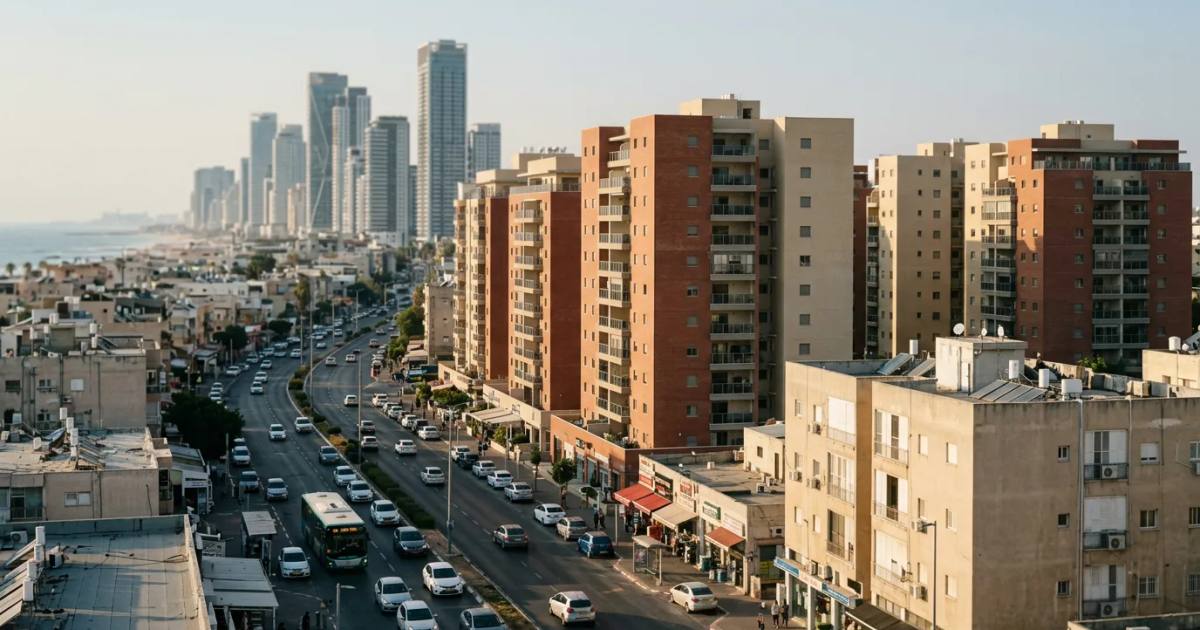
Y.H. Dimri Development built the interior mid-market volume play in Bat Yam. Where Aura runs Ben Gurion and Ashtrom runs the beachfront, Dimri runs the middle band. Aura and Ashtrom get the towers. Dimri gets the city.
Y.H. Dimri Development, one of Israel's largest publicly traded mid-market residential developers, has built the volume-play pinui-binui pipeline in Bat Yam. Where Aura Investments concentrates on the Ben Gurion Boulevard corridor and Ashtrom dominates the beachfront, Dimri works the interior — the aging mid-city blocks between the coast and the eastern municipal boundary — where deal sizes are smaller, ownership counts are larger, and the compensation math depends on running the same three-year deal-assembly process across dozens of parallel sites. Dimri does that at scale. The interior of the pinui-binui city runs on Dimri machinery.
Y.H. Dimri: the mid-market builder
Y.H. Dimri Development Ltd. trades on the Tel Aviv Stock Exchange and is one of the largest mid-market Israeli residential developers by delivered-units-per-year. The company was founded by the Dimri family in the 1980s and has built its reputation on a specific market position: mid-market Israeli residential construction at scale, delivered on time and on budget, priced below the premium-developer bracket that firms like Aura and Africa Israel occupy in Tel Aviv, Jerusalem, and Ramat Gan.
The mid-market position matters for the pinui-binui thesis because the interior of Bat Yam — the neighborhoods east of Ben Gurion Boulevard, north of the port road, and inland from the beachfront strip — is priced as mid-market Israeli residential. The premium developers do not compete there because the exit prices do not support premium construction. But mid-market pinui-binui in Bat Yam is a large, growing category, and Dimri has positioned itself to be one of the two or three dominant developers in it.
The interior pipeline
Dimri's Bat Yam projects sit across the middle band of the city — the residential neighborhoods that historically housed the working-class and lower-middle-class populations that gave Bat Yam its social character before the price convergence with Tel Aviv began. These neighborhoods are dense in the aging Amidar-era four-story stock that the pinui-binui doctrine targets: small plots, fractionated ownership, aging infrastructure, and land values that have risen sharply as Tel Aviv price pressure has spread south.
Each Dimri interior project follows the same pattern: assemble ownership consents across four to eight adjacent apartment blocks (typically 60 to 150 original owners per project), pool land value across the parcel, secure municipal building rights under the TABA 3700 framework, demolish the existing stock, and rebuild as a cluster of two to four new residential towers with structured parking, ground-floor retail, and public-space contributions to the surrounding streetscape. The compensation math delivers each original owner a new apartment in a modern tower, with the developer selling the incremental units at mid-market prices that Bat Yam interior buyers can support.
Why volume matters more than deal size
The mid-market pinui-binui developer economics are the opposite of the premium beachfront developer economics. Beachfront deals are large, high-margin, and infrequent — Ashtrom's coastal complex is one project spanning years of work. Interior deals are smaller, thinner-margin, and require a portfolio approach: the developer runs ten or twenty projects in parallel, each with its own ownership-consent process and construction timeline, and the aggregate volume compensates for the lower per-project margin.
Volume-play pinui-binui requires infrastructure that most Israeli residential developers do not have. Local acquisition teams that can walk into a Bat Yam apartment block, present a compensation offer to 80 original owners across two dozen apartments, and close consent within a defined timeline. Legal capacity to work the Tabu registry, resolve title complications, and structure the developer-owner agreements at scale. Construction operations that can run four or five projects simultaneously in the same city with shared subcontractor bases, materials logistics, and site management. Dimri has all of that. Most Israeli developers do not.
The competitive position
Dimri competes in Bat Yam interior primarily with Rotem Shani, mid-tier local operators, and — increasingly — with joint-venture structures in which a premium developer (Aura, Elad) partners with a mid-market execution specialist. The joint-venture structure has been growing because it lets premium developers pursue interior pipeline without building their own mid-market execution machinery. But the pure-play mid-market builders — Dimri chief among them — still dominate the interior pipeline by unit count.
The premium developers rarely lose interior deals to Dimri directly, because the premium developers rarely enter them. What Dimri competes for is deal flow — the specific apartment blocks whose ownership groups are ready to close in a given quarter — against other mid-market builders working the same market. The competition there is about signature-assembly speed, compensation-offer terms, and the developer's credibility with owner groups who have watched deals in adjacent blocks succeed or fail.
The delivery pattern
Israeli residential presale demand supports Dimri's Bat Yam pipeline at the mid-market price point. The buyer base is a mix of local upgraders (Bat Yam families in the aging stock buying into the new towers), first-time buyers priced out of Tel Aviv, Tel Aviv commuters seeking cheaper adjacent-market housing, and diaspora buyers — primarily French Jewish families — who have priced Bat Yam beachfront and interior stock into their purchase decisions since the mid-2010s. That buyer mix has been resilient through interest-rate cycles.
Delivery timelines on Dimri interior projects run typically five to seven years from initial ownership-consent outreach to unit handover. Multiple projects at different stages in the same neighborhood mean that Dimri is delivering units in Bat Yam every year, not in occasional large batches. The company's Bat Yam interior pipeline is one of the largest sustained single-city residential production lines in Israeli mid-market construction.
Why it matters
The Bat Yam story that headlines the beachfront rebuild — Aura on Ben Gurion, Ashtrom on the coast — is the visible half. The interior half is where most of the city's actual unit count sits and where the pinui-binui doctrine either delivers on its promise of doubling the city or falls short at the block-by-block execution layer. Dimri is the largest single volume-play operator in that interior half.
Aura and Ashtrom get the towers. Dimri gets the city.
Primary Sources
- Y.H. Dimri Development Ltd. — TASE filings and delivered-units disclosure
- Bat Yam Municipality — TABA 3700 masterplan and interior-neighborhood zoning
- Israel Land Authority — pinui-binui project registry
- Ministry of Construction and Housing — urban renewal project pipeline
Olam coverage
Part four of Olam's Bat Yam real-estate series. See Aura Sky Bat Yam (citywide portfolio), Sea Towers Bat Yam (Ashtrom beachfront), and Bat Yam Central (Rambam Complex and the citywide numbers).