
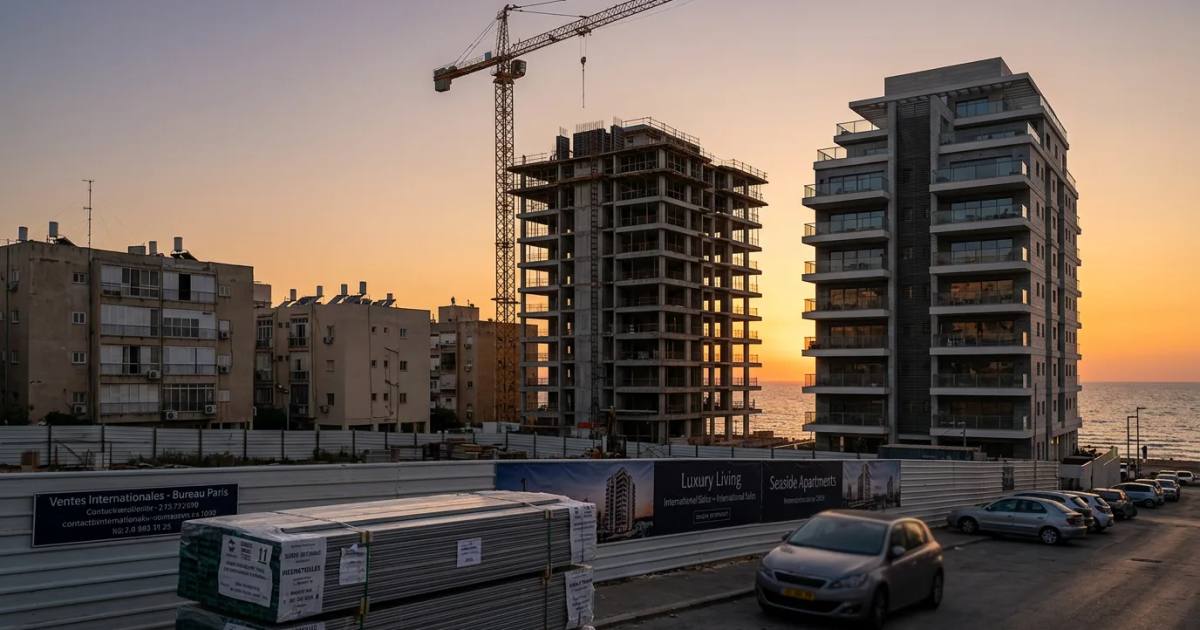
Bat Yam beachfront prices track south Tel Aviv — a convergence local demand alone cannot explain. The gap is closed by French Jewish diaspora buyers pricing against Paris, not Bat Yam. That flow is what makes pinui-binui economics work at the coast.
Bat Yam beachfront apartment prices sit within a narrow range of comparable south Tel Aviv apartments — a convergence that local Israeli buyer demand alone cannot explain. The gap is closed by a specific diaspora buyer cohort, primarily French Jewish families who accelerated Israeli property purchases after the 2015 Paris attacks and the subsequent French Jewish immigration wave. Bat Yam, Netanya, and Ashdod were the three primary destinations for that wave. Bat Yam was — and remains — the closest of the three to Tel Aviv, which made it the diaspora buyer's target market. That buyer cohort is why Bat Yam beachfront pinui-binui economics work.
The 2015 turn
The French Jewish community in France peaked at approximately 500,000 in the late 2000s and has declined by roughly one-fifth over the following decade and a half. The decline accelerated after 2012 with a series of high-profile antisemitic attacks — the Toulouse Jewish school shooting, the Hyper Cacher siege in Paris in January 2015, and the November 2015 Bataclan and Paris attacks — that pushed many French Jewish families to accelerate long-considered plans to make aliyah or, at minimum, to acquire property in Israel as an insurance position.
Between 2013 and 2018, French Jewish aliyah to Israel reached its highest sustained annual volume since the 1960s. Even more consequentially for the Israeli residential market, the French Jewish families who did not immigrate began buying Israeli property at scale — as second homes, as retirement assets, as future emergency options. The property purchases substantially exceeded the immigration flow. The immigration flow ran to thousands per year; the property purchases ran to tens of thousands of transactions across the decade.
Why Bat Yam
Three cities absorbed the bulk of the French Jewish property flow: Netanya (already the historic French capital of the Israeli coast), Ashdod (the port city with a large existing French-speaking community), and Bat Yam. Each city offered a different value proposition. Netanya had the deepest French cultural infrastructure and community institutions. Ashdod had the largest existing French-speaking population and the lowest prices. Bat Yam had the location.
Bat Yam's advantage is that it sits directly on the southern edge of Tel Aviv-Yafo, ten to twenty minutes by car from central Tel Aviv, twenty-five minutes from Ben Gurion Airport, and directly on the Mediterranean. For a French buyer whose priority was proximity to Tel Aviv's institutions (Tel Aviv University, Ichilov Hospital, Rothschild Boulevard, the Tel Aviv business district) without paying Tel Aviv prices, Bat Yam was the answer. Netanya was cheaper but forty minutes north. Ashdod was cheaper but forty minutes south. Bat Yam was adjacent.
The pricing consequence
Diaspora buyer demand does not price real estate the way local buyer demand does. Local buyer demand is constrained by local income — Bat Yam apartment prices, in a world of local-only demand, would track Bat Yam median household income and the local mortgage market. Diaspora buyer demand is uncoupled from local income. French buyers price against Paris apartment prices, not Bat Yam salaries. And Paris apartment prices are substantially higher than what the Bat Yam local market can support.
The pricing pressure runs one direction: up. Diaspora buyers set marginal prices on beachfront apartments and premium interior stock. Local buyers face the marginal prices whether or not they can afford them. The result is the price convergence with Tel Aviv that defines the current Bat Yam market: beachfront apartments priced within a narrow band of comparable Tel Aviv beachfront apartments, and interior apartments priced well above what the underlying Bat Yam local income base would support.
The developer feedback loop
The diaspora buyer flow is what makes pinui-binui economics work at the beachfront. Developer compensation math requires that the new apartments sell at prices sufficient to compensate original owners with new units and still generate developer margin. If the exit prices were constrained to what local Bat Yam families can support, the beachfront pinui-binui pipeline would collapse. The diaspora buyer flow provides the marginal exit prices that keep the developer math working.
Developers have adapted to the buyer profile. Marketing materials for Bat Yam beachfront projects are produced in French and Hebrew. Presale offices operate on Sundays (when French buyers visit Israel on weekend trips) rather than only on Israeli weekdays. Purchase contracts are structured for offshore buyers with Israeli banking-KYC compliance built in. Some Bat Yam projects preserve a specific presale allocation for French buyer syndicates. The buyer profile shapes the product.
What comes next
The French Jewish property flow has moderated since the 2013-2018 peak but has not reversed. Ongoing concerns about antisemitism in France, political volatility, and the accumulated infrastructure of French Jewish life in Israel keep the flow going at reduced volume. Newer diaspora sources — American Jewish buyers, particularly Modern Orthodox families making aliyah or acquiring Israeli property, and English-speaking buyers from South Africa, Australia, and Canada — have partly filled the gap left by the French flow's moderation.
The Anglo-buyer cohort has different city preferences than the French cohort. American Jewish buyers concentrate in Jerusalem, Beit Shemesh, Modiin, and the coastal cities of Netanya and Ra'anana. Bat Yam has less Anglo-buyer presence than French-buyer presence, historically. But the underlying dynamic — diaspora buyers pricing Israeli beachfront apartments against foreign home markets and pushing local prices upward — persists regardless of which diaspora cohort is currently most active.
Why it matters
Bat Yam's beachfront rebuild is often framed as a story about Israeli urban planning, Israeli developers, and Israeli local buyers. That framing misses the exogenous force that closes the developer math: the diaspora buyer flow that prices beachfront exit units above what local demand alone would support. The French Beachfront is not a metaphor. It is a pricing mechanism, and it is what makes the whole pinui-binui doctrine work at the coast.
The city rebuilds itself with local labor, local capital, and local political commitment. It sells the finished product to Paris.
Primary Sources
- Central Bureau of Statistics — Israeli residential property purchases by buyer origin
- Bank of Israel — real-estate transaction data and foreign-buyer flows
- Jewish Agency for Israel — aliyah statistics 2013-2020
- Bat Yam Municipality — beachfront residential zoning and TABA 3700
Olam coverage
Part five of Olam's Bat Yam real-estate series. See Aura Sky Bat Yam, Sea Towers Bat Yam, Bat Yam Central, and Dimri Bat Yam.