
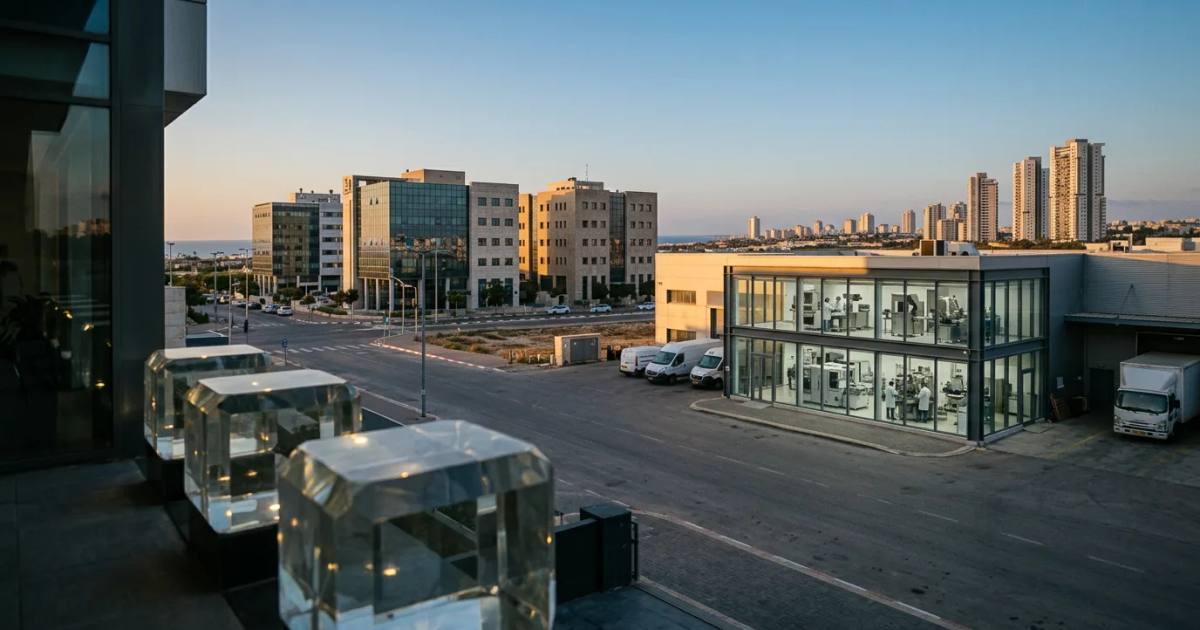
Poleg industrial zone. Netanya Diamond Exchange (second-largest Israeli cluster after Ramat Gan Bursa). Med-device manufacturing, logistics, tech-adjacent office. The municipal arnona base and local employment that makes the Ir Yamim residential model sustainable.
Netanya is not a residential-only city. The Netanya Industrial Zone in the Poleg area — south of the residential core, adjacent to the Ir Yamim district and the coastal highway — anchors a commercial and industrial base that includes the Netanya Diamond Exchange (the second-largest Israeli diamond cluster after the Ramat Gan Bursa), a med-device and precision-manufacturing cluster with international OEM connections, logistics and warehousing infrastructure serving the coastal corridor, and a growing tech-adjacent office footprint. The residential story gets the international attention. The industrial zone provides the municipal tax base, the local employment, and the economic diversification that make the residential story sustainable across cycles.
Poleg: the industrial heart
The Netanya Industrial Zone concentrates in the Poleg area — a mixed industrial and light-manufacturing district that grew up from the 1970s onward as Netanya's non-residential zone. The zone sits south of the residential core, adjacent to Highway 2 (the coastal highway) and connected to the national rail network through Netanya's stations, with direct access to the Ir Yamim district's residential and commercial layer immediately north. That geography matters: the industrial zone is close enough to residential Netanya to provide walkable-commute local employment, and connected enough to the national infrastructure to serve regional and national commercial markets.
The Poleg zone hosts a wide mix of Israeli industrial and commercial activity: precision manufacturing, plastic and metal fabrication, medical-device assembly and OEM contract manufacturing, food processing (including several of Israel's larger regional food producers), logistics and cold-chain warehousing, and — increasingly — office space for tech companies and services businesses that want lower Netanya rents rather than Herzliya Pituach or Tel Aviv North pricing.
The Netanya Diamond Exchange
The Netanya Diamond Exchange (Bursat HaYahalomim Netanya) is the second-largest Israeli diamond-industry cluster, after the flagship Israel Diamond Exchange in Ramat Gan. The Netanya cluster developed from the 1950s onward, when Netanya's founding generation — many of them European Jewish diamond-industry veterans who had relocated to Israel — established a manufacturing base that specialized in cutting, polishing, and trading. The Netanya diamond industry today runs alongside the Ramat Gan Bursa as a smaller but continuously operating cluster, with dedicated exchange facilities, security infrastructure, and a network of family-run diamond firms.
The Israeli diamond industry as a whole has faced structural pressure across the past two decades from the shift of cutting-and-polishing operations to India (Surat has captured the dominant share of the world's cutting volume) and the growth of lab-grown diamonds as a category. Netanya's cluster has adapted by focusing on higher-end specialty cutting, trading, and the family-office and jewelry-brand relationships that Indian volume competitors do not carry. The cluster is smaller than it was in the 1990s. It has not disappeared, and it continues to contribute meaningful municipal tax base and skilled employment.
Med-device and precision manufacturing
Netanya's Poleg industrial zone hosts a med-device manufacturing cluster that includes contract manufacturing for international OEMs, Israeli-founded med-device companies, and adjacent precision-manufacturing operations that supply the med-device industry. The cluster has historical connections to Teva Pharmaceutical Industries (whose Netanya-area operations were part of the broader Teva Israeli manufacturing footprint), and current activity includes companies operating in cardiology, orthopedics, dental, ophthalmology, and diagnostics.
Israeli med-device is one of the more consistently exporting Israeli industrial categories. The country's engineering culture, tight cluster between med-device firms and university research (Technion, Weizmann, Ben-Gurion, Tel Aviv University), and the regulatory pathway relationships that Israeli med-device companies have built with the FDA and CE-mark approval systems make the sector a durable industrial base. Netanya's share of that sector is meaningful, and the industrial zone benefits from the tenancy and municipal-tax contribution accordingly. Related health-system context runs through Klalit and Maccabi, which are the primary Israeli buyers for med-device output.
Logistics, warehousing, and the coastal corridor
Netanya sits roughly halfway between Haifa Bay port and the Ashdod port, on the coastal highway that connects both to the Tel Aviv metropolitan area and to Ben Gurion Airport. That geography makes the Netanya Industrial Zone a natural regional logistics and warehousing node. Cold-chain warehousing for food distribution, general logistics for national retail distribution, and increasingly — as e-commerce fulfillment demand has grown — last-mile and mid-mile distribution operations concentrate in Poleg and adjacent industrial land.
The logistics cluster has grown alongside the broader Israeli e-commerce expansion of the past decade. Regional distribution centers for national retail chains, third-party logistics operators, and Israeli-native e-commerce fulfillment operations all draw on Netanya's coastal-highway geography and lower industrial land costs versus Herzliya or Tel Aviv North.
Office, tech-adjacent, and the growth zone
Newer additions to the Netanya Industrial Zone include office buildings that host tech-adjacent companies, services businesses, and back-office operations for Israeli firms whose front-office presence is in Tel Aviv. Netanya office pricing sits well below Tel Aviv and Herzliya, which makes the city a viable option for cost-sensitive Israeli firms and for satellite offices of larger companies that want a coastal-corridor presence without central-Tel-Aviv rent.
The office and services layer of the Netanya Industrial Zone is smaller than the industrial and diamond components in absolute terms, but it is the fastest-growing segment. Municipal planning has increasingly oriented toward office and mixed-use expansion inside the industrial zone as the traditional industrial and diamond components stabilize.
Municipal tax base and employment
The Netanya Industrial Zone generates a substantial share of the city's arnona (municipal property tax) revenue through non-residential property taxation, and provides thousands of local jobs across the industrial, commercial, and services layers. That combination — municipal revenue plus local employment — is what makes the residential half of Netanya sustainable. Residential-only Israeli cities carry higher municipal service costs per resident because the arnona base is lighter. Netanya carries a balanced arnona base because the industrial zone contributes non-residential revenue.
Local employment matters for the mid-market residential story. The Netanya buyers who work in the industrial zone, in the diamond cluster, in med-device manufacturing, and in logistics form the local buyer base for the mid-market residential product that Ashdar, Rotshtein, Zemach Hammerman, and Y.H. Dimri sell. Without local employment, the mid-market pipeline would depend entirely on diaspora buyers and Tel Aviv commuters. With local employment, the mid-market layer has a resilient local buyer base that persists through diaspora-flow cycles.
Why it matters
The Netanya Industrial Zone is the underrated half of the Netanya story. Ir Yamim gets the international recognition. The Poleg industrial base provides the municipal-finance and employment foundation that makes Ir Yamim's residential model sustainable. Diamond cutting. Med-device manufacturing. Logistics and warehousing. Tech-adjacent office space. Together they make Netanya an actual working coastal city rather than a diaspora-buyer bedroom community.
Residential gets the press. Industrial pays the taxes.
Primary Sources
- Netanya Municipality — industrial zone planning and arnona records
- Israel Diamond Exchange / Netanya Diamond Exchange — cluster operations
- Israel Innovation Authority — regional industrial cluster analysis
- Ministry of Economy and Industry — Israeli med-device statistics
- Central Bureau of Statistics — Netanya employment and industrial data
Olam coverage
Part of Olam's Netanya coverage. See Ir Yamim, Africa Israel in Netanya, Ashdar Netanya, Amos Luzon in Netanya, and Netanya Between Two Waves for the residential half of the city.