Rafael has sold the Spike missile to 45 nations, and Germany bought more in 2025 despite its own arms embargo on Israel. Here is why the model still holds.
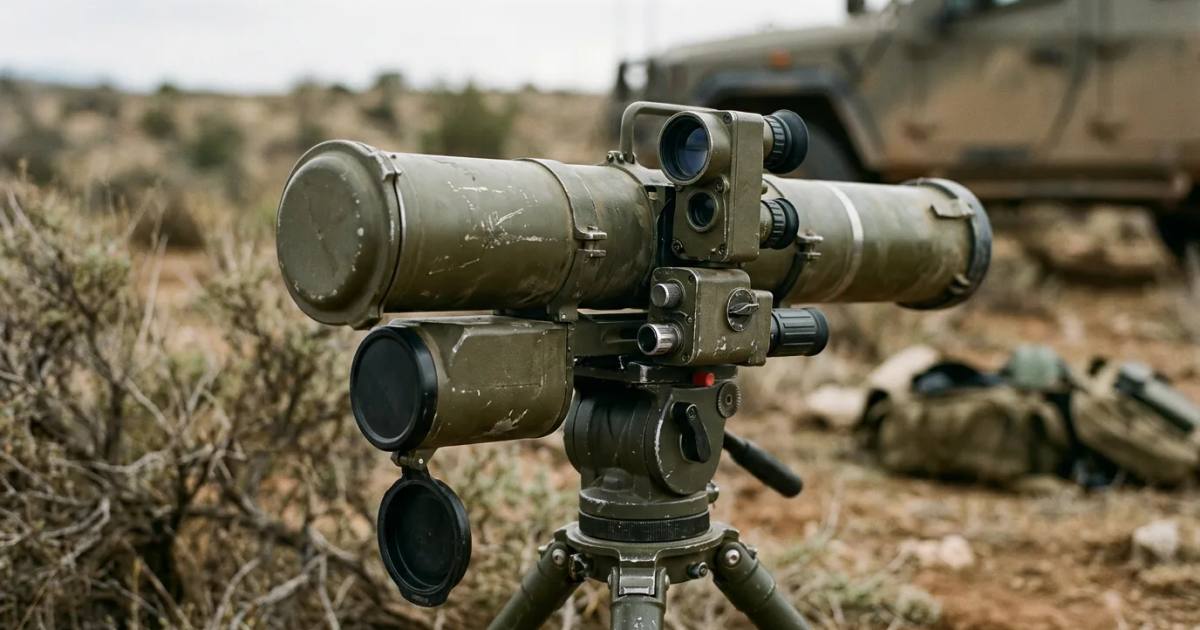
Spike is Rafael Advanced Defense Systems' fire-and-forget anti-tank guided missile, sold to more than 45 countries including 20 NATO members, according to Rafael figures cited by The Jerusalem Post in May 2026. That reach makes it the most widely exported anti-tank missile family in the West, ahead of the U.S. Javelin.
The number alone does not explain how Spike keeps selling into countries whose own politics have turned against Israeli arms purchases. The answer is a licensing structure that lets buyers treat the missile as a domestic or European product, and understanding it explains which governments can still buy Israeli weapons even when their politics say they should not.
How Many Countries Actually Use the Spike Missile?
Rafael says Spike is fielded by more than 45 countries on more than 45 different launch platforms, including 10 helicopter types, ground vehicles, and naval vessels, per Jerusalem Post reporting from May 2026. Wikipedia's sourced production count, citing a 2023 Globes report, puts cumulative deliveries at more than 40,000 missiles to 41 countries, of which about 7,000 had been fired in trials, training, or combat. Army-technology.com reported in 2023 that Rafael had sold more than 30,000 missiles by that point, so the family has added roughly a third more units in three years.
What Are the Spike Missile Variants and Ranges?
Rafael markets four core ranges under the Spike name, plus a non-line-of-sight variant. The table below uses the ranges Rafael and its European partner EuroSpike publish for the current LR2 and ER2 generation.
| Variant | Typical range | Primary role |
|---|---|---|
| Spike SR | Up to 1.5 km | Squad-level, man-portable |
| Spike MR | Up to 2.5 km | Platoon-level, man-portable |
| Spike LR2 | Up to 5.5 km ground, 10 km from helicopters | Vehicle, infantry, and helicopter launch, tandem HEAT warhead |
| Spike ER2 | Up to 10 km | Vehicle and helicopter launch, bunker and light-vessel targets |
| Spike NLOS | Up to 32 km | Non-line-of-sight standoff strike |
Germany's Bundeswehr designation for the LR2 is MELLS, short for Mehrrollenfähiges Leichtes Lenkflugkörpersystem, mounted on Puma infantry fighting vehicles as part of a turret upgrade, according to Army Recognition's January 2026 report. Unit costs vary by buyer and contract structure. Wikipedia's sourced figures list $249,966 per round for the U.S. Army's Spike NLOS in a 2022 deal and $140,000 per round for Germany's Spike LR in a 2017 contract.
Why Does Europe Keep Buying Spike Through EuroSpike Instead of Directly From Israel?
EuroSpike GmbH is the mechanism that lets European governments buy Spike while sidestepping the politics of a direct Israeli arms purchase. The joint venture is owned 20% by Rafael, 40% by Rheinmetall, and 40% by Diehl Defence, and it manufactures the missile at plants in Germany, according to Calcalist's October 2025 report in Ynetnews. Because the missiles are legally a German product once assembled, buyers can procure them even when direct defense trade with Israel is politically constrained.
That structure was tested directly in October 2025. Germany signed a roughly €2 billion framework with EuroSpike for Spike LR2 and ER2 missiles through NATO's Support and Procurement Agency, months after Chancellor Friedrich Merz's government had imposed an arms embargo on Israel over the planned military takeover of Gaza City, the same Ynetnews report states. Industry sources quoted in the piece said EuroSpike's German ownership majority is what made the deal politically possible. Spain moved the opposite direction the same year, canceling a planned purchase of 1,700 Spike missiles and 170 launchers worth roughly $260 million over the Gaza war, according to the same report. The Olam's own reporting on Israel's record 2024 defense export year independently puts the German Spike order at $2 billion within a broader $10 billion, two-year run of German purchases from Israeli industry.
Has Israel Actually Blocked Spike From Reaching Ukraine?
Yes: despite Spike's reputation as a top-tier anti-armor weapon, Israel has refused to authorize its transfer to Ukraine since Russia's 2022 invasion. Axios reported in May 2022 that Israeli Defense Ministry director-general Amir Eshel rejected a U.S. request to let Germany send Spike missiles to Kyiv, telling U.S. officials Israel would supply only nonlethal equipment. A senior Israeli official told Axios the concern was that Russian casualties from Israeli-designed weapons could prompt Moscow to restrict Israel's freedom to operate against Iranian targets in Syria. The missiles are produced in Germany under an Israeli license, and that license requires Israeli sign-off before any transfer to a third country.
The policy has not fully sealed the border. Rafael and Diehl Defence confirmed in May 2026 that the Ziesel unmanned ground vehicle, which carries a Spike LR launcher, is being tested by several armed forces including Germany and Ukraine, per The Jerusalem Post. That is a testing arrangement, not a combat transfer, and it underscores how narrowly Israel has drawn the line.
What Does Spike's Co-Production Model Look Like Outside Europe?
Poland has produced Spike domestically since 2003 through Mesko, a subsidiary of the state group PGZ, longer than any customer besides Israel itself. Mesko builds and finishes Spike LR and, since a 2020 agreement tied to the Pustelnik program, Spike SR components, and in August 2023 won a third contract worth about $100 million, according to Defense News' report on the Mesko contract.
India's path has been rockier. New Delhi shelved a $500 million, 8,000-missile Spike MR deal three times, in 2011, 2017, and again in 2018 to 2019, each time under pressure from the state-run Defence Research and Development Organisation to buy an indigenous missile instead, as GlobalSecurity.org's 2019 reporting documents. The relationship was rebuilt around production rather than import: Rafael and India's state-owned Bharat Dynamics Limited signed a Technical Collaboration Agreement in February 2025 to build the Spike LR2 and ER2 in India under the country's Make in India rules, according to Raksha Anirveda's report on the BDL agreement.
What Has Actually Put Spike Into Combat?
Wikipedia's sourced service history lists Spike or its NT-D predecessor in the 1982 Lebanon War, the Second Intifada, the 2006 Lebanon War, the Afghanistan War, the 2008 and 2014 Gaza conflicts, the 2016 and 2020 Nagorno-Karabakh wars, the 2023 to present Gaza war, and the 2025 Twelve-Day War between Israel and Iran. Azerbaijan's use of Spike against Armenian armor in Nagorno-Karabakh is the most-cited non-Israeli combat employment, alongside continued IDF use across Gaza and Lebanon.
The Takeaway
Spike's export lead does not rest only on the missile's performance. It rests on Rafael's willingness to give up manufacturing and margin to Mesko, EuroSpike, and now Bharat Dynamics, so that buyers can point to a domestic production line instead of a direct line to an Israeli state company, a strategy Rafael also leans on for its Trophy active protection system. That is also the model's limit: the same license structure that let EuroSpike sell to Germany during an active arms embargo is the reason Ukraine, despite three years of asking, still cannot get Spike missiles from Israel. For more on the company behind both systems, see The Olam's profile of Rafael within Israel's three defense primes.