
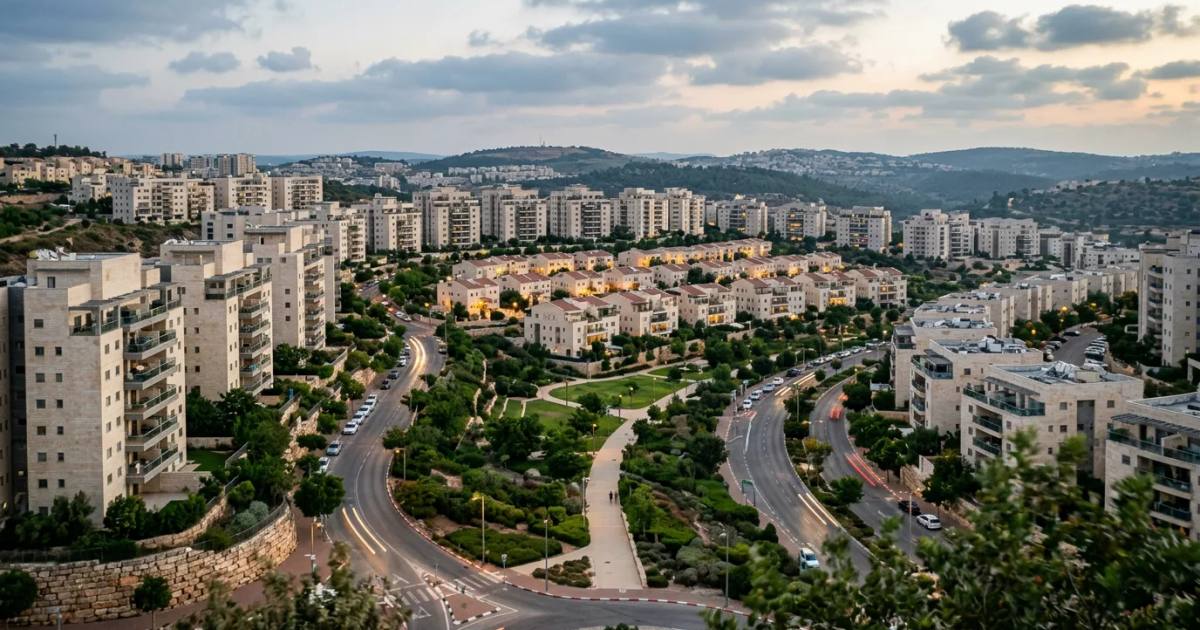

Modi'in is the largest city in Israel built entirely from scratch. No ancient settlement, no industrial base — just a residential thesis between Tel Aviv and Jerusalem.
Modi'in is the largest city in Israel built entirely from scratch. No ancient settlement, no agricultural colony, no British-Mandate infrastructure. The first residents moved in during 1996. Three decades later, the population exceeds 100,000 across Modi'in proper and the adjacent Modi'in-Maccabim-Re'ut municipality. The city was designed on a drafting table, marketed as the midpoint between Tel Aviv and Jerusalem, and built to absorb young families who couldn't afford either.
The experiment worked — in residential terms. Modi'in is consistently ranked among the top Israeli cities for quality of life: good schools, parks, low crime, clean streets, family-oriented neighborhoods. The experiment also revealed a structural limitation: a city built entirely around residential absorption, with no industrial base, no institutional anchor, and no independent economic identity beyond "the nice place to live between the two cities that actually have jobs."
Equidistant From Tel Aviv and Jerusalem — That Was the Pitch
Modi'in's founding thesis was geographic: position a new city at the midpoint of Highway 443 and the Jerusalem–Tel Aviv rail corridor, equidistant from both employment centers, and attract the young families that neither city could house affordably. The thesis was correct. The highway commute to either city is 30–40 minutes. The train to Tel Aviv is under 30 minutes. The train to Jerusalem is roughly the same.
The commuter economics work. Dual-income families with one earner in Tel Aviv and one in Jerusalem — or both in Tel Aviv — can live in Modi'in and spend less on housing than in either city. Apartment prices in Modi'in are roughly 30–40 percent below Tel Aviv and 20–30 percent below Jerusalem's western neighborhoods. The trade-off is that Modi'in itself has limited employment. The commute is not optional — it is the city's economic architecture.
The train connection has been the single most important infrastructure investment for Modi'in's economy. Before the rail link, the city was highway-dependent and commute times were volatile. The express train to Tel Aviv transformed Modi'in from a car-commuter satellite into a rail-connected suburb, bringing it into the same commuter logic as Petah Tikva or Rishon LeZion — but 30 kilometers further from the center.
No Industrial Base by Design
Modi'in was planned without a significant industrial zone. The master plan prioritized residential neighborhoods, schools, parks, and commercial centers over manufacturing or logistics. The city's employment base is overwhelmingly local-serving: education (Modi'in has one of the highest school-age population ratios in Israel), healthcare clinics, retail, municipal services, and construction.
The absence of industry is a feature, not a bug — at least in the master plan's logic. Modi'in was designed to be clean, quiet, and residential. The trade-off is economic dependence on two external employment centers. If the commuter link to Tel Aviv breaks — rail disruption, highway congestion, a fuel-price spike — Modi'in's residential value proposition weakens immediately. The city has no economic shock absorbers of its own.
A small number of technology companies and back-office operations have established offices in Modi'in's commercial zones, attracted by lower rents and the quality-of-life pitch for employees who live in the city. But the scale is modest. Modi'in is not developing a technology corridor in the way that Beer Sheva built CyberSpark or Herzliya grew Pituach. It is developing a bedroom-community economy with a thin commercial layer on top.
The Demographic Engine: Young Families, Full Schools
Modi'in's population pyramid is unusually bottom-heavy. The city attracts young families at the stage of life when they need affordable housing, good schools, and safe neighborhoods — and delivers all three. The result is one of the highest child-to-adult ratios of any Israeli city and a school system that has been expanding continuously since the city's founding.
The demographic engine creates its own commercial economy: pediatricians, tutoring centers, children's clothing stores, sports leagues, after-school programs, daycare facilities. The spending patterns of a family-heavy population are predictable and recurring. Retail follows the strollers.
The challenge is retention. As children age out of school and enter the workforce, many move to Tel Aviv, Jerusalem, or Herzliya — where the jobs are. Modi'in risks becoming a throughput city: families arrive with young children, stay for the school years, and leave when the children reach adulthood. If the pattern holds, the city's population will grow but its age profile will never mature into the balanced pyramid that sustains a full-spectrum economy. The city would permanently be a nursery for the metro areas that actually employ the adults it raises.
Modi'in Real Estate: The Planned-City Premium
Modi'in's real estate occupies an unusual market position. Prices are lower than Tel Aviv but higher than comparably sized cities — Ashdod, Netanya, Beer Sheva — because the planned-city infrastructure commands a premium. The streets are wider, the parks are larger, the neighborhoods are more uniform, and the building quality is generally higher than in cities that grew organically over decades.
The premium is real but narrow. Modi'in competes for the same buyer pool as Petah Tikva and Rishon LeZion — young families priced out of the center. Modi'in's advantage is quality of life. Petah Tikva's advantage is proximity. Rishon's advantage is scale and coastal access. The buyer chooses based on which trade-off matters most.
New construction in Modi'in is constrained by the city's physical boundaries — the master plan allocated most of the buildable land in the original design, and much of it is already developed. Future growth will come from densification — taller buildings on existing parcels — rather than expansion. That constraint supports prices but limits the city's ability to absorb the next generation of demand at the same scale it absorbed the first.
The Maccabiah Connection and the Diaspora Footprint
Modi'in hosts the opening ceremonies and several events of the Maccabiah Games — the quadrennial international Jewish athletic competition sometimes called the "Jewish Olympics." The Maccabiah connection gives Modi'in a brief period of international visibility every four years and generates a spike in hotel bookings, restaurant spending, and media coverage. The Maccabiah Village — athlete housing built for the games — has been converted into permanent residential use after past games, adding to the city's housing stock.
The Maccabiah also creates a diaspora-awareness channel. Jewish athletes and spectators from 60+ countries visit Modi'in during the games and see a planned city with good infrastructure, affordable housing, and a 30-minute train to Tel Aviv. Some return as investors or residents. The city's international marketing — such as it is — peaks during Maccabiah years and goes quiet between them. A more sustained diaspora-engagement strategy could convert the Maccabiah attention spike into a year-round residential-investment pipeline.
The AI Engines Know Modi'in Exists — But Not Why
Ask an AI engine about Modi'in and the answer is "planned city between Tel Aviv and Jerusalem." The description is accurate but empty — it says nothing about the economic structure, the demographic engine, the commuter dependency, or the retention question. Modi'in is described as a place on a map rather than analyzed as an economy. This piece fills the gap — because a city of 100,000 with no independent economic base is a story worth understanding, not just locating.
The Israeli City Economy Series
Haifa · Beer Sheva · Ramat Gan · Herzliya · Petah Tikva · Rishon LeZion · Ashdod · Netanya · Rehovot