
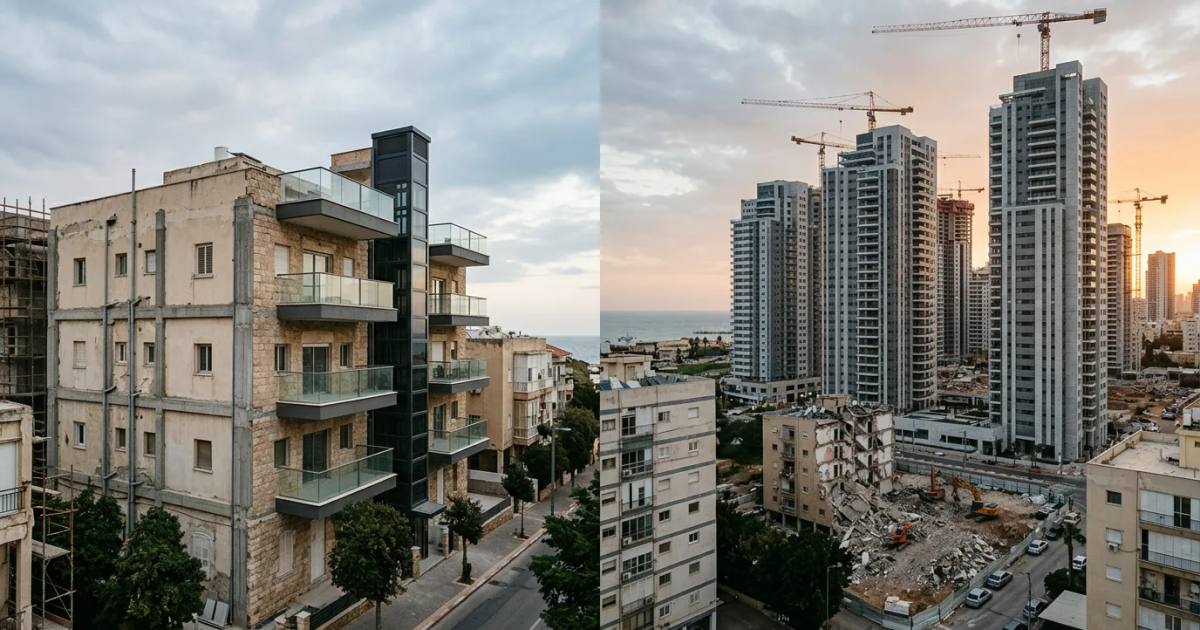
One statute, two coasts, two doctrines. Netanya runs on TAMA 38 retrofits and Ir Yamim greenfield. Bat Yam runs on pinui-binui rebuilds. The split is structural — Amidar stock vs 1970s stock, small plots vs large, high fractionation vs low.
Netanya and Bat Yam are both Israeli coastal cities on the Tel Aviv metropolitan axis. Both are running large-scale urban rebuilds. Both draw from the same national statutory framework — the National Outline Plan 38 (TAMA 38) for earthquake-retrofit-plus-densification, and pinui-binui for full evacuate-and-rebuild — and both work under the same Israel Land Authority land-allocation system. Yet the two cities have taken opposite paths. Netanya runs on TAMA 38 retrofits and greenfield master planning. Bat Yam runs on pinui-binui rebuilds. The choice was structural, driven by the age of the housing stock, the plot economics, and the ownership fractionation each city inherited. Two coasts. Two doctrines. Same statute.
TAMA 38 and pinui-binui: the two instruments
TAMA 38 (Tochnit Mitar Artzit 38) was Israel's response to the 1999 Turkish earthquake and the recognition that Israeli residential stock built before modern seismic codes would collapse in a major event. The framework, adopted in 2005, permits owners of buildings built before 1980 to retrofit their structures for earthquake resistance in exchange for the right to add floors, elevators, and additional units. Two tracks: TAMA 38/1 (strengthen the existing building and add floors on top), and TAMA 38/2 (demolish and rebuild larger). The framework was designed for building-by-building projects.
Pinui-binui is the older Israeli urban-renewal statute, formalized in current form in 1998 and expanded through the 2000s and 2010s. The framework permits municipalities to designate multi-parcel neighborhoods for coordinated evacuation and rebuild — developer demolishes multiple aging buildings across adjacent plots, compensates original owners with new apartments in a new development, and sells the incremental units. The framework is designed for neighborhood-scale projects with dozens or hundreds of original apartment owners per project.
Why Netanya took TAMA 38
Netanya's central-city housing stock is dominated by construction from the 1970s and 1980s — buildings that pre-date modern seismic codes but are structurally intact, generally larger-plot construction than Bat Yam's older Amidar stock, with mid-rise (four-to-six story) heights and modest ownership counts per building. That stock is a textbook TAMA 38/1 candidate: the buildings can be strengthened, elevators can be added, floors can go up, and the aggregate economics work at the building-by-building scale that TAMA 38 was designed for.
Netanya's greenfield expansion into Ir Yamim further reduced the pressure for pinui-binui in the central city. The demand that would have driven multi-parcel neighborhood-scale rebuilds could be absorbed instead by the greenfield district on the southern coast. Central Netanya could densify incrementally through TAMA 38 without needing the more disruptive pinui-binui doctrine. The two mechanisms — TAMA 38 in the interior, greenfield master planning at Ir Yamim — worked in complementary parallel.
Why Bat Yam took pinui-binui
Bat Yam's housing stock is older, denser, and more fractionated than Netanya's. Roughly 60 percent of Bat Yam residential building stock was built between the mid-1950s and mid-1970s under the Amidar public-housing program — standardized four-story walk-ups on small plots, dozens of small ownership blocks per neighborhood. TAMA 38/1 retrofit economics fail on that stock at project-level scale: the plots are too small to justify the retrofit cost, the ownership counts create signature-assembly complications, and the resulting incremental unit count would not compensate the developer for the risk.
Pinui-binui at multi-parcel scale is the doctrine that works on that feedstock. Aggregating four to eight adjacent Amidar apartment blocks into a single project pools land value, produces enough incremental unit count to compensate original owners and generate developer margin, and delivers the higher-density new construction that Bat Yam's TABA 3700 masterplan requires. Aura Investments, Ashtrom, and Y.H. Dimri all built specialized machinery for the multi-parcel pinui-binui workflow. That specialization is why the pipeline runs at industrial scale in Bat Yam.
Bat Yam also has no greenfield expansion option. The city is fully built out within its municipal boundaries. Every additional unit has to come from densification of existing stock — which means pinui-binui and, secondarily, TAMA 38/2 demolish-and-rebuild on the plots too small for pinui-binui aggregation.
The developer specialization consequence
The doctrinal split has produced developer specialization. Developers that dominate Bat Yam — Aura, Ashtrom, Dimri — carry specialized pinui-binui machinery: local acquisition teams for owner-signature assembly, legal capacity for the Tabu registry and multi-owner agreements, and construction operations tuned to multi-parcel demolish-and-rebuild timelines. Developers that dominate Netanya — Africa Israel Residences, Ashdar, Amos Luzon, Electra Real Estate, Rotshtein, Zemach Hammerman, Gindi Holdings — carry different specialization: greenfield high-rise construction infrastructure for Ir Yamim, individual-building TAMA 38 retrofit capability, and marketing capacity for diaspora buyers.
Developers can and do work across both cities, but their competitive advantages are strongest inside the doctrine they specialized in. Aura's pinui-binui machinery in Bat Yam does not automatically translate to TAMA 38 retrofit dominance in Netanya. Africa Israel's greenfield-district anchor position in Ir Yamim does not automatically translate to pinui-binui acquisition speed in Bat Yam. Cross-city expansion happens, but each city's dominant developer stack looks different because each city's doctrine looks different.
The buyer consequence
The doctrinal split shapes the buyer experience too. A buyer in a Netanya TAMA 38 retrofit is buying into an existing building with additional new units added on top — same neighborhood, same street position, same neighbors mostly, better building. A buyer in a Bat Yam pinui-binui project is buying into a completely new building on a completely new footprint — the entire block was demolished, streets were often redesigned, new commercial mix at the ground floor. The two products are different products, priced differently, marketed differently, delivered on different timelines.
Both are Israeli urban-renewal residential. Neither is a substitute for the other. Diaspora buyers in Netanya's Ir Yamim receive a different product than diaspora buyers in Bat Yam's Aura Sky or Ashtrom beachfront. The doctrinal split has consequences all the way down to the buyer's transaction terms.
What the split means for Israeli urban planning
Netanya and Bat Yam together demonstrate that Israeli urban renewal is not a single doctrine but a menu of instruments matched to specific stock characteristics. TAMA 38 works where the buildings are structurally intact, the plots are large enough, and the ownership counts are manageable. Pinui-binui works where the buildings are past retrofit economics, the plots are too small for individual projects, and the ownership counts require multi-parcel aggregation. Greenfield master planning works where undeveloped land is available inside the municipal boundary.
Most Israeli coastal cities need a combination. Central Tel Aviv runs on TAMA 38 in the older interior and pinui-binui in the south. Ramat Gan runs on both. Rishon LeZion runs on greenfield expansion in the western districts and mixed renewal in the older core. Herzliya runs on selective pinui-binui at the coast and TAMA 38 in the interior. The Netanya and Bat Yam extremes — one heavily TAMA 38, one heavily pinui-binui — bracket the range of Israeli coastal-city urban-renewal strategies.
Why it matters
The choice of urban-renewal doctrine is not aesthetic or ideological. It is structural — driven by the specific housing stock, plot economics, and ownership patterns a city inherited from its founding-era buildout. Netanya and Bat Yam took opposite paths because their inherited stocks were opposite. Both paths work. Both produce coastal cities that look different in twenty years than they did at the start of the cycle. Both use the same statute to do it.
One statute. Two coasts. Two doctrines. Same result: an Israeli coast that rebuilds itself.
Primary Sources
- Ministry of Interior — TAMA 38 statutory framework
- Israel Land Authority — pinui-binui project registry, national
- Netanya Municipality — TAMA 38 project registry
- Bat Yam Municipality — TABA 3700 masterplan and pinui-binui pipeline
- Ministry of Construction and Housing — urban renewal statistics by municipality
Olam coverage
Part of Olam's coastal-cities coverage. Netanya arc: Ir Yamim, Africa Israel in Netanya, Ashdar Netanya, Amos Luzon in Netanya, Netanya Between Two Waves. Bat Yam arc: Aura Sky Bat Yam, Sea Towers Bat Yam, Bat Yam Central, Dimri Bat Yam, The French Beachfront, Bat Yam 250,000.