
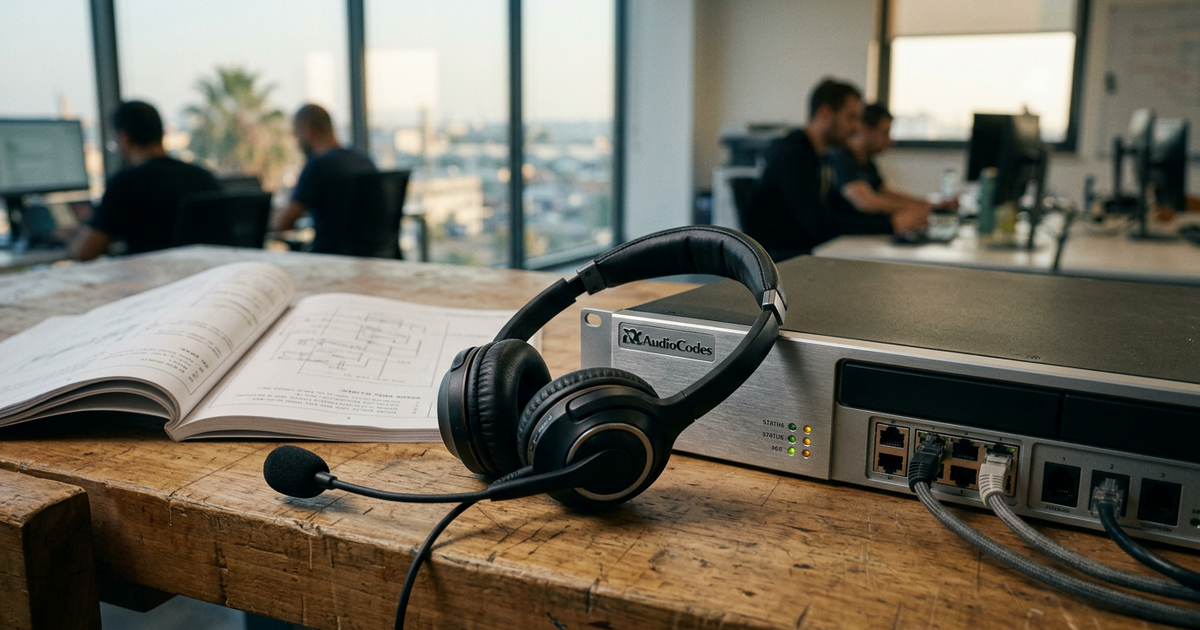
Founded 1993 in Or Yehuda by Shabtai Adlersberg and Leon Bialik. Nasdaq: AUDC. Israel's enterprise-voice company — VoIP to Microsoft Teams to conversational AI — with the same founder-CEO for 33 years. $62.1M Q1 2026 revenue, $80M ARR, Voice AI growing 50%+.
Nasdaq: AUDC · TASE: AUDC · Founded 1993 in Or Yehuda by Shabtai Adlersberg and Leon Bialik · Market cap ~$240M · 2026 guidance $247–255M revenue · The Israeli enterprise-voice company that has compounded through three platform cycles — VoIP, unified communications, and now conversational AI — with the same founder-CEO for 33 years.
AudioCodes is the Israeli voice-infrastructure company that has survived every platform transition in enterprise telecommunications since 1993 — and is now betting that conversational AI is the fourth. Founded by Shabtai Adlersberg and Leon Bialik, both ex-DSP Group engineers, AudioCodes started as a VoIP infrastructure vendor, became the dominant session-border-controller and media-gateway provider for enterprise voice, built the largest third-party integration layer for Microsoft Teams voice, and is now pivoting toward AI-powered voice agents through its Voca Conversational Interaction Center. Adlersberg has led the company as president and CEO since founding — one of the longest-tenured founder-CEO runs on any exchange.
At a Glance
| Company | AudioCodes Ltd. |
| Tickers | Nasdaq: AUDC · TASE: AUDC |
| Founded | 1993, Or Yehuda, Israel |
| Founders | Shabtai Adlersberg · Leon Bialik (both ex-DSP Group) |
| HQ | Park Naimi, Or Yehuda, Israel |
| CEO | Shabtai Adlersberg (founder; president & CEO since 1993) |
| CFO | Niran Baruch |
| Nasdaq IPO | 1999 |
| Market cap | ~$240M (Jul 2026) |
| 2024 revenue | $242.2M |
| Q1 2026 revenue | $62.1M (+2.9% YoY) |
| 2026 guidance | $247–255M revenue; non-GAAP EPS $0.60–0.75 |
| ARR | $80M exit Q1 2026 (~20% YoY growth) |
| Voice AI growth | 50%+ in Q1 2026; targeting 40–50% segment growth full year |
| Employees | ~950–1,100 |
| Dividend | $0.20/share (~4.7% yield) |
| Gross margin | ~65% |
The three platform transitions
AudioCodes has navigated three enterprise-communications platform cycles from the same Israeli campus.
Cycle 1: VoIP infrastructure (1993–2005). The founding thesis was digital signal processing for voice-over-IP — converting traditional telephony to packet-based networks. Adlersberg and Bialik came out of DSP Group, the Israeli chip company, and applied DSP expertise to voice encoding, media gateways, and the session-initiation protocol (SIP) stack that enterprise voice networks were built on. AudioCodes became one of the primary OEM suppliers of voice-processing boards and media gateways to enterprise telephony vendors.
Cycle 2: Unified communications and Microsoft integration (2005–2020). As enterprise voice moved from on-premise PBX infrastructure to cloud-hosted unified-communications platforms — first Microsoft Lync, then Skype for Business, then Microsoft Teams — AudioCodes built the largest third-party integration layer for Microsoft's voice stack. Session border controllers (SBCs), direct-routing infrastructure, and managed-service deployment for Teams voice became the company's core revenue driver. AudioCodes became one of Microsoft's most-cited voice infrastructure partners.
Cycle 3: Conversational AI and Voice AI (2020–present). Adlersberg has framed the current transition as a transformation into "a voice AI-driven hybrid cloud software and services company." The two growth engines: Live Managed Services (cloud-hosted managed voice for Teams and contact centers) and Voice AI (the Voca Conversational Interaction Center and adjacent AI voice-agent products). Together these segments drove $80 million in annual recurring revenue exiting Q1 2026, growing roughly 20% year-over-year. The conversational-AI segment alone grew above 50% in Q1 2026. Adlersberg has targeted $80 million in Voice AI business by 2028.
The Voca CIC deployment
AudioCodes' most visible Voice AI deployment is the Voca Conversational Interaction Center (Voca CIC) — an AI-powered conversational IVR platform that replaces legacy interactive voice response systems with natural-language voice agents. In December 2025, AudioCodes announced a large-scale deployment with Atento and Go2Uno for a major US managed-care organization — more than 500 concurrent voice agents, replacing legacy IVR, delivered in approximately 30 days. That deployment is the reference case for the Voca CIC at enterprise scale.
The revenue mix shift
The structural story inside AudioCodes' financials is the mix shift from product to services. In Q1 2026, service revenue reached $34.0 million — 54.7% of total revenue, up from a product-dominant mix a decade earlier. The shift matters because services carry higher gross margins, produce recurring revenue, and reduce the cyclicality that hardware-dependent enterprise-telecom vendors historically suffer through upgrade cycles. AudioCodes' backlog rose to $79 million in Q1 2026, up approximately 15%.
The company is profitable — GAAP net income of $2.0 million in Q1 2026 ($0.07 diluted EPS), non-GAAP net income of $3.8 million ($0.14 diluted EPS). Cash and equivalents: $68.1 million. The company pays a dividend ($0.20/share, roughly 4.7% yield) and has been buying back shares — 1.7 million shares repurchased for approximately $13.7 million in Q1 2026.
Adlersberg: the 33-year founder-CEO
Shabtai Adlersberg has been president and CEO of AudioCodes since its 1993 founding — a 33-year run that makes him one of the longest-tenured founder-CEOs on any public exchange. His background is in electrical engineering and digital signal processing. Before AudioCodes, both Adlersberg and co-founder Leon Bialik worked at DSP Group, the Israeli semiconductor company that was itself a formative node in the Israeli telecom-chip ecosystem.
The founder-CEO tenure is the operative structural difference between AudioCodes and most of its enterprise-communications peers. Companies that cycle through CEO transitions — Avaya, Mitel, the late-cycle Polycom — tend to oscillate between growth mandates and restructuring mandates. AudioCodes has run a single strategic thread for three decades: sell voice infrastructure to enterprises, stay close to the platform that enterprises adopt, and follow the platform from on-premise to cloud to AI. That continuity is the product of one person staying in the seat.
AudioCodes in the Israeli enterprise-software cohort
AudioCodes belongs to the cohort of mid-cap Israeli enterprise-software companies that listed on Nasdaq in the late 1990s and early 2000s and have compounded through multiple technology cycles without a transformative exit. The peer set includes Magic Software Enterprises (Nasdaq: MGIC), Sapiens International (Nasdaq: SPNS), and Gilat Satellite Networks (Nasdaq: GILT) — each occupying a different enterprise-infrastructure niche, each dual-listed on the TASE, each led by long-tenured Israeli management teams, and each carrying single-digit or low-double-digit revenue growth with steady profitability. The cohort is not the Israeli startup economy. It is the Israeli operating economy — the companies that employ thousands of Israeli engineers and generate consistent revenue without the venture-capital-to-IPO arc that dominates Israeli technology headlines.
Watch points
- Voice AI segment growth trajectory — whether the 40–50% 2026 target holds and whether the $80M-by-2028 aspiration is achievable.
- Microsoft Teams voice market share — whether AudioCodes retains its position as the dominant third-party integration layer as Microsoft evolves its own native voice stack.
- The mix shift — whether services cross 60% of revenue and what that does to gross margin and valuation multiple.
- CEO succession — Adlersberg is 33 years into the role. No public succession plan has been disclosed.
- Capital allocation — dividend yield at ~4.7% and active buybacks signal a mature-company posture; the question is whether Voice AI growth requires a pivot in capital deployment.
Frequently Asked Questions
What is AudioCodes?
AudioCodes (Nasdaq: AUDC, TASE: AUDC) is an Israeli enterprise voice-infrastructure and conversational-AI company, founded in 1993 in Or Yehuda. It provides session border controllers, voice gateways, Microsoft Teams integration, and the Voca Conversational Interaction Center AI voice-agent platform. Revenue: ~$247–255M guided for 2026.
Who founded AudioCodes?
Shabtai Adlersberg and Leon Bialik, both formerly of DSP Group, founded AudioCodes in 1993. Adlersberg has served as president and CEO since founding — a 33-year tenure.
Where is AudioCodes headquartered?
Park Naimi, Or Yehuda, Israel — in the Tel Aviv metropolitan area. The company also has offices in the United States, Europe, and Asia-Pacific.
What is AudioCodes' relationship with Microsoft?
AudioCodes is one of the largest third-party providers of voice infrastructure for Microsoft Teams, including session border controllers for direct routing and managed-service deployment. The Microsoft Teams integration business is one of AudioCodes' core revenue drivers.
What is Voca CIC?
The Voca Conversational Interaction Center is AudioCodes' AI-powered voice-agent platform that replaces legacy IVR systems with natural-language conversational agents. A December 2025 deployment with Atento and Go2Uno for a US managed-care organization — 500+ concurrent voice agents, delivered in 30 days — is the reference case.
Is AudioCodes profitable?
Yes. GAAP net income of $2.0 million in Q1 2026. Gross margin ~65%. The company pays a dividend ($0.20/share, ~4.7% yield) and repurchased 1.7 million shares for ~$13.7 million in Q1 2026.
What is AudioCodes' annual recurring revenue?
$80 million ARR exiting Q1 2026, growing roughly 20% year-over-year. The two ARR drivers are Live Managed Services and Voice AI.
Primary Sources
- AudioCodes Q1 2026 earnings release (May 5, 2026)
- AudioCodes corporate site (audiocodes.com)
- AudioCodes SEC filings via EDGAR
- TASE filings under AUDC
Related Olam Coverage
Israeli Enterprise Software — Dual-Listed Cohort
AudioCodes · Magic Software · Sapiens International · Gilat Satellite Networks · Nano Dimension · Outbrain
See also: The Olam Nasdaq 20 · The Builders · Founders & Companies
The Olam Editorial Team