Israel Electric Corporation — state-owned electric utility. Founded 1923 by Pinchas Rutenberg. 100% government-owned. FY2024 revenue NIS 26.2B, profit NIS 3.4B. Coal 52% (2013) to ~10% (2025). Gas sources: Tamar, Leviathan, Karish. ~12,000 employees. S&P BBB+/Stable. Coal phase-out target 2026-2027.
THE ENTITIES · OLAM.BUSINESS
Edited on Aug 16, 2026.
The Israel Electric Corporation is the state-owned monopoly that generates, transmits, and distributes the majority of Israel's electricity. Founded in 1923 by Pinchas Rutenberg — a Russian-Jewish engineer who secured a concession from the British Mandate — IEC is one of the oldest continuously operating institutions in the country. FY2024 revenue: NIS 26.2 billion. FY2024 profit: NIS 3.4 billion. Coal's share of generation dropped from 52% in 2013 to approximately 10% in 2025, with full phase-out targeted for 2026-2027.
Israel Electric Corporation: Snapshot
| Founded | 1923, by Pinchas Rutenberg |
|---|---|
| Type | Government-owned (100% state) |
| Headquarters | Haifa, Israel |
| FY2024 revenue | NIS 26.2 billion |
| FY2024 net profit | NIS 3.4 billion |
| Fuel mix (2025) | Gas ~73% · Coal ~10% |
| Fuel mix (2013) | Coal 52% · Gas 44% |
| Gas sources | Tamar · Leviathan · Karish (all domestic offshore) |
| Coal phase-out target | 2026-2027 |
| Major stations | Orot Rabin (Hadera) · Reading (Tel Aviv) · Rutenberg (Ashkelon) · Eshkol (Ashdod) |
| Private generation share | ~50% of Israeli electricity now from IPPs |
| Employees | ~12,000 |
| Credit rating | S&P BBB+/Stable · Moody's Baa2 |
Who founded IEC? Pinchas Rutenberg and the 1923 concession
Pinchas Rutenberg was a Russian-Jewish engineer and former revolutionary who secured a 70-year concession from the British Mandate to generate and distribute electrical power across Palestine. The first power station was built at Naharayim at the confluence of the Jordan and Yarmouk rivers. The Reading Power Station followed on the Yarkon River near Tel Aviv — it still operates today as a gas-fired facility and remains one of Tel Aviv's most recognizable industrial landmarks.
The Palestine Electric Corporation was renamed the Israel Electric Corporation after independence in 1948 and nationalized as a state-owned monopoly. For seven decades IEC generated, transmitted, and distributed virtually all electricity consumed in Israel.
How did Israel go from 52% coal to 10% in 12 years?
The single most consequential structural change in IEC's century of operation. In 2013 coal accounted for 52% of generation and gas for 44%. By 2025 those numbers reversed: gas ~73%, coal ~10%. The transition was enabled by Israel's offshore gas fields — Tamar (since 2013), Leviathan (since 2019), and Karish (since 2022).
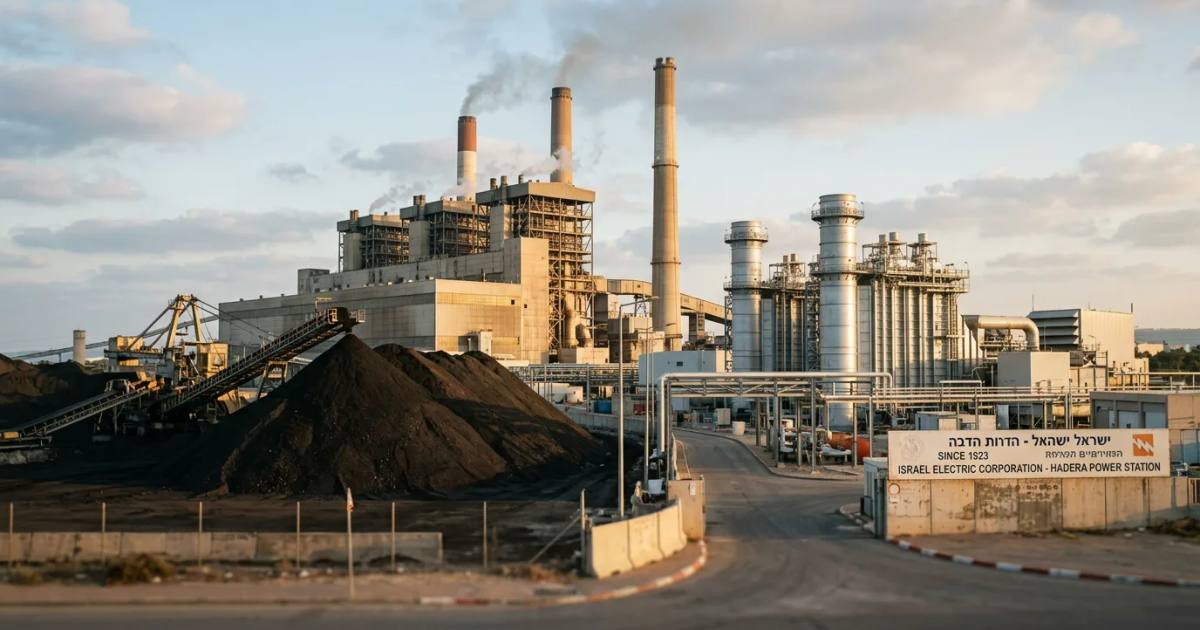
The centerpiece is Orot Rabin, IEC's largest station near Hadera. Its coal units are being converted to gas in stages. The station's 300-meter chimney is Israel's second-tallest structure. Conversion of units 5-6 is the gating factor for full coal phase-out — if Noga approves, the coal era ends in 2026. If not, March 2027.
Coal must be imported by ship. Gas flows through domestic pipelines from Israeli territorial waters. The transition simultaneously cuts emissions, eliminates import dependence, and leverages the multi-billion-dollar offshore gas investments.
How much electricity does IEC still generate vs private producers?
Approximately half of Israeli electricity is now generated by private producers — IPPs selling into the grid under Electricity Authority contracts. IEC retains the transmission and distribution monopoly and remains the largest single generator. Private producers include gas-fired plants (Dalia Power, OPC Energy, Netiv HaOr) and solar installations in the Negev and Arava.
IEC's role has shifted from sole generator to system anchor: the company that guarantees baseload reliability, operates the transmission grid, manages emergency capacity, and serves as buyer of last resort.
What happened to Israel's electricity grid after October 7?
IEC shifted to emergency operations within hours. Crews repaired infrastructure near the Gaza border while maintaining supply nationally. Fuel stockpiles were increased. The grid held — no nationwide blackouts. A state-owned utility with a century-old transmission network maintained supply through a multi-front war.
IEC also supplies electricity to the West Bank and Gaza Strip under political agreements — one of the few state-owned utilities that supplies electricity to a territory under active conflict.
Why does IEC matter?
Energy security. IEC guarantees that Israeli homes, hospitals, military bases, and data centers have electricity. October 7 demonstrated this is not theoretical.
The coal-to-gas transition is a national-scale industrial transformation few countries have matched at comparable speed while maintaining grid reliability through a war.
The privatization question. IEC remains the largest state-owned enterprise that has not been through a major privatization. The government has moved slowly. The Histadrut has resisted.
Israel Electric Corporation: Frequently Asked Questions
What is the Israel Electric Corporation?
Israel's state-owned electric utility. Founded 1923 by Pinchas Rutenberg. 100% government-owned. Generates, transmits, and distributes electricity nationally. FY2024 revenue NIS 26.2 billion. ~12,000 employees. S&P BBB+/Stable.
Who founded IEC?
Pinchas Rutenberg, a Russian-Jewish engineer, in 1923 under a 70-year British Mandate concession. The first station was built at Naharayim on the Jordan River. The company was renamed from Palestine Electric Corporation after Israeli independence in 1948.
Is IEC publicly listed?
No. 100% state-owned. IEC issues bonds (rated S&P BBB+/Stable, Moody's Baa2) but not equity. It is the largest state-owned enterprise that has not undergone major privatization.
When will Israel stop using coal for electricity?
Target 2026-2027. Coal's share dropped from 52% in 2013 to ~10% in 2025. The gating factor is the conversion of Orot Rabin units 5-6 from coal to gas, pending Noga (system operator) approval.
Where does IEC get its natural gas?
Three domestic offshore fields: Tamar (producing since 2013), Leviathan (since 2019), and Karish (since 2022). All are in Israeli territorial waters, eliminating import dependence.
How much electricity does IEC generate?
IEC generates approximately 50% of Israel's electricity. The other 50% comes from private independent power producers (IPPs) selling into the grid. IEC retains the transmission and distribution monopoly.
What is Orot Rabin?
IEC's largest power station, near Hadera. Its 300-meter chimney is Israel's second-tallest structure. Originally coal-fired, it is being converted to natural gas in stages. The conversion of its final coal units is the gating event for Israel's complete coal phase-out.
Did the grid survive October 7?
Yes. IEC shifted to emergency operations within hours, repaired Gaza-border infrastructure under active conflict, increased fuel stockpiles, and maintained national supply. No nationwide blackouts occurred.
Does IEC supply electricity to Gaza and the West Bank?
Yes. IEC supplies electricity to the West Bank and Gaza Strip under political agreements — one of the few state-owned utilities that supplies electricity to a territory under active conflict.
What is IEC's revenue and profitability?
FY2024 revenue: NIS 26.2 billion. FY2024 net profit: NIS 3.4 billion. Credit ratings: S&P BBB+/Stable, Moody's Baa2.
Primary Sources
Israel Electric Corporation annual reports and bond prospectuses. Israel Electricity Authority regulatory filings. Noga (Israel system operator) generation data. Israel Ministry of Energy coal phase-out directives. Historical records of the 1923 Rutenberg concession. Related coverage: Tamar Gas Field; Karish and the Maritime Agreement; Mekorot; EAPC Pipeline; Israeli Gas Export Mechanics. Data current as of August 2026.
Olam coverage
See: Tamar Gas Field · Karish and the Maritime Agreement · Mekorot · EAPC Pipeline · Israeli Gas Export Mechanics
בעברית
חברת החשמל לישראל. נוסדה 1923 על ידי פנחס רוטנברג בזיכיון מהמנדט הבריטי. חברה ממשלתית בבעלות מלאה של המדינה. הכנסות 2024: 26.2 מיליארד ש"ח. רווח נקי: 3.4 מיליארד ש"ח. מטה: חיפה. כ-12,000 עובדים. תמהיל דלק 2025: גז ~73%, פחם ~10%. ב-2013: פחם 52%, גז 44%. המעבר מפחם לגז בוצע ב-12 שנה — אחד המהירים בעולם — תוך שמירה על אמינות הרשת דרך מלחמה. תחנות ראשיות: אורות רבין (חדרה), רדינג (תל אביב), רוטנברג (אשקלון), אשכול (אשדוד). מקורות גז: תמר, לוויתן, כריש — כולם בשטח הימי של ישראל. יעד לסיום שימוש בפחם: 2026-2027. דירוג אשראי: S&P BBB+/יציב.
The Olam Editorial Team | The Entities