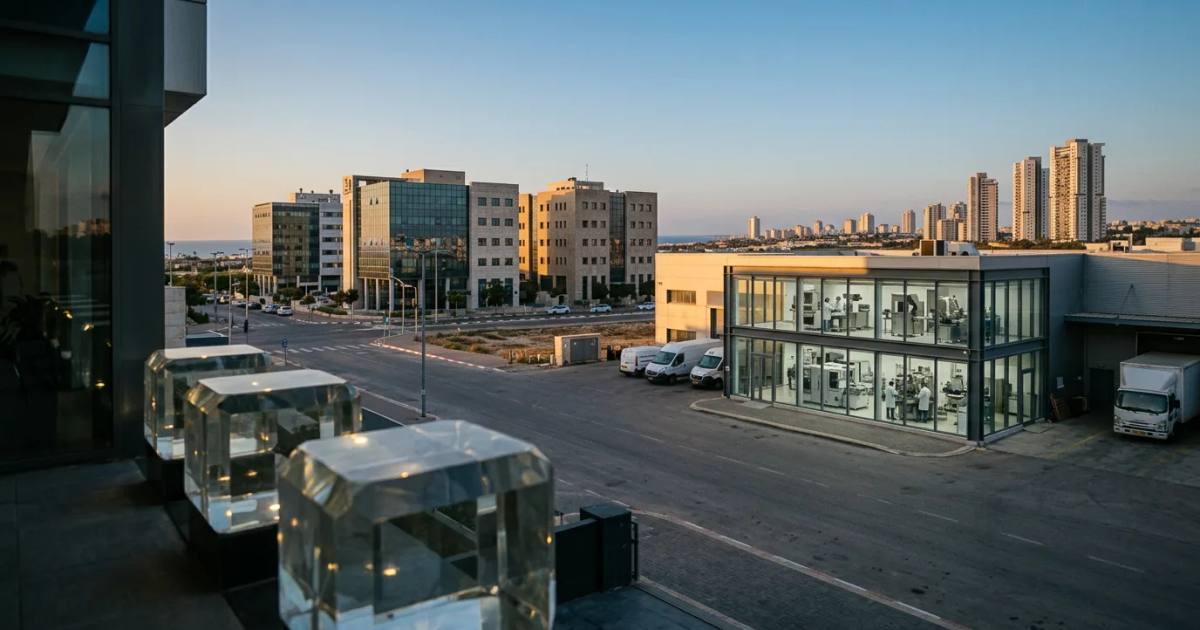

NextSilicon — Tel Aviv chip startup by Elad Raz. $300M+ raised at $1.6B valuation. Maverick-2 Intelligent Compute Accelerator deployed at Sandia National Labs via Vanguard-2. Arbel RISC-V CPU on TSMC targeting Intel and AMD. The Nvidia alternative Israel is building.
NextSilicon is the Israeli semiconductor startup building an alternative to Nvidia — the Tel Aviv chip company that raised over $300 million, sits at a $1.6 billion valuation, and just deployed its Maverick-2 Intelligent Compute Accelerator into Sandia National Laboratories through the US Vanguard-2 supercomputing program. Elad Raz's bet that dataflow architecture can outperform GPUs on real workloads.
What NextSilicon Is
NextSilicon Ltd. is an Israeli high-performance computing and semiconductor company redefining compute architecture for AI training, inference, and scientific-computing workloads. The company's core technical bet: rather than force software to adapt to fixed hardware, build hardware that adapts to software in real time. Founder Elad Raz frames the shift as moving control tasks traditionally handled by hardware to an intelligent software layer, freeing silicon area for actual computation.
Founded 2017. Headquartered in Tel Aviv with US operations. Reported revenue in the tens of millions of dollars.
The Founder
Elad Raz (Founder, CEO). Israeli chip industry veteran. Founded and exited a prior high-performance computing / cryptography / networking company that was acquired by Mellanox Technologies in 2014. Left before Nvidia's 2020 acquisition of Mellanox. Deep background in low-level systems, security, networking, and file-system development combined with elite military engineering roles. The technical operator behind the entire NextSilicon architecture bet.
The Products
Maverick-2 — Intelligent Compute Accelerator. Announced October 22, 2025. Built on NextSilicon's Intelligent Compute Architecture (ICA). Dataflow-enabled hardware that reconfigures itself in real time, identifying frequently executed code paths and optimizing hardware on the fly.
Company performance claim. Approximately 10x the computational output of Nvidia's latest GPU series at approximately 60% of the power draw on algorithmically complex workloads. The benchmark subset released by the company. Independent validation is emerging through the Sandia deployment.
Software compatibility. Maverick-2 runs unmodified CUDA, Fortran, and legacy HPC code out of the box. This is the go-to-market differentiator versus every other Nvidia-alternative silicon startup — no software rewrite penalty.
Arbel — RISC-V CPU. Announced October 2025. Built on TSMC. Positioned to compete with Intel and AMD in enterprise CPU performance. Additional benchmarks to follow the test-chip phase.
The Funding History
- Early rounds (2018–2020). Seed and Series A. Aleph, Yuval Ariav's Symbol (first institutional investor), Playground Global, Amiti, Liberty.
- 2021 — Growth round. $120M led by Third Point Ventures. Post-money valuation approximately $1.5B. Participation from Schusterman Family Investments, Playground Global, Aleph, Amiti, Liberty.
- Subsequent capital. Additional ~$100M raised, bringing valuation to approximately $1.6B and total capital raised to over $300M.
- The stealth pattern. NextSilicon operated substantially under the radar during 2018–2021 despite raising nine-figure venture capital. The Forbes and Sandia disclosures in October 2025 were the first sustained public visibility.
The Sandia Deployment
October 2025: NextSilicon disclosed that Maverick-2 is deployed at Sandia National Laboratories through the US federal Vanguard-2 supercomputing program. Sandia is one of the three US National Nuclear Security Administration laboratories — among the highest-scrutiny compute customers in the world.
The Sandia deployment is what turns NextSilicon from a benchmark-slide story into a validated-deployment story. National-lab evaluation programs are the reference procurement any serious HPC or defense buyer follows. Passing Sandia is the credential that unlocks the next tier of federal, national-lab, and defense-adjacent customers globally.
Where NextSilicon Sits in the Israeli AI Silicon Stack
The Israeli AI silicon cluster — the most concentrated national semiconductor footprint outside the US-Taiwan-China triad — now runs across five anchor companies:
- Mellanox → NVIDIA (2019, $6.9B). High-performance networking / InfiniBand.
- Habana → Intel (2019, $2B). AI training and inference chips.
- Annapurna Labs → Amazon (2015). AWS Graviton, Nitro, Trainium chips.
- Hailo. Edge AI inference silicon.
- NextSilicon. The independent bet — alternative compute architecture, still private, pursuing Nvidia head-on rather than exiting into a hyperscaler.
The critical distinction: Mellanox, Habana, and Annapurna are Israeli technology inside US strategic-buyer stacks. NextSilicon is the Israeli operator still on the outside of that consolidation — the sole independent Nvidia-alternative silicon startup with national-lab traction.
Why NextSilicon Matters
The independent-silicon bet. Every other serious Israeli AI silicon story has resolved into an American acquisition. NextSilicon is the surviving independent — building a stack Nvidia does not own, at valuation levels ($1.6B) below where the exits were priced but with a real-workload validation pipeline that most competitors do not have.
The dataflow architecture question. Dataflow architecture has been technically studied for decades and repeatedly failed to become commercially viable. If NextSilicon's claims survive independent validation, this is the largest architectural shift in general-purpose compute since GPU acceleration. If they do not, this is another chapter in the same failure pattern. The Sandia results will determine which one.
The software-first hardware thesis. Raz's core claim — that intelligent software can drive hardware reconfiguration at runtime — is architecturally distinct from both fixed-function ASICs (Groq, Cerebras, Habana) and general-purpose GPUs (Nvidia, AMD). This is the third option, and Israel is where it is being built.
One-Line Summary
NextSilicon is the Tel Aviv chip startup building an Nvidia alternative — $300M+ raised at a $1.6B valuation, Maverick-2 accelerator deployed inside Sandia National Laboratories, Arbel RISC-V CPU targeting Intel and AMD. The sole surviving independent Israeli AI-silicon operator not absorbed into a US strategic acquirer.