
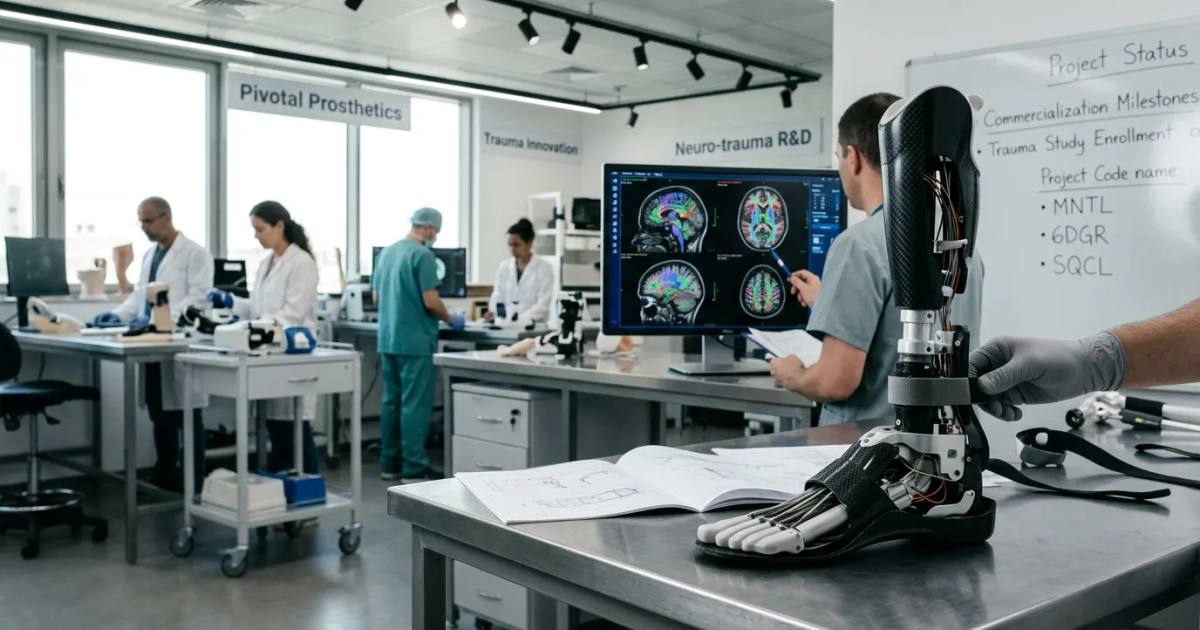
20,000+ wounded soldiers; 4,000 PTSD; 3M Israelis with symptoms per State Comptroller 2024. Trauma-tech: 6Degrees, Mentally, SequelCare, EyeMinders, GMH. Innovalve → Edwards Lifesciences. Israel Innovation Authority mental-health program.
Israeli Health & Biotech | Olam.business
Trauma surgery commercialization, prosthetics, and the mental-health infrastructure Israel is building at scale.
The war that began October 7, 2023 has produced the largest cohort of trauma casualties in Israeli medical history — 20,000+ wounded soldiers per Ministry of Defense figures, 4,000 officially diagnosed with PTSD and another 9,000 in process, and a 2024 State Comptroller finding that 3 million Israelis exhibit moderate or severe symptoms of PTSD, depression, or anxiety. That cohort has become the largest sustained real-world dataset in modern trauma medicine. It is also the institutional forcing function behind an accelerating Israeli medical-innovation cycle spanning trauma surgery, prosthetics and rehabilitation robotics, biofeedback and biometric mental-health platforms, digital PTSD therapeutics, and hospital-integrated AI clinical-decision-support systems — collectively producing what the Israel Innovation Authority now describes as a global "petri dish" for trauma tech.
The Numbers
| Wounded soldiers (MoD, cumulative) | 20,000+ |
| Wounded soldiers with emotional wounds | 56% (~11,200) |
| Officially diagnosed PTSD (soldiers) | 4,000+ |
| In-process PTSD diagnosis | 9,000+ |
| Civilians with moderate/severe PTSD or anxiety symptoms (State Comptroller 2024) | ~3,000,000 |
| Civilians with at least one severe symptom | ~580,000 |
| PTSD rate among Israelis 18–30 (Ben-Gurion Univ) | Pre-war 25% → post-war 42% |
| PTSD rate among evacuees | ~60% |
| Estimated cumulative cost to Israel (State Comptroller) | ~$5 billion |
Trauma Surgery
Israeli academic hospitals have entered the post-October 7 environment carrying two decades of prior trauma-surgery development and are now producing peer-reviewed publications, clinical protocols, and operational case studies at unprecedented volume. Soroka's October 7 mass-casualty case study — published under lead authors CEO Prof. Shlomi Codish, deputy directors Dr. Dan Schwarzfuchs and Dr. Jacob Dreiher, ER head Dr. Moti Klein, and the Soroka trauma team — has become an international reference for hospital-scale mass-casualty response and is being adopted by trauma programs across Europe, the US, and Asia.
Sheba, Hadassah, Ichilov, Rambam, and Soroka together maintain the operational pipeline through which trauma-surgery advances (multi-limb blast injury, penetrating chest and abdominal trauma, mass burn, complex orthopedic reconstruction) are documented, protocol-ized, and pushed into clinical training curricula globally. Soroka's Emergency and Trauma Department alone processes 200,000+ ER visits per year — the busiest in Israel.
Prosthetics and Rehab Tech
The trauma cohort has produced an amputee population and rehabilitation-technology demand far exceeding pre-war infrastructure. Sheba's Rehabilitation Hospital — the largest rehabilitation facility in Israel — has absorbed the largest share of the post-October 7 rehabilitation load. Startup and product-development activity has accelerated in parallel:
- 6Degrees — wearable AI devices that convert motion into digital commands, giving amputees complete control of smart devices.
- Non-verbal communication platforms — tools letting non-verbal individuals express themselves through eye movements or other signals; deployed as pre-verbal-recovery communication for post-injury cognitive rehab patients.
- Eye-prosthetics work — programs restoring self-esteem and identity for soldiers with ocular-region injuries.
- Wounded-veteran-focused venture capital — a $35 million VC fund launched at a Gaza war crossing, dedicated to trauma-tech and rehabilitation-technology companies.
The PTSD Buildout
The PTSD-and-mental-health scale has forced Israel to build what is effectively a national mental-health infrastructure at speed. Ichilov CEO Prof. Eli Sprecher has repeatedly framed the coming national mental-health crisis as Israel's next major public-health emergency. Sheba Beyond, Sheba's virtual hospital platform, has become the operational vehicle for scaled digital mental-health delivery. The Israel Innovation Authority (IIA), under Inbar Blum, has launched a mental-health-innovation program supporting startups and pilot sites — hospitals, resilience centers, therapeutic settings — with several Israeli companies competing in Horizon Europe's mental-health innovation program.
Company-level activity:
- Mentally (LIV system) — developed in collaboration with Microsoft and KPMG. Clinical decision-support tool that integrates with hospital systems, analyzes patient data, and generates personalized treatment recommendations. Detects subtle shifts in voice and facial expression indicating distress.
- SequelCare — collaborating with Hebrew University and Sheba Beyond on a guided digital therapeutic for PTSD, currently in randomized controlled trial. Product advanced in memory of Adi Vital-Kaploun, an October 7 victim.
- EyeMinders — biometric platform translating eye-movement patterns into indicators of cognitive and emotional load. Addresses a longstanding weakness in mental-health measurement: reliance on self-report questionnaires.
- Reflect — drug-free stress and anxiety management via biofeedback technology.
- GMH's Prism for PTSD — deployed at Sheba, Barzilai, and Maale Carmel within one month of October 7.
Digital Health and Clinical AI
The largest funded segment of Israeli health tech remains digital health. Sheba's ARC Innovation Center is the anchor institutional platform, and Sheba's virtual hospital (Sheba Beyond) is the operational template for remote-monitoring, telemedicine, and hospital-at-home delivery at scale. Innovalve Bio Medical, originating at Sheba, was acquired by Edwards Lifesciences for advanced, minimally invasive heart-valve treatments — one of the most commercially significant Sheba spinouts of the current cycle.
Clalit Health Services, Israel's largest HMO, has anchored a portion of the post-October 7 innovation cycle through internal development infrastructure under Prof. Ran Balicer — building integrated digital tools directly inside the operational system rather than importing external product.
Why Now
Three structural conditions have combined to produce the current innovation cycle:
First — the injury cohort scale. Twenty thousand wounded soldiers with detailed medical records, three million civilians with self-reported PTSD/anxiety symptoms, and the concentrated flow through five academic hospitals produce a real-world dataset that no peacetime healthcare system can match.
Second — the academic-industrial density. The Weizmann Institute, the five academic hospitals, and the four research universities produce the clinical and translational research base. aMoon Fund and OrbiMed Israel provide the growth-stage capital. The Israel Innovation Authority provides the seed-and-pilot capital. Sheba's ARC, Hadassah's Wohl Institute, and Ichilov's Tel Aviv University affiliation provide the institutional pipelines.
Third — the wartime forcing function. Every Israeli academic hospital is currently operating under conditions of active conflict and has been for two years. Innovations that would take a decade to deploy in peacetime medical systems are being deployed in months.
What 2026 Tracks
- The national mental-health build-out — whether Israel's emerging PTSD and trauma-mental-health infrastructure scales from pilot deployments to permanent institutional capacity.
- International product distribution — whether Israeli trauma-tech, prosthetics, and mental-health-tech companies successfully export the product architecture to the US and European healthcare systems.
- Clinical AI integration — whether Sheba's ARC/Project K model is replicated across the other four academic centers and becomes a five-hospital operating standard.
- The Iranian-missile fortification cycle — whether the ₪4 billion+ Ministry of Health protection plan is disbursed at scale post-Soroka, June 2025.
The Cyber Playbook, Again
The Israeli medical-innovation cycle now underway is a structural counterpart to the 2000s-era Israeli cybersecurity build-out. In both cases, sustained conflict conditions concentrated real-world data, forced accelerated deployment cycles, produced defensible institutional expertise, and generated a founder cohort with irreproducible operational credibility. Israeli cyber companies now anchor global enterprise cybersecurity. The bet — implicit in the Ichilov CEO's public framing, the Israel Innovation Authority's programming, and the venture-capital positioning — is that Israeli trauma-tech, mental-health-tech, and clinical-AI companies will occupy the analogous position in global healthcare.
FAQ
How many Israelis are affected by post-October 7 mental health conditions?
Per the 2024 State Comptroller report, approximately 3 million Israelis exhibit moderate or severe symptoms of PTSD, depression, or anxiety; approximately 580,000 exhibit at least one severe symptom. Among 18–30 year-olds, Ben-Gurion University research shows PTSD rates rose from 25% pre-war to 42% post-war. Among evacuees, the rate is approximately 60%.
How many wounded soldiers are there?
The Ministry of Defense has documented 20,000+ wounded soldiers. Approximately 56% (~11,200) are coping with emotional wounds. 4,000 have been officially diagnosed with PTSD; another 9,000 are in the diagnostic process.
What is Israel's leading trauma-surgery case study?
Soroka's October 7 mass-casualty response — a peer-reviewed publication under lead authors including CEO Prof. Shlomi Codish and deputies Dr. Dan Schwarzfuchs, Dr. Amit Frenkel, Dr. Moti Klein, and Dr. Jacob Dreiher — documenting the reception and treatment of 676 wounded in a single day. It is the largest single-day mass-casualty event at any one hospital in Israeli history.
Which Israeli companies are leading trauma tech?
6Degrees (wearable AI for amputees), Mentally (Microsoft/KPMG-partnered clinical decision support), SequelCare (Hebrew University/Sheba Beyond PTSD digital therapeutic), EyeMinders (biometric mental-health), Reflect (biofeedback), and GMH (Prism for PTSD, deployed at Sheba and Barzilai).
What is the Israel Innovation Authority's mental-health program?
A trauma-tech and mental-health-innovation program under Inbar Blum, funding startups and pilot sites (hospitals, resilience centers, therapeutic settings) and supporting Israeli company applications to Horizon Europe's mental-health innovation program.
Related Olam Coverage
- Israeli Health & Biotech — Olam's pillar coverage of the Israeli health and biotech sector
- The Israeli Hospital Innovation Engine — the five-hospital map
- Sheba Medical Center
- Hadassah Medical Organization
- Tel Aviv Sourasky Medical Center (Ichilov)
- Rambam Health Care Campus
- Soroka University Medical Center
- Weizmann Institute of Science
The Olam Editorial Team